Explainer
A Handful of Cooperatives Control the U.S. Milk Market
Food•1 min read
News
Better work training and pay structure could improve labor conditions.

Words by Jessica Scott-Reid
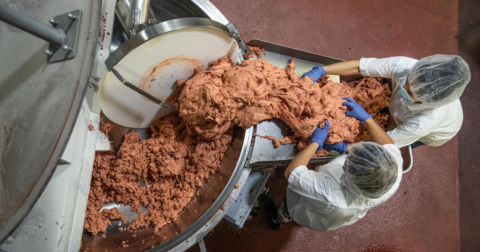
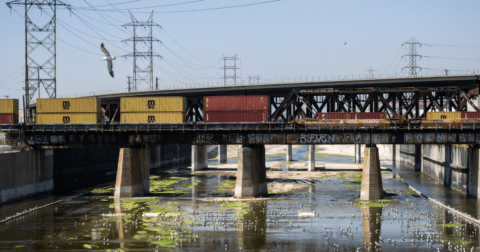
Meatpacking is one of the most dangerous jobs in America, but a new report homes in on the city of Vernon in Los Angeles County, California. Workers outnumber residents in Vernon, where around 50,000 people come to work in meatpacking and food processing facilities each day.
The report documents what it’s like to work in Vernon’s meatpacking industry and recommends steps towards improving worker safety. It is the result of a collaboration between the UCLA Labor Center and workers’ rights groups Los Angeles Alliance for a New Economy and El Centro with literature review, industry analysis and testimony from workers’ interviews and focus groups as the foundation for the analysis.
The findings are also relevant beyond Vernon, as the Trump administration’s Department of Agriculture expanded exceptions to meat processing line speed limits in 2025.
The city of Vernon has served as a major hub for meatpacking and food processing for the last half-century. According to the report, as of 2023, the meatpacking and food processing workforce was overwhelmingly made up of people of color, with Latino workers accounting for 88% of employees, and nearly 75% of the workers born outside the United States. These workers are from El Salvador, Guatemala, Honduras and Nicaragua, but most were born in Mexico. Nearly two in five (39%) workers are heads of household, the report finds, meaning they are not just responsible for themselves, but also for their families.
Over the last few decades, the report details, there has been a change in the way employment works in the area. Working directly for a meatpacking company in a stable, unionized job has frequently been replaced by long-term contract work now managed by staffing agencies. The report found 50 staffing agencies hiring for meatpacking and food processing work in Vernon and the surrounding area.
Another example in the report describes how management favors lead workers who prioritize line speed over safety. When a lead worker decided to slow the line down for safety reasons, “Management subsequently removed this lead from their position, and reprimanded them for being ‘too human’ by failing to enforce stricter working conditions that maximized efficiency.”
Poultry processing is especially grueling, as the work is less automated and more likely to be paid by the piece, rather than by the hour. According to worker testimony in the report, wages are low, sometimes paid late or not at all and workers are rarely reimbursed for the personal protective equipment and kitchen gear they’re required to purchase to do their jobs, including knives, metal gloves and safety boots. There are even fewer options for recourse, as the poultry processing companies often own the staffing agencies themselves, which shields them from liability and puts more corporate layers between the worker and the company.
Workers have to count the time it takes to change into and out of their gear and walk across the parking lot, towards their breaks, ultimately leaving them with 10 minutes for lunch or no time for bathroom breaks. One worker shared that they got ill and an infection from holding it, rather than going to the bathroom, according to the report. “That’s when I started to ask for permission,” the worker said, ”because I used to just hold, and now I get scolded for taking longer than needed.”
“A recurring refrain that kept coming to mind as we were doing the research,” Brian Justie, a lead researcher on the report, tells Sentient, “was something that one of the workers said to us…‘speed over safety.’” But there are ways to make the industry safer, Justie says.
The UCLA report offers a number of recommendations for change in the meatpacking and food processing industries in Los Angeles County. These include an independently run center for workers in Vernon, better meatpacking industry training and language accessibility for workers and prohibiting piece-rate compensation.
Labor advocates could also expand their coalition. The report recommends that groups work closely with other advocates to push for concessions from companies, like a guaranteed percentage of union jobs.
“It’s like David versus Goliath,” Justie says of taking on the food industry. “How could you possibly battle this behemoth?” The way to do it, he says, “is to band together from the other side and make sure that the animal welfare folks and the school nutrition folks and the labor folks,” are all working together.
Jessica Scott-Reid is Sentient's Disinformation Correspondent covering disinformation, misinformation and the impact of both on culture. A freelance journalist based in Canada, Jessica has covered animals, the environment and food systems for major media in Canada and beyond, for the last decade. Jessica has been a contributor to Sentient since 2019, and her work also appears regularly in The Globe and Mail, Toronto Star, Winnipeg Free Press and Corporate Knights Magazine.

Feature
Fisheries & Aquaculture•4 min read

Solutions
While the country’s farms tend to have high animal welfare standards, Bhutan also imports most of its meat.
Farms•7 min read
Feature
Fewer than 15% of veterinary school graduates are opting to care for farm animals.
Food•6 min read