News
Farmed Salmon May Not Be as Nutritious as It Once Was, New Research Suggests
Health•5 min read
News
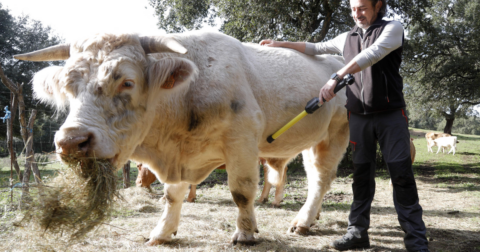
Cattle with drug-resistant tuberculosis lead researchers to call for better monitoring of cross-species transmission of TB.
News • Health • Public Health

Words by Gabriella Sotelo
A cough, followed by a blood-stained handkerchief, is etched into popular culture as a signal of impending death. The killer is tuberculosis, and it has been at the heart of human tragedy as the world’s deadliest infectious disease in recorded history. This often fatal infection may be as much a story of cattle as it is of humans.
Bovine tuberculosis (TB) is a zoonotic disease, meaning it can move between animals and humans. A new review reports that transmission of TB from cattle to humans is well documented, but the reverse has received less scrutiny, with limited data on how often it occurs.
In farms, ranches and slaughterhouses—where people are often in close quarters with cattle—the authors suggest that infection spreads to cattle through the air or contaminated feed and to humans through contaminated feed and water. And a 2022 meta-analysis of global research reports that the prevalence of bovine TB shows up in 5% of raw milk on dairy and cattle farms globally and raises concern for public health. Once infected, humans can develop active TB, which can spread from person to person.
Even though there aren’t any known cases of human-adapted TB being transmitted back to people, the researchers warn that drug‑resistant human TB found in cattle could become a public health concern if the disease does cycle back to humans. They say this potential risk calls for better monitoring and tracking of TB transmission between the two species.
There is growing evidence of TB spreading from humans to cattle, especially in regions with high infection rates among livestock workers, like Ethiopia and Nigeria.
“They’re both very similar of course, they both can hop from one to the other,” Russ Daly, a veterinarian and professor at South Dakota State University, tells Sentient. “But for the most part, human TB, the Mycobacterium tuberculosis, really is adapted well to people, and Mycobacterium bovis is really well adapted to cattle. So it’s a little harder for one to jump to the other, compared to just being in their own animal.”
The review article, published online in early January in the journal Tuberculosis, documents cases of cattle infected with human-adapted TB and examines how the disease is monitored.
Countries with documented cases are wide-ranging and include China, Croatia, Egypt, Ethiopia, Ghana, India, Nigeria, Pakistan, Poland, Rwanda, Slovenia, South Africa, Spain, Sudan, Tanzania, Turkey and the United States.
The earliest reported case in the study occurred between 1995 and 1997 in Tanzania, where two cows tested positive for human TB at two separate dairy farms. The farm owners had a family history of TB, and the authors suggest the family may have been the source of TB infection in the cows, but this cannot be confirmed.
The most recent case study took place in 2025 in Ethiopia, where 122 cows from four slaughterhouses had tuberculosis-like lesions. Out of the 18 cows that tested positive for TB, one was confirmed to have human TB, suggesting possible human-to-animal transmission, according to the authors.
In the United States, a possible case of human-to-cattle transmission was reported in 2018. A 1-day old heifer calf had been transported from New Mexico to Texas, where post import TB testing is required. At 4 months of age, the calf tested positive for a rare strain of TB that was also found in three nearby human cases, “indicating probable human-to-cattle transmission,” the authors comment. But the exact source could not be confirmed.
Globally, 30% of TB infection in humans were linked to bovine TB in 2014. According to the CDC, bovine TB accounts for less than 2% of human cases in the U.S., and this low rate of infection is likely due to long-standing cattle disease control programs and widespread milk pasteurization.
“We don’t see it here in the United States or the developed world too much, ” Daly, who is not associated with the study, says. He shares that the biggest way humans become infected with bovine TB is “through the milk product and raw milk.” The bacteria and infection may start in the lungs, but it can spread to the cow’s udder.
Unlike fast-spreading diseases such as avian influenza, bovine TB is managed through targeted testing, quarantine, and “test-and-remove” strategies rather than mass culling. The USDA’s National Tuberculosis Eradication Program uses routine slaughter surveillance and testing before cattle are moved across state lines, allowing authorities to identify infected animals while limiting economic disruption.
Still, bovine TB can be difficult to detect because an animal in the early stages of infection usually doesn’t show any symptoms. Those that do appear typically indicate advanced disease, and these symptoms may include mild fever, reduced appetite, weight loss, intermittent coughing, swollen lymph nodes and diarrhea.
There are also concerns of growing antibiotic resistance of TB in cattle. The researchers note that some infected cows have been found carrying drug-resistant strains of human TB, which could potentially be passed back to humans through contaminated animal products or exposure, though this has yet to be observed.
The study calls for improved strategies to monitor species-specific and drug-resistant cases of TB in livestock, given the potential public health risk if a drug-resistant, human-adapted infection were to transmit back to humans.
While the discovery of human TB in cattle may raise concerns, according to Daly, it does not pose an immediate threat to U.S. food safety. “As far as food safety, I think we’re really well off with the level of pasteurization that we have in the commercial milk supply,” he says, and also notes that the U.S. has protections in place in slaughterhouses as well.
Anytime another species can serve as a reservoir for a human disease, it could potentially transmit back to people. But so far, there isn’t much evidence of it moving from cattle back to humans. “It’s something I wouldn’t be directly concerned about as a consumer or citizen,” says Daly.
Gabriella is Sentient's Fact Checker, steering the outlet's fact check process and team. Prior to this, she was an Editorial Fellow at Sentient. Her journalism background is in both environmental and science reporting, and her work has appeared in The Guardian, Gizmodo and National Audubon Society. She holds her MSc in Science Communication from Imperial College London.

News
Health•5 min read

Monona County officials and residents fear a repeat of the communication gaps and loopholes that left them caught off guard by a plan to import treated slaughterhouse manure.
Health•9 min read
News
The rapid growth of chickens — now, 31 billion globally — has sped up pathogen evolution, boosting persistence, antibiotic resistance and spillover to humans.
Health•3 min read