Investigation
What Does a Small Town Do When the Water Is Undrinkable?
Climate•8 min read
News
A 90-day pause due to “loan delinquency” may signal that the viability of anaerobic digesters is being scrutinized at the federal level.

Words by Nina B. Elkadi
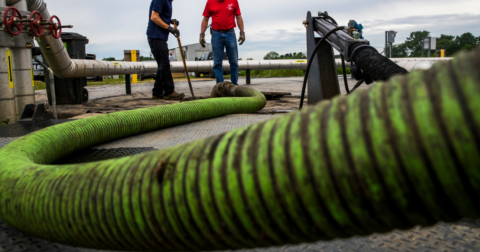
On January 14, the United States Department of Agriculture hit pause for 90 days on a program that has allocated hundreds of millions of dollars toward on-farm anaerobic digester projects. The agency announced an administrative pause on loans for these projects, which turn animal waste, often from factory farms, into biogas for energy.
In a letter announcing the pause, Rural Business Cooperative Service Administrator J.R. Claeys wrote that almost a third of the 21 loans amounting to $386.4 million are delinquent — $102.6 million in total. The pause extends to other environmental agriculture projects, such as “vertical farming, hydroponics, aeroponics, and aquaponics,” which together have a delinquency rate of 43%, or $135 million.
The agency has administered funds for these projects since 2008, when funding for on-farm energy projects was established through the Rural Energy for America Program.
Anaerobic digesters break down manure and other organic matter to produce biogas, which is then processed into natural gas or biomethane. These projects have been promoted by the U.S. government as a ‘climate-smart’ way to offset agriculture industry emissions, but they come with significant tradeoffs ranging from herd expansion and associated pollution to economic instability.
Since 2000, one in five manure digesters built in the United States have shut down, Brent Kim, a faculty scientist at the Johns Hopkins Center for a Livable Future, tells Sentient. They have shut down for various reasons, Kim says, including design flaws, bankruptcy of the farm that built the digester or problems with odors. But Kim’s research team found that the manure digesters often shut down because “the cost of operating the digester exceeded the amount of revenue that was brought in.” These facilities take millions of dollars upfront to build, and even when they are in operation, he says, they’re still heavily reliant on taxpayer dollars to keep them up and running.
The USDA says it will use the 90-day pause to investigate the financing of these projects across the country.
Patrick Serfass, the executive director of the trade association American Biogas Council, writes to Sentient that he anticipates the USDA will resume loan guarantees after the pause. Still, the pause may signal that scrutinizing the economic viability of manure biodigesters has reached the federal level.
The USDA pause comes just days after 34 advocacy organizations — including Friends of the Earth, Earthjustice, the Socially Responsible Agriculture Project and Food and Water Watch — filed a petition urging the USDA to deem these projects ineligible for grants and loans because “they are a harmful and inefficient use of taxpayer dollars.”
Lisa Doerr, a farmer in Polk County, Wisconsin, has been investigating factory farm financing for years. She is the treasurer of the nonprofit Sustain Rural Wisconsin Network — another group listed on the petition — which advocates for the health and economic vitality of rural communities in the state.
There’s a myth that factory farm expansions “are our manifest destiny,” and that “there’s nothing anyone can do,” Doerr says. “And I think what people have missed is, no, actually this is a very well orchestrated set of government policies that are driving these financial investments.”
One project in Gillett, Wisconsin was financed using $41.5 million worth of municipal tax-exempt bonds. Last June, the project defaulted on its principal loan payment — a default that underscores the financial risk of these projects. The loan default could be a bellwether for the rest of the country.
California’s Low Carbon Fuel Standard provides carbon credit incentives for anaerobic digesters that convert manure into biogas. Some critics of the program raise the critique that the policy has led to increased herd sizes in the Midwest as investors capitalize on potential profit from manure.
Through her research, Doerr found a presentation from Pagel Ponderosa Dairy — a 12,500-head dairy — in which their chief financial officer highlights biogas as a new revenue stream for the company that would produce $1,360 a year per cow.
“If we’re talking 10,000 cows, we’re talking $13 million a year in cash flow,” Doerr says, speculating that the revenue projections from biogas could potentially outpace revenue generated from milk.
When many of these estimates for the value of manure were being generated, credits in California’s market were valued highly, as they were in the presentation Doerr viewed. The presentation was not dated, but the credit values that it used align with 2021 values. Since 2022 those prices have fallen, and as Kim and his colleagues write in a recent paper published in Current Environmental Health Reports, “revenue now equals costs for the average California dairy manure digester.”
As these numbers illustrate, the biogas industry can, in theory, be lucrative — especially when the market inflates the value of manure — raising a larger, philosophical question, Kim says.
“What is the function of a dairy cow?” he asks. “Is the value of the cow to give people milk to drink, or is the value of the cow to generate manure?”
When federal and state tax dollars, often in the form of subsidies, are awarded to dairy operations for manure digesters, they “essentially give money to farmers for the waste that they’re generating,” Kim says. This creates “additional incentives for the farmer to have more cows or more animals, because they’re getting a kickback for the manure that they generate,” which can result in expanded herd sizes. Preliminary results from a study in pre-print find that, in California, dairies with manure digesters add an estimated 860 more cows to their herds after three years than comparably-sized dairies without manure digesters.
The people who live closest to these operations bear costs that are not factored into investor portfolios. Larry Brenner owns and runs the restaurant, Vino in the Valley, in Pierce County, Wisconsin. He relies on summer tourism from nearby cities like Minneapolis-St. Paul to keep the business alive. The county is filled with trout streams, rolling hills and, above all, peace and quiet.
“Unfortunately,” he says, right on top of the hill overlooking his valley, a “monstrosity” of a dairy is planning to expand its operation from 1,200 to 6,500 cows on a 76-acre plot.
Brenner grew up working on his extended family’s dairy farms. “It’s very much in my blood, it’s in my heart,” he says. But the operation overlooking his valley is “not a farm. It’s a factory.”
After California, Wisconsin is now the state with the most manure digesters participating in California’s low carbon fuel standard, with 20 facilities added to the program since 2019. Wisconsin is the second-highest milk-producing state in the country behind California.
Brenner already worries about the quality of his water and what an expanded livestock operation might do to its drinkability. Already, he says, he’s “living the nightmare” with high nitrate levels at his place, and just purchased a new $7,000 system to filter them out. Drinking water that contains nitrate levels above the Environmental Protection Agency (EPA) limit is associated with increased cancer risks, and in young children with the disease methemoglobinemia, which can be fatal.
According to a report from the Alliance for the Great Lakes, more than 90% of the nitrate contamination in private and public wells across Wisconsin is from excessive manure and fertilizer application by the agricultural industry. Manure that has been through a biodigester can still be spread on fields afterward, and digested manure can even be more polluting, according to USDA guidance. The excess nitrogen from manure that is spread on fields ends up in waterways and groundwater as nitrate pollution. And Wisconsinites are spending millions out of pocket for clean water.
As of 2022, the dairy expansion uphill from Vino in the Valley is run by Appleton-based Breeze Dairy Group, which initially proposed the expansion using $18 million in public financing to go toward solid waste processing facilities. The community opposed the public financing, and though it was rejected, the operation is still expanding.
“What’s to stop this other conglomerate of people and investors from Appleton that don’t live here?” Brenner says. “They don’t have a house here. They couldn’t care less what happens to our roads and to our wells and to our rivers, and it’s all about the money. They’ve got millions invested.”
In December, elsewhere in Pierce County, just two days after a Vanguard Renewables anaerobic digester came online at Peterson Family Dairy, the outer membrane of the digester ruptured, causing a gas leak.
“It’s kind of a big deal if it failed straight out of the gates,” Brenner says. Anaerobic digesters allow these dairies an excuse to keep growing larger, Breener adds, and “have an excuse to say that, ‘Oh, well, we’re thinking about the environment. We’re going to put in this multi-million dollar digester that’s going to solve all those problems,’ which, in essence, is not true.”
Anaerobic digesters on farms have a wide range of public health effects, Kim says, resulting in “pollution swapping,” which describes an intervention that’s billed as a solution, but really, is “trading some pollutants for others,” he says. “So is it a win?”
The USDA’s halt on manure biodigester loans may be part of the second Trump administration’s broader crackdown on ‘climate-smart’ programs, which also included the 2025 cancellation of $3 billion in grants for ‘climate-smart’ agriculture.
Whether or not there is a political motivation, Kim writes, “there are plenty of reasons — that appeal to both sides of the political aisle — to question the merits of paying mega-dairies to generate more manure.”
“If every operation in the United States had a manure digester and it was operating perfectly, we would only be able to address an estimated 11% of U.S. agricultural greenhouse gas emissions,” Kim explains. “The manure digester isn’t even eliminating all of that, because there’s methane leaks., Tthere’s increased nitrous oxide emissions, potentially. So, point being, we’re only getting a small fraction of livestock greenhouse gas emissions.”
Manure biodigesters shore up the dairy industry, he argues, “not just further entrenching, but expanding this industry that we know is a major driver of the climate crisis.”
The USDA loans “support rural communities and farmers — particularly small and mid-sized operations — helping them keep farms in the family, and manage manure by recycling it into renewable energy and soil-enriching fertilizer,” writes Serfass, of the American Biogas Council. He also notes that hundreds of facilities have become operational this year “supported by nearly $2.8 billion in investment, and the vast majority are offering both environmental [benefits] for their communities and financial benefits for their investors.”
For Doerr, the delinquency rates speak for themselves.
“This could all be just changed with the stroke of a pen,” she says.
Nina B. Elkadi is an Editor-at-Large for Sentient. Her investigative reporting explores corporate influence within the agricultural industry, the environmental impacts of factory farming, and how negligence impacts consumers and workers. Her work also appears in National Geographic, Inside Climate News, Civil Eats, High Country News, Ambrook Research, JSTOR Daily, Barn Raiser, and more. She splits her time between Washington D.C. and her hometown of Iowa City.
Feature
Climate•9 min read

Feature
Cheap staples like canned beans and oats are not only easy to prepare, but better for you and the environment.
Climate•5 min read

Explainer
You likely contribute to overconsumption in ways you might not realize.
Climate•12 min read