News
Lawsuit Seeks Answers on EPA’s Abandoned CAFO Pollution Panel
Policy•4 min read
News
But the bill faces steep odds of passage in a sharply-divided Congress


Words by Seth Millstein
House Republicans finally released their newest farm bill proposal, only for an East Coast blizzard to delay plans to start debating it. The House is now set to debate the bill beginning March 3.
The Farm, Food, and National Security Act of 2026 includes changes to pesticide law, animal welfare requirements and the Dietary Guidelines for Americans that will significantly shape federal food policy going forward — if it manages to pass Congress.
A number of agricultural groups cheered the bill, including the National Pork Producers Council, the National Cattlemen’s Beef Association, the American Soybean Association and the American Farm Bureau Federation. Other farm-affiliated organizations, like the National Young Farmers Coalition and the American Meat Producers Association, had mixed reactions, while environmental nonprofits such as the Center for Biological Diversity harshly denounced the bill. Let’s take a look at why it’s so controversial.
The farm bill is a legislative package passed roughly every five years that provides the regulatory backbone for America’s farming and food industries. SNAP funding, disaster preparedness, crop insurance, agricultural subsidies, conservation programs and farm loans are just some of the wide-reaching programs that it funds.
The farm bill is considered a “must-pass” piece of legislation. In addition to the aforementioned policies, which are vital to the agriculture sector, farm bills also include what’s known as “suspension of permanent law.” These are a group of policies that prevent the implementation of obsolete 1930s-era price controls that, if allowed to take effect now, would wreak havoc on commodity prices.
These obsolete price controls can be understood as a powerful incentive, Brad Lubben, extension associate professor of agricultural economics at the University of Nebraska-Lincoln, tells Sentient.
“It’s been described as: that’s the hammer that makes sure something happens,” Lubben says. “By maintaining that language, it forces there to be attention to a farm bill when it expires.” Essentially, it is a ticking time bomb that forces lawmakers to the table to debate larger agricultural issues.
This year’s farm bill is what is sometimes called a “skinny” farm bill, which means that it omits a number of policies that would normally be included in the farm bill but were instead passed in various bits of other legislation last year.
The vast majority of the usual farm bill policies were tucked into other pieces of legislation in 2025, including the so-called “megabill” and a series of short-term spending bills at the end of the year. This has made passage of this skinny farm bill a much lower priority for Congress than it normally is, as the must-pass provisions that it would normally include have already been passed.
Nevertheless, it includes a couple of high-profile policies that are worth taking a closer look at.
One of the most controversial aspects of the skinny bill is a set of provisions concerning pesticides.
First, the bill would require national uniformity in pesticide labels around the country. The EPA creates warning labels for pesticides, and all pesticides are required to display them, but some states, like California, have enacted regulations for certain chemicals that require pesticide companies to include additional warning labels on their products within state borders.
For instance, when California regulators determined in 2017 that glyphosate, a key ingredient in the pesticide brand Roundup, is carcinogenic, the state began requiring manufacturers to include a warning label to that effect. But the EPA uses a different process than California to determine carcinogenic risk, and the federal agency concluded that the compound isn’t carcinogenic. This led to a court battle over which label, California’s or the EPA’s, glyphosate manufacturers should place on their products.
The new farm bill would block states and localities from requiring pesticides to have warning labels that differ from the EPA’s. Just as importantly, it would prohibit courts from penalizing pesticide companies for failing to include warnings not required by the EPA. In effect, this latter provision would shield pesticide manufacturers from any lawsuits accusing them of insufficient warning labels, as long as their labels complied with EPA regulations.
These new pesticide proposals, which Republicans have tried unsuccessfully to include in previous legislation, are shaping up to be some of the most contentious parts of the skinny bill. Democratic Rep. Chellie Pingree of Maine has already pledged to introduce an amendment to remove them, and influencers in the Make America Healthy Again (MAHA) movement have said they’ll be campaigning to have the pesticide provisions removed as well.
The farm bill would also repeal the animal welfare requirements for breeding pigs that are part of a California law called Proposition 12. This has been a longstanding wish of the pork industry, which has tried and failed to get the California regulation overturned in the courts.
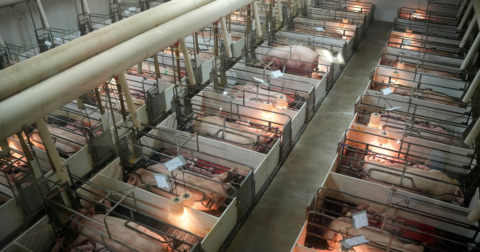
Proposition 12 is a California law that forbids the cramped confinement of certain livestock, namely egg-laying hens, breeding pigs and veal calves. For example, it requires breeding pigs to have at least 24 square feet of floor space each, which is about the size of a small closet. Absent Prop 12’s requirements, breeding pigs are often kept in crates too small for them to turn around, called gestation crates and farrowing crates. But Prop 12 also forbids the sale, in California, of products from livestock raised in cramped confinement conditions. As a result, some out-of-state pork and egg producers have opted to comply with Proposition 12’s laws so they can sell their products in California’s large and lucrative market.
The new farm bill includes language that would ban states from imposing requirements on livestock production as a condition for selling them within state borders, which would effectively repeal most of Proposition 12. However, it contains a carve-out for egg-laying chickens, meaning that the nation’s egg producers would still have to comply with Proposition 12’s requirements in order to sell eggs in California.
Unlike most hot-button policy issues, support for Proposition 12 doesn’t neatly fall along party lines. Although it was passed by voter referendum in a deep blue state, Joe Biden’s Secretary of Agriculture urged Congress to overturn it. Likewise, a good number of elected Republicans want to keep Proposition 12 on the books, arguing that repealing it would either infringe on states’ rights or, in the eyes of some, open the door to Chinese control of American farmland.
Lubben notes that both the pesticide provisions and the Proposition 12 repeal are examples of issues in which federal legislation “might take away certain state-level policies or activities.”
The farm bill is also making some changes to the development of the Dietary Guidelines for Americans, the latest version of which was just released earlier this year.
Under existing law, the guidelines are required to be updated every five years, but the new bill changes this timeline to every ten years, starting in 2030. It also adds a requirement that the guidelines’ recommendations must take chronic disease into consideration.
The bill also adds new transparency requirements regarding the Dietary Guidelines Advisory Committee. This is a panel of experts that, when it comes time to update the guidelines, studies the latest nutritional research and presents recommendations to the Health and Human Services Secretary and Secretary of Agriculture, who have final say over what the dietary guidelines include.
Although the farm bill doesn’t change this process, it requires publicly available financial disclosures from members of the advisory committee that reveal any potential conflicts of interest.
While this bill was highly anticipated in the agriculture sector, there’s a decent chance it won’t pass in its current form — or any form.
To begin with, Republicans currently have only a four-seat majority in the House. This means that if Democrats stick together and uniformly oppose the bill, it will fail if just two Republicans vote against it. Last year, 14 House Republicans signed a letter opposing the repeal of Proposition 12, so if nothing else, that portion of the skinny bill may be on thin ice.
Then there’s the Senate. Republicans have a majority of just three seats in the upper chamber, and the math is even harder thanks to the prospect of a Democratic filibuster. Even if every Senate Republican votes for the skinny farm bill, they’ll also have to win over at least seven Democrats in order to reach the 60-vote minimum needed to circumvent the filibuster.
In the Senate, Republican leadership has already indicated that it might strike some of the more controversial portions of the bill, specifically those regarding pesticides and Proposition 12, in order to gain these Democratic votes. But Lubben isn’t too optimistic that they’ll succeed.
“There is no real appetite for bipartisan consensus building at the moment,” Lubben says. “Last year’s [megabill] process really struck a blow against that bipartisan support. So it’s tough to imagine how it gets to the finish line.”
Nevertheless, House Republicans are soldiering ahead with the bill. They’re now set to begin debating it on March 3, and by all indications, it’ll be a very contentious debate.
Seth Millstein is a writer and musician living in the Bay Area. He has helped launch several early-stage journalism startups, including Bustle and Timeline, and his work has been published in Bustle, Huffington Post, The Daily Dot and elsewhere.

Feature
Elections•15 min read

News
The move was meant to appeal to ranchers but the industry’s response was muted.
Policy•8 min read

Feature
Research from over 75 years ago set today’s federal standard for nitrates in drinking water.
Factory Farms•14 min read