News
Beagles Are Still Bred on Farms for Testing and Research, an Open Rescue Reveals
Factory Farms•5 min read
News
A new poll finds widespread disapproval of standard confinement and slaughter methods used in the animal agriculture industry.
News • Factory Farms • Policy

Words by Gaea Cabico
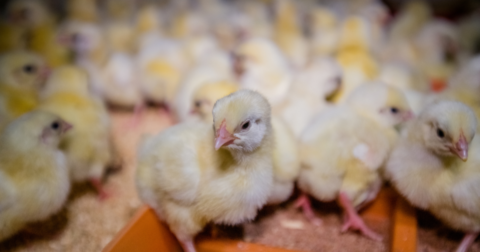
Nearly all livestock in the United States is raised in industrial facilities, where animals are often kept in cramped, harsh conditions. A new poll suggests that most American adults consider standard factory farm practices — including battery cages and routine mutilations — unacceptable.
Disapproval of common animal agriculture practices ranged from 71% to 85%, according to a survey of 1,049 Americans conducted by Faunalytics, an animal advocacy research group. Respondents were most opposed to confinement methods, such as battery cages for laying hens (85%), gestation crates for pigs (84%), and crowded barns for broiler chickens (82%).
Slaughtering practices like killing pigs in gas chambers and killing chickens while they are shackled were the least objected to. Even so, the majority of respondents still opposed these measures, with 71% and 77% calling them unacceptable, respectively.
The survey’s findings give animal welfare advocates additional insight into a legal line of argument. If further public opinion data also find that these animal agriculture practices are not widely accepted, there is an argument that they may not be exempt from many state anti-cruelty laws.
Legal advocates “could argue that the court must interpret common acceptance according to what is understood by ordinary people. So then they can therefore cite our poll,” Andrea Polanco, the lead author of the Faunalytics research, tells Sentient. “For people who are working in policy, they can use this data to introduce ballot initiatives.”
The Faunalytics research is a useful tool for advocates and lobbyists, agrees Matthew Liebman, a professor at the University of San Francisco and an expert in animal law. “It could, in theory, drive some policy reform. I could imagine somebody who does legislative lobbying taking this to a lawmaker and using this to show support for stricter regulation of factory farming,” he tells Sentient.
But using the data to pursue animal cruelty cases would be more challenging, Liebman notes. Many state cruelty laws in the U.S. exempt routine practices performed on farm animals and the exact language varies. Nebraska, Iowa and Texas have even explicitly excluded livestock from their general animal cruelty statutes and instead created specific laws addressing farm animal abuse. For example, Nebraska’s Livestock Animal Welfare Act criminalizes cruel mistreatment of livestock, but exempts “commonly followed practices” that happen “in conjunction with the slaughter of animals for food.”
“There’s a lot of promising avenues for applying state anti-cruelty laws to the practices that happen in factory farms,” says Liebman, noting that it depends on the wording of the law. “A ‘common practice’ would be one that is just used a lot.” In contrast, the term ‘commonly accepted’ means that people also accept the practice. Liebman says this raises the question, “Commonly accepted by whom? By farmers or by the general public?” So the ‘commonly accepted’ wording appears to offer more room for maneuvering.
Litigation is further complicated because anti-cruelty is prosecuted under criminal law, and in these cases only prosecutors or district attorneys can bring charges. That means that animal welfare groups cannot file criminal cases themselves; they must persuade local district attorneys to take action, Liebman explains.
“That’s where all these other problems of the social power of factory farms come into play,” Liebman says. The industry is often powerful in local communities, for example as a major employer or a political donor. Still, some animal advocacy organizations have found ways to navigate these challenges by pursuing civil litigation to halt alleged violations, he says. For instance, in 2023, Legal Impact for Chickens sued North Carolina-based poultry producer Case Farms, which supplies chicken to KFC and Taco Bell, alleging gross mismanagement and cruelty toward newborn chicks. However, a lower court ruling dismissed the case and last week the North Carolina Court of Appeals denied Legal Impact for Chickens’ request to revisit it.
Other civil litigation strategies for enforcing standards under anti-cruelty laws include public nuisance suits, unfair competition claims, and taxpayer waste lawsuits, Liebman says. These approaches, he says, rely on an alleged criminal cruelty violation to establish underlying illegal activity that forms the basis of a civil claim such as, for example, a public nuisance lawsuit.
Other practices that a majority of Americans find unacceptable, according to the Faunalytics survey, are: making broiler chickens grow so fast that they struggle to walk (79%); hanging, stunning and slitting the chickens’ throats before boiling them (77%); castrating calves without pain relief (82%); removing calves’ horn buds (79%); separating calves from mothers at birth (76%), de-beaking chickens (82%); grinding male chicks alive (84%); and docking piglets’ tails (81%).
The findings of the study echo a 2023 national survey by the American Society for the Prevention of Cruelty to Animals, which found that 79% of American adults are somewhat or very concerned about the impacts of industrial-scale farms on animal welfare. It also found that 75% favor a ban on new factory farms.
The researchers used the survey platform Prolific to recruit a group of respondents that was mostly representative of national demographics, though Hispanic or Latino respondents were underrepresented. The survey was given the title “Opinions on Farming Practices” to avoid biasing the respondents towards people with the strongest opinions either for or against factory farming methods.
When Faunalytics broke down the survey results by gender, race, age, region of the country, income and political affiliation, the differences were surprisingly minimal. Most people surveyed considered these methods unacceptable. “A lot of people are against these practices when they find out they contain suffering, but once it comes to the actual behavior change, a lot of people struggle with a lot of barriers,” Polanco says.
In the report, Faunalytics urges advocates to focus on campaigns that target the most widely opposed practices — battery cages, gestation crates, cramped barns, and chick culling — while also pushing retailers and producers to adopt cage-free housing for farmed animals and in-ovo sexing for egg-laying hens, which would prevent the killing of male chicks.
The organization also advises that advocates frame their messaging around this broad public disapproval of common factory farm methods. This can rebut the stereotype that caring for animals is just a fringe concern, it adds.
Gaea Cabico is Sentient's editorial fellow, and an award-winning journalist from the Philippines who reports on climate change, environmental issues and energy through a social justice lens. She is currently pursuing a master's degree in science journalism at New York University.
Investigation
Policy•9 min read
News
As bird flu cases surge, Colorado lawmakers target the practice of killing poultry birds by heatstroke.
Factory Farms•6 min read
News
In a new poll, 82% of Iowa voters want their elected official to protect clean water and cut pollution from industrial agriculture.
Elections•5 min read