Investigation
Trump Made Meatpacking Investigation a Campaign Promise but Antitrust Staff Has Been Gutted
Policy•12 min read
Feature
Undercover footage reveals some drivers falsify logbooks, while rules for livestock protections and driver fatigue can also be at odds, raising public safety concerns.

Words by Jessica Scott-Reid
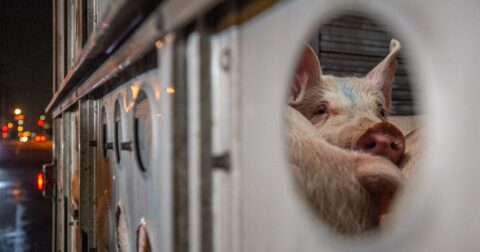
In August 2025, an undercover investigator recorded videos of three livestock truck operators appearing to admit to falsifying their logbooks while visiting truck stops across the Midwest. Truck drivers are legally required to record their driving and rest hours, typically through electronic logging devices. However, a loophole allows agricultural transports to use paper logbooks due to a number of exemptions.
The investigation carried out by the animal advocacy groups Strategies for Ethical and Environmental Development (SEED) and Animal Partisan found that animals and the public may be put at risk when drivers falsify or fail to maintain required logs. There’s a general mentality, the investigator tells Sentient, “of go and don’t stop,” for breaks, regardless of the rules.
Rules put in place to avoid driver fatigue can also be at odds with an animal welfare rule called the Twenty-Eight Hour Law, which is how long animals may stay on a truck without being unloaded and given food, water and rest.
Animal welfare advocates have long called for stronger oversight. One U.S. congresswoman is pushing to tighten animal transport regulations and strengthen enforcement. Meanwhile, a meat industry-backed proposal seeks even greater flexibility and permanent exemptions.
Federal law allows livestock transported across state lines to remain on trucks for up to 28 consecutive hours without food, water or rest, after which they must be unloaded and given at least five hours of rest, except in cases of accidental or unavoidable delay.
However, the Twenty-Eight Hour Law does not always align with mandated hours-of-service laws and other safe-driving rules, Adrienne Craig, staff attorney and senior policy associate of Animal Welfare Institute’s Farmed Animal Program, tells Sentient.
Truck drivers are legally permitted to drive a maximum of 11 hours after a break of at least 10 consecutive hours. But for the animals, “stopping for ten hours and sitting in a trailer is not good for their welfare,” depending on the weather, where they are and their condition, says Craig. She adds that a shipment of animals over long distances could not feasibly be completed in under 28 hours with a single driver.
The 11-hour driving limit is intended to protect drivers and reduce the risk of fatigue on the road. To monitor this, federal regulations require all commercial truck drivers to maintain detailed records of their driving and rest hours using electronic logging devices.
But through a loophole, livestock haulers are exempt because the Department of Transportation is prohibited from enforcing the ELD requirement for livestock haulers, explains Craig.
Without the oversight of electronic and automated tracking in exemption zones, livestock transporters are effectively bound by an honor system that relies on self-reporting. However, the SEED investigation suggests that some drivers are not complying with it.
Sentient reviewed the video footage gathered by SEED’s investigator, in which one driver states, “I don’t even use mine,” in reference to his logbook. “It’s blank. They don’t bother you,” he added, presumably talking about the authorities.
Another driver admits that, “once you get to your delivery, you have to take a ten-hour break. But you’re also on paper, so you can make it look however you want.”
There is also a driver who talks about running two logbooks, “One that’s real and one that’s real,” he says, using air quotes each time he says ‘real.’ Drivers who don’t take the required breaks to prevent fatigue can put animals and themselves at risk, as well as anyone else in the path of a crash.
For the period between November 2023 and August 2025, Animal Partisan obtained official records for 10 crashes involving livestock trucks. Five of those crashes were caused by unsafe speeds and speeding, and the other five by reckless, unsafe or distracted driving.
Logbooks are an essential part of the Department of Transportation’s regulatory scheme “to protect the driving public from fatigued drivers behind the wheel of tractor-trailers,” writes Will Lowrey, legal counsel for Animal Partisan, in an email to Sentient. He says his group “repeatedly encounters the aftermath of livestock truck accidents caused by unsafe speeds, reckless or distracted driving, and improper lane changes. It’s reasonable to infer that some of these accidents happened because the driver — responsible for the lives of dozens or hundreds of animals — was fatigued.”
In September of 2025, Animal Partisan filed a complaint with the Federal Motor Carrier Safety Administration regarding the SEED trucker logbook investigation, alleging that the three livestock transport companies and their drivers violated federal safety rules.
In January 2026, the agency dismissed the complaint, determining the video footage of the driver admissions was “insufficient.” Sentient contacted the Federal Motor Carrier Safety Administration to inquire if there was any investigation into any of the drivers. The agency did not respond.
The considerable number of livestock animals harmed during truck transport in the United States could be reduced with more oversight and better enforcement, say animal advocates. According to a 2022 investigation by The Guardian, tens of millions of animals die during transport or soon after arriving at slaughterhouses in the United States each year. This includes around 20 million chickens, 330 thousand pigs and 166 thousand cattle. “A further 800,000 pigs are calculated to be unable to walk on arrival,” according to the article.
But as animal advocates press for greater accountability, the meat industry and one Republican congressman are pushing for more flexibility. In July 2025, Colorado representative Jeff Hurd introduced a bill that seeks to permanently exempt commercial vehicles transporting animals, including livestock, from federal hours-of-service rules and electronic logging requirements. The Hauling Exemptions for Livestock Protection (HELP) Act frames its exemptions as a means to increase animal welfare.
“The HELP Act provides much-needed relief from burdensome regulations, allowing haulers to prioritize animal welfare without unnecessary delays,” said Tennessee representative John Rose in a statement supporting the bill. The bill has also received endorsement from industry groups, including the American Farm Bureau Federation and National Cattlemen’s Beef Association.
Sentient contacted Hurd’s office to inquire if any animal welfare groups were consulted during the creation of the bill, or if any have endorsed it. Hurd’s office did not respond.
Meanwhile, the Humane Transport of Farmed Animals Act was introduced in September 2025 by Democratic Congresswoman Dina Titus of Nevada, in collaboration with the Animal Welfare Institute. It directs the Departments of Transportation and Agriculture to develop better enforcement mechanisms — including inspections of vehicles and written or electronic records related to animal transport — to ensure compliance with the Twenty-Eight Hour Law. It would also expand protections by prohibiting interstate movement of animals deemed unfit to travel.
“The Humane Transport of Farmed Animals Act would stop this lax regulation that has resulted in many animals being injured or succumbing to disease during transport,” Titus said in a statement.
“This bill is a critical step to closing many of the gaps in current federal law that have allowed animals to suffer in transport for decades,” writes Lowrey. “Meaningful enforcement would disincentivize haulers from treating animals as merely inanimate commodities.”
Sentient contacted Titus’s office for comment on the SEED investigation alleging drivers falsified logbooks. A representative says the incident “is exactly the lack of oversight the bill seeks to address.”
The two proposals target different parts of the livestock transport system. One would expand driver-hour exemptions, while the other seeks stronger enforcement of animal rest requirements.
As Congress continues to debate whether to loosen or strengthen oversight of livestock transport, advocates argue that the stakes are clear. Without reliable monitoring and enforcement of driving hours and rest breaks, animal safety could remain at risk.
Editor’s note: A founder of SEED serves on Sentient’s board of directors. The board does not have any editorial input.
Clarification (February 19, 2026): An earlier version of this article stated that livestock haulers may use paper logbooks within 150 air miles of the loading location of livestock due to distance-based exemptions. While federal rules require all commercial drivers to use electronic logging devices (ELDs), livestock haulers are effectively exempt at any distance because Congress has barred the Department of Transportation from enforcing the ELD mandate, according to Adrienne Craig, staff attorney and senior policy associate of Animal Welfare Institute’s Farmed Animal Program. We have updated the introduction and the “Separate Rules for Drivers and Animals” sections to reflect this enforcement loophole.
Jessica Scott-Reid is Sentient's Disinformation Correspondent covering disinformation, misinformation and the impact of both on culture. A freelance journalist based in Canada, Jessica has covered animals, the environment and food systems for major media in Canada and beyond, for the last decade. Jessica has been a contributor to Sentient since 2019, and her work also appears regularly in The Globe and Mail, Toronto Star, Winnipeg Free Press and Corporate Knights Magazine.
News
Factory Farms•4 min read
News
Riverview’s mega-dairy expansion in Morris would store 250 million gallons of liquid manure and use water volumes equal to 75% of the local supply.
Climate•4 min read
News
The administration says animal welfare laws in California are raising egg prices nationwide.
Policy•6 min read