Feature
In an Era of Mega-Farms, These Schools Still Serve (Some) Locally Grown Food
Farms•6 min read
News
A new study finds that restoring coral reef fisheries could feed multitudes, especially where food is most needed.

Words by Gabriella Sotelo
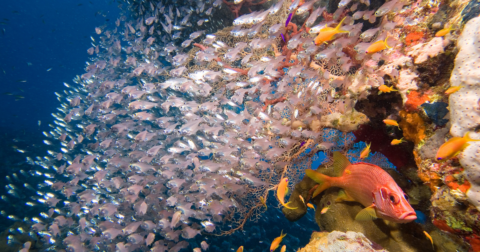
Restoring fish populations in coral reefs would boost coastal food supply, feeding up to 1.4 million more people, particularly in developing countries, according to new research. The greatest benefits would be seen in areas that are struggling with malnutrition.
Reef fisheries currently feed millions of people worldwide, especially in coastal regions where alternative food sources are often limited or difficult to access. In these communities, “it’s the main source of protein,” says fisheries scientist Ray Hilborn of the University of Washington, who was not involved in the study.
Despite their importance, many coral reef fish populations have already been overfished, leaving them depleted and unable to provide as much harvested fish for these communities as they once did. Overfishing can also wreak havoc on marine ecosystems, destroying food webs and potentially weakening the ocean’s ability to keep carbon emissions out of the atmosphere.
“What are the real-world consequences of overfishing for people?” Joshua Cinner, a professor at the University of Sydney, and an author of the study, tells Sentient. “Most of the people affected by this are people in developing countries where malnutrition is a real threat and people don’t have enough food.”
To understand precisely what is being lost, and what could potentially be regained, researchers analyzed 1,211 coral reef sites associated with 23 nations worldwide. They found that if the stocks were allowed to recover, sustainable catches could rise by nearly 50%, but this would require careful management. Recovery could take six years if there were a complete moratorium on fishing (a tactic the authors don’t propose using), according to the study, or up to 50 years if fishing was restricted less severely. The study was published in PNAS in December.
Using ecological and fisheries data, the researchers found that rebuilding coral reef fish populations could significantly increase the number of sustainable fish servings produced each year, particularly in countries already facing high levels of malnutrition. Fisheries recovery could play an important role in addressing food insecurity in tropical regions, the study found.
For each country included in the study, recovery could add around 300,000 servings of fish per year for areas like Reunion Island, and up to nearly 484 million servings per year in larger countries like Indonesia. This would require most fish populations to double in biomass, or the total weight of fish on the reef, although required increases vary widely among different reefs.
In some places, like French Polynesia, a recovered coral reef fish population could feed nearly the entire coastal population. In other countries, such as the Maldives, Mauritius and Tanzania, more than 20% of coastal residents could benefit.
The study warns that climate change could make recovery more difficult. Rising ocean temperatures are expected to reduce coral reef biomass in many regions, which could lower future fish production even if management improves. On top of this, overfishing has already damaged reef ecosystems, decimating key species that maintain reef health and hampering the system’s ability to provide food.
Climate change may also indirectly increase pressure on reef fisheries by affecting agriculture, particularly in regions where people rely on both farming and fishing to meet basic needs. Agriculture is both a key driver of the climate crisis and is also affected by it. Climate change increases the frequency of droughts and extreme heat, reduces soil moisture and creates other conditions that lower crop yields. “If there’s a drought,” Cinner says, “what are people going to do? They’re going to have to fish harder to make up for it.”
The study stresses that food supply gains can only be achieved if depleted fish stocks are allowed to recover, which in most places requires temporary reductions in fishing pressure. In modeling scenarios where fishing pressure was reduced, researchers estimated recovery times ranging from just 6 years to 50 years, depending on how much fishing continued during the recovery period.
“What we were trying to do was provide a yardstick of what’s actually required” to allow fish populations to recover to the level at which they’ll yield the most food, Cinner says.
The authors are not suggesting that putting a complete stop to fishing should be a policy goal, Cinner says. They note that complete fishing moratoria are not a realistic policy goal for most reef-dependent regions, particularly where communities rely on fishing for daily food and income. The importance of fishing is not just economic. “One of the things we often don’t realize about livelihoods is the cultural importance that it can have for people as well,” Cinner says. Reducing reef fish consumption to help recovery, according to the study, will also require targeted interventions that address the connection between fishing and identity, as well as community well-being.
Rebuilding overfished stocks is a painful process, Hilborn notes. Reducing harvests is far easier said than done for communities that are already struggling with dwindling fish populations, he says. “There’s no easy solution to that, there is no silver bullet.”
The authors write that recovery, especially under climate change, will need local involvement, cooperation and alternative food sources to ensure people are fed while fisheries bounce back. It will require active interventions, they write, especially for places that are still currently overfishing their reefs, such as Indonesia, the Philippines, Mexico, the Dominican Republic, Jamaica, Nicaragua, Oman and Panama.
Despite those challenges, researchers say the findings reinforce a principle long established in fisheries science: reducing excessive fishing pressure can ultimately lead to larger, more sustainable catches that would benefit everyone in the long run.
Gabriella is Sentient's Fact Checker, steering the outlet's fact check process and team. Prior to this, she was an Editorial Fellow at Sentient. Her journalism background is in both environmental and science reporting, and her work has appeared in The Guardian, Gizmodo and National Audubon Society. She holds her MSc in Science Communication from Imperial College London.

Investigation
Food•4 min read
Feature
A retired Cargill meat scientist urged the industry to take seriously a growing list of health concerns, including lameness, heat stress, congestive heart failure and late-term deaths in feedyards.
Food•2 min read
Investigation
As H5N1 infects over 70% of the state’s dairy herds, exposed farmworkers are left without PPE or mitigation training in their native language. And some aren’t informed of an outbreak…
Food•13 min read