News
New Colorado Bill Aims to Change How We ‘Depopulate’ Chickens
Factory Farms•6 min read
Investigation
Longtime poultry plant workers are left uncertain and fearing job loss amid Tyson Foods’ confusion over immigrant Temporary Protected Status — despite their legal right to work.

Words by Grey Moran
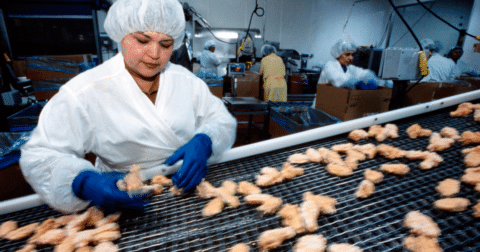
For decades, Salvadorans with Temporary Protected Status (TPS) have worked at Tyson Foods’ chicken processing plants in Springdale, Arkansas, building communities and raising their families in the foothills of the Ozark Mountains. Until recently, they’ve lived largely without fear of deportation and had relative job security. A humanitarian designation, TPS is granted to citizens of countries deemed unsafe by the United States, giving holders the right to live and work in the United States legally. For Salvadorans, this has been the case for 25 years.
Yet even with protected status — extended through September 9 of this year by the Biden Administration — Salvadoran employees have been navigating permit processing delays and misinformation about the legal status of their work authorization, threatening their continued employment at Tyson Foods. In a letter, the company notified a group of TPS holders that their “employment authorization will be expiring on 3/09/2026,” and they would “not be allowed to work” after March 9 unless they showed valid work authorization documents. The notice left workers on edge and confused about whether they would be terminated by Tyson Foods.
According to a Tyson employee this is one of a few notices the company sent, beginning in January, alerting them to expiring work authorization.
“They give you two warnings. The third is the final warning to tell you that if you don’t receive your document by the date they tell you, you will be automatically dismissed for not having a valid status, which is a work permit,” says a Salvadoran employee at one of Tyson’s chicken processing plants, in an interview with Sentient that was conducted in Spanish and translated to English. The poultry worker agreed to speak on the condition that his name not be used.
If not fired on March 9, many Salvadorans will likely need to leave the company in six months, when their protected status is set to expire.
“You feel like you’re marked, that you’re already isolated, like ‘Look at that guy, they’re going to throw him out. He’s going to have to leave,’” says the employee, whose wife and children depend on the income he earns from this job. Throughout this alienating experience, his eldest daughter has supported him, saying, “Oh, Dad, let’s not worry too much, because time will tell what’s in store for us again, so just do everything you can to keep your job.”
The issue initially stemmed from bureaucratic delays in processing work permits. Then it was exacerbated by Tyson Foods due to confusion and misinformation over the proof required to validate Salvadoran employees’ extended protected status and authorization to work in the United States.
TPS holders from El Salvador have been waiting for around a year for renewed Employment Authorization Documents (EADs), a work permit used by non-citizens to demonstrate to employers that they have the legal right to work. U.S. Citizenship and Immigration Services (USCIS) automatically extended their work permit cards through March 9. But as that deadline approaches, Salvadorans are still waiting for their new work permits to arrive in the mail.
But still, many Salvadoran TPS holders have other documents they’re allowed to use as proof of their work authorization. In particular, many recipients of Tyson’s termination warnings have received either the notice that they applied or the actual acceptance that their EAD card is coming in the mail, according to Magaly Licolli, who co-founded Venceremos, a human rights organization led by poultry workers, including many Tyson employees in Arkansas.
It’s not up to Tyson to determine what form of authorization they’re willing to accept, as long as it is valid, according to Jessica Bansal, an attorney with the National Day Laborer Organizing Network, who represents TPS holders in ongoing lawsuits.
In fact, “employers are required to accept facially valid proof of work authorization that includes, obviously, a work permit that has a future expiration date, but it also includes expired work permits in certain situations, including if the person has a renewal application pending and has received an automatic extension,” adds Bansal. These are documents that many Salvadoran TPS status holders possess.
But Licolli says that workers have faced challenges getting Tyson to accept these USCIS notices as proof of work authorization over the past two months.
“Some workers have been approved by the system,” says Licolli, which results in USCIS sending a notice confirming the approval of a new EAD card. “The thing that workers have been struggling with Tyson . . . is that they don’t want to accept that letter or notification that they got approved. They actually want to see the actual card.”
Licolli suspects that the issue stems from miscommunication between levels of leadership at Tyson. In a meeting with Tyson’s corporate leadership, she advised the company to make sure that the managers on “the plant floor understand how to guide these conversations with workers, to really ensure that they are not misinforming the workers or really causing this fear.”
Two Tyson employees confirmed that the company’s Human Resources department told them and other workers that they would only accept the renewed EAD card as proof of employment — at least up until recently. As of early March, this appears to be changing, the workers said, noting that the company began calling employees into the Human Resources office to review other USCIS paperwork in lieu of new cards.
Navigating the uncertainty around whether they will need to leave their jobs in March or September has been distressing for Tyson workers.
“I feel worried, overwhelmed, because at least there I have health insurance. My children are going to lose that health insurance,” says the Tyson employee, who applied for a new EAD card in February but has yet to receive it. “I feel overwhelmed to the point where I don’t know what to do.”
Sentient reached out and asked Tyson to clarify whether “Tyson Foods initially would only accept a renewed Employment Authorization Document as proof of work authorization and refused to accept other valid work authorization documentation.” In response, a Tyson spokesperson stated, “As this matter involves individual employment records, we cannot comment on specific cases.”
“Tyson Foods is committed to ensuring that everyone working in our facilities is legally authorized to do so, following all federal requirements,” the spokesperson wrote in an email to Sentient. “We actively share information and resources to help team members understand recent changes and which documents can be used to show employment eligibility.”
A similar dilemma faces Salvadoran TPS holders at other companies across the country, according to José Palma, the coordinator for the National TPS Alliance. “Many companies are coming to the conclusion that the automatic extension of the work authorization is expiring on March 9, and therefore they will have to let go of the workers,” says Palma. “But that is a wrong interpretation.” He says that he only knows of a small percentage of Salvadorans who have received the new cards.
Palma says the National TPS Alliance has been actively reaching out to companies in an effort to correct misinformation before workers are potentially fired. They have been distributing a legal explainer, in both Spanish and English, outlining the documents that employers are required to accept as proof of work authorization.
This extended delay in issuing EAD cards may be due to bureaucratic backlogs or, as Jessica Bansal sees it, more willful neglect to destabilize the lives of immigrants. She points out that the administration ended automatic extensions of EAD cards for TPS holders last October, making it more likely that this lapse in work permits will happen again.
“They’re trying to make life impossible for lawfully present immigrants as well as unlawfully present immigrants,” says Bansal. “So they’re trying to make it impossible for people to work, even though they have a legal right to work, by not processing their applications.”
These work authorization hurdles endured by TPS holders from El Salvador are part of the Trump Administration’s sweeping delegalization campaign, the largest effort in U.S. history to revoke the lawful status of upwards of a million people so far. Temporary legal status programs have been among the first targets, including a humanitarian parole initiative that admitted more than 500,000 migrants, urgently seeking safety, to the United States.
So far, the Trump Administration has moved to cancel the TPS designation of 11 countries, with some decisions blocked by court orders. Each country is reviewed individually by the Department of Homeland Security to determine whether the country still meets the conditions for TPS. “If your country is still not a safe place to be, it’s supposed to be renewed, and there’s no limit on how many times it can be renewed,” says Bansal.
Yet the administration has concluded that every country is safe, even those currently embroiled in volatile armed conflicts. “They say, ‘Oh, it’s safe to go back to Afghanistan. Safe to go back to South Sudan,’” says Bansal, who is on the legal team alleging that the termination decisions for a few countries are illegal. “So, it’s a clear effort to get rid of this program as part of the campaign to sort of get rid of immigrants generally.”
“TPS holders, they followed all the rules. These people have been subject to background checks more times than you could even count,” added Bansal. “And I think that reveals that the true intention here is to deport immigrants.”
El Salvador is one of four remaining countries with an active TPS status, and it is expected that the Department of Homeland Security will continue on its course and cancel the country’s designation when it comes up for review, at least 60 days before the current status expires in September. Around 170,000 Salvadorans would lose their legal right to live and work in the United States, increasing their risk of being detained and deported.
“It’s very terrifying for them to live in this situation where they don’t know if they’re going to be deported,” says Licolli. “These people that were working legally for many years, feeding their families and really feeding everybody’s tables, now are in the situation of being called criminals.”
Licolli and workers want Tyson to do more to stand up to the Trump Administration and directly challenge policies that could dramatically alter the lives of the company’s loyal employees, who have given the company decades of labor. Last month, the majority of Tyson’s shareholders shot down a resolution calling on the company to issue a report that would provide transparency around immigration-related risks, including how cutoffs of work authorizations could affect its employees and operations.
Tyson “has the power to tell the government that they need the workers and that we have produced so much, made so much profit for this company,” as one employee put it. “And now [the company] discards us, treats us like nothing, like throwing a piece of paper in the trash.”
Interviews with Salvadoran workers were conducted in Spanish and translated into English.
Grey is an award-winning investigative journalist with Sentient who is based in Durham, North Carolina. They have written for Civil Eats, The Guardian, The Atlantic, The New Republic, Al Jazeera, The New York Times, The Intercept, Guernica, The Nation, New York Magazine, Popular Science, Mother Jones, The American Prospect, Teen Vogue, Grist, Autostraddle and The Center for Public Integrity. Their articles have been anthologized in No Planet B, published by Haymarket Books, and The Best American Food Writing, edited by Mark Bittman.

News
Elections•5 min read

News
But the bill faces steep odds of passage in a sharply-divided Congress
Policy•8 min read

Explainer
Rooted in indigenous stewardship, the NANI Act would have joined a growing movement to grant ecosystems inherent legal rights.
Climate•5 min read