News
Marine Heatwaves and El Niño Are Disrupting Fisheries
Climate•6 min read
News
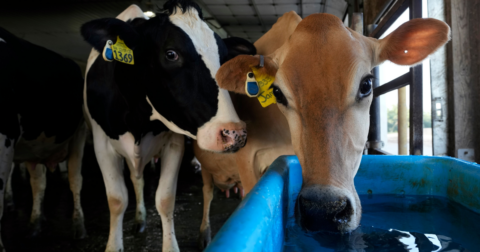
Since 2010, meat consumption habits in the US and Europe have diverged, while many countries with the greatest increases are in Asia.


Words by Ben Felder, Investigate Midwest
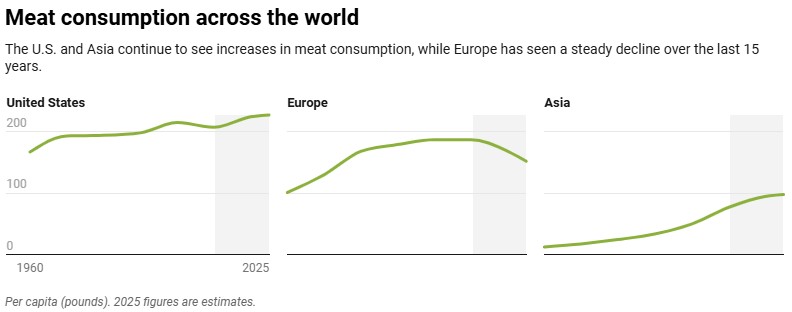
Residents of the United States and Europe have increasingly eaten more meat since 1960, but the two regions’ meat consumption has diverged over the past 15 years.
Since 2010, U.S. meat consumption per capita has risen by 10%, while Europe has seen a nearly 19% decline, according to data from the United Nations and U.S. Department of Agriculture.
This year, the U.S.’s annual per capita consumption of poultry, pork, beef and other red meat products is estimated to reach 227 pounds per person.
Europe’s estimated rate is 152 pounds per person.
U.S. meat consumption had been dropping at the start of the century before bouncing back up in 2010, largely thanks to an improving economy.
The decline in the European Union has been driven by higher meat prices, increased environmental awareness and the rising popularity of plant-based diets, according to a European Commission report. Europe’s decline in meat consumption is expected to continue for at least another decade, the report added.
Many see declining meat consumption as one of the most needed strategies for combating climate change. One-third of human-made greenhouse gas emissions come from the global food system, with more than half coming from the meat industry, according to a 2021 study.
While Europe has seen a significant drop, the opposite is true in Asia. In 1960, the U.S.’s meat consumption rate was nearly 13 times higher than Asia’s. Today, the U.S. still consumes significantly more meat, but the gap has narrowed.
Meat consumption in Asia has doubled since 1990, reaching an estimated 98 pounds per person this year.
On a per country basis, Vietnam, India and Turkey had the largest percentage gains over the 15 years, largely credited to rising economies and the increasing influence of a western diet.
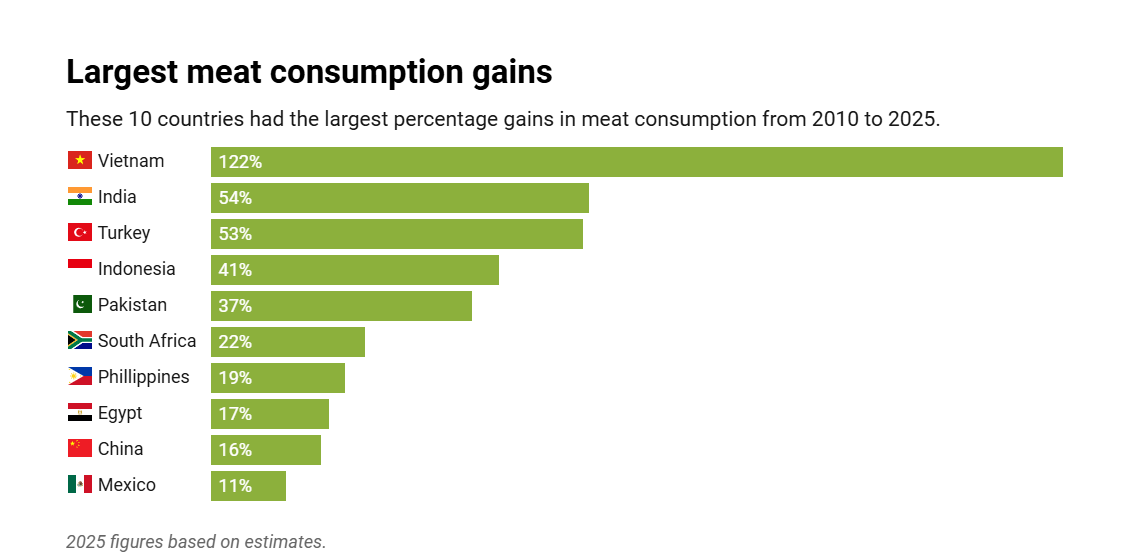
Vietnam, which now tops 145 pounds annually per capita, has become a major meat producer, but it still relies mostly on imports, especially poultry, buffalo, pork and cattle, according to Vietnam News.
While some have predicted a future decline in North America, the rise in Asian nations is likely to continue.
“North America and Oceania, which historically have strongly preferred beef, are expected to see the most significant decrease in per capita consumption,” according to predictions in a recent United Nations report. “In contrast, China, the world’s second-largest beef consumer, although relatively low in per capita terms, is projected to see a further … increase in its per capita consumption by 2032. This is partly due to a growing middle class in China, which has increased demand for meat, including beef.”
This article first appeared on Investigate Midwest and is republished here under a Creative Commons Attribution-NoDerivatives 4.0 International License.
Ben Felder is Investigate Midwest’s first editor in chief. He was hired in 2023 to cover agribusiness and the meat industry in Oklahoma. Felder previously worked for The Oklahoman as a political enterprise reporter blending narrative storytelling, data analysis and investigative reporting to cover the state’s political leaders, the influences behind them, and their impact on everyday Oklahomans.

News
Climate•4 min read

News
Are four years of pro-environment policies about to come to an end?
Climate•8 min read

Feature
Iceland said “No” to joining the European Union this weekend, choosing to shield its marine resources from rampant overfishing.
Climate•3 min read