News
Farmed Salmon May Not Be as Nutritious as It Once Was, New Research Suggests
Health•5 min read
News
The sharp one-year increase is raising concerns among public health experts.
News • Health • Public Health

Words by Natasha Gilbert
A rising number of antibiotic drugs that are essential for human health are now being sold for use in farm animals, data released by the Food and Drug Administration shows. The upward trend in sales is raising concerns among public health experts who say that overuse in animals is helping to drive up antibiotic-resistant infections in people. Antibiotic resistance — where bacteria are not effectively treated by antibiotics — leads to almost 3 million infections and 35,000 deaths a year in the United States alone.
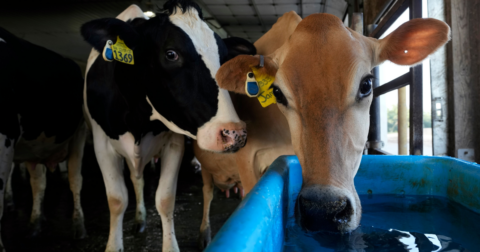
More medically important antibiotics are sold for use in livestock than for humans each year, studies show. They are used to treat sick animals and are given to healthy animals to prevent disease. Diseases can spread quickly between animals in intensive farming systems, which can be crowded and where hygiene and welfare can be poor.
The new FDA data shows that sales between 2023 and 2024 rose by roughly 16%. Anne Schechinger, an agricultural economist at the environmental advocacy organization the Environmental Working Group, says she is “shocked” to see such a large leap in sales over the one-year period.
The rise in sales suggests that the FDA’s plans to curb antibiotic use in farm animals are failing, says Steven Roach, Safe and Healthy Food Program Director at Food Animal Concerns Trust, a group that advocates for humane and healthy farm animals.
Since 2017, the FDA has banned the use of medically important antibiotics to boost animal growth. Today, farmers can only use antibiotics for preventing or treating disease. The FDA now requires veterinarians to issue prescriptions for these drugs.
Data from Europe shows that most antibiotic treatments are given to groups of animals to prevent the spread of disease rather than to individuals to treat illness. Similar data is not collected by the FDA in the United States.
The World Health Organization — from which the U.S. recently withdrew — has recommended that farmers restrict antibiotic use in healthy animals to prevent disease to help curb the development of antimicrobial resistance.
These controls led to an initial large drop in sales for use in farm animals, but the data shows that sales are resurging. In a study published in 2024, the Environmental Working Group found an upward trend in sales since 2017 but growth was slower, rising by around 10% over roughly 6 years.
The FDA doesn’t routinely collect data on how much antibiotics farmers use. Thus, annual sales of antimicrobials are used as an indication of the amount of the drugs administered to farm animals, although not all drugs sold will be consumed.
The FDA data also shows that of medically important antibiotics sold for use in animals in 2024, the largest amount were sold for use in swine, totaling 3 million kilograms — some 43% of total sales, says an Environmental Working Group analysis from January. The second-highest sales were for use in cattle, with 41% of total sales.
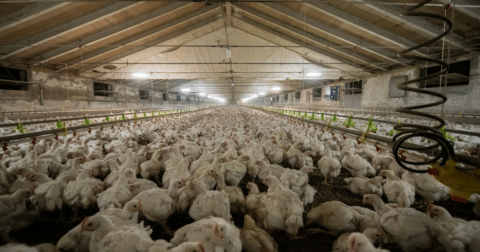
Sales for antibiotics in chickens grew the most across all animals, rising by 79% in 2024 after having fallen in 2022 and 2023, says Schechinger. But overall use in chickens is low — only 4% of sales were intended for use in chickens.
It is unclear what is driving the rise in sales, but it is not due to farmers raising more animals, says Schechinger. Fewer cattle and turkey were raised in 2024 compared to 2023, and the number of pigs and chickens increased by less than 1%, writes Roach.
Gail Hansen, a public health veterinarian, and former state epidemiologist and veterinarian for the Kansas Department of Health and Environment, writes to Sentient that she hasn’t seen evidence of a rise in bacterial disease in any food animals that would explain the increase in antibiotic sales.
Roach suggests that meat companies that have backtracked on commitments to reduce antibiotic use could have contributed to the growth in sales.
Schechinger would like to see the FDA investigate what is driving the rise in sales and start tracking how antibiotics are used on farms. Currently, the agency doesn’t collect data on the amount of antibiotics used to treat sick animals or to prevent disease in healthy animals. The FDA also doesn’t track how long farmers continue treating their livestock with antibiotics.
“We can’t slow the growth if we don’t know why it’s happening,” she says.
Hansen calls on the FDA to develop targets for cutting antibiotic sales and use, similar to those adopted in other countries, including in the European Union, which aims to reduce sales by 50% from 2018 levels by 2030.
The FDA should also set “meaningful duration limits” on the length of time that farmers can use antibiotics, writes Roach.
Improving farming practices could also help reduce antibiotic use, says Schechinger.
For example, Denmark, Europe’s second-largest pork producer, slashed antibiotic use by, among other actions, increasing the amount of barn space allotted to individual hogs and improving ventilation in the facilities, says Schechinger.
Continued overuse of antibiotics in farm animals could endanger human and animal health, writes Hansen. Drug developers are not discovering new antibiotic drugs at the same rate that bacteria are developing resistance, she adds.
Diseases that were once easily treatable could become deadly again. Similarly, bacterial diseases in a herd or flock of animals could wipe out most of the animals. “It would medically bring us back nearly 100 years,” she writes.
Natasha Gilbert is a freelance journalist reporting on the environment, science and health. Her work has been supported by the Fund for Investigative journalism and published in Grist, the Guardian and US Right to Know, among others. She is a former staff reporter for Nature. Natasha likes telling people's stories and getting at the truth. She is a good listener, a keen observer and a bit of a cynic.

News
Health•5 min read

Monona County officials and residents fear a repeat of the communication gaps and loopholes that left them caught off guard by a plan to import treated slaughterhouse manure.
Health•9 min read
News
The rapid growth of chickens — now, 31 billion globally — has sped up pathogen evolution, boosting persistence, antibiotic resistance and spillover to humans.
Health•3 min read