News
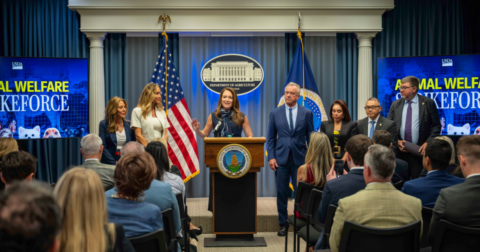
Trump’s ‘New Era of Animal Welfare’ Excludes Almost All Farm Animals
Policy•5 min read
Solutions
A Texas law dictating special labeling requirements for plant-based foods and cultivated meats violates the First Amendment, a federal court finds.

Words by Grace Hussain
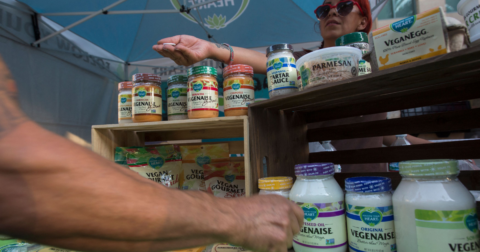
Late last month, a federal court struck down a Texas state law requiring plant-based and other meat alternatives to include a prominent disclaimer on the label as unconstitutional for violating the First Amendment. The law applied to cultivated or lab-grown meats, as well as foods made from plants, fungi and insects.
According to the decision, the Texas state official named as defendants in the suit failed to provide evidence that consumers were confused by plant-based food labels. News coverage when the law was passed in 2023 referenced a consumer survey conducted by the Texas Farm Bureau and a Texas cattle feed group, yet defendants did not produce that survey during the course of the lawsuit.
The plaintiffs, Turtle Island Foods, Inc., better known as Tofurky, and the Plant Based Foods Association, did produce survey evidence to the court, and this survey found most consumers were not confused by labels currently used in the marketplace.
Plaintiffs’ survey of 144 participants in Texas showed that 96% of survey participants were able to correctly identify plant-based foods with labels that did not meet the Texas law’s particular requirements. And when products were labeled according to the Texas law, some consumers were confused, the court noted.
“Changing labels to comply with what we think the law said actually increased consumer confusion where there was none before,” says Amanda Howell, lead attorney for the plaintiffs and managing attorney at Animal Legal Defense Fund.
The court also pointed out that there are already consumer protection laws in place to prohibit false or misleading labels.
The Texas decision comes as the plant-based industry is awaiting the Food and Drug Administration’s finalized version of draft guidance for labeling plant-based foods that was published January 2025.
Howell tells Sentient that the Texas case should serve as a cautionary tale for FDA officials. “I really hope that FDA sits up and takes notice of [the decision],” Howell says, “because I think it suffers from many, if not more, of those same constitutional infirmities.” In particular, Howell points to free speech concerns and a lack of evidence that the new guidelines are in the public’s interest.
Food production contributes around a third of all greenhouse gas emissions, with the bulk of those food-related emissions fueled by meat and dairy production. Research points to reducing meat consumption, either by eating more whole plant-based foods like beans or substitutes like the ones targeted by the Texas law, as an effective action for drawing down those emissions. One study published in July 2025 found that 60 percent of meat or other animal-sourced foods would need to be replaced with plant-based or cultivated meat by 2050 in order to limit global warming.
Howell and the plaintiff’s other attorneys filed their complaint in 2023, shortly after Texas’ Governor Gregg Abbott had signed the bill into law.
Texas officials argued at the time that the law was necessary in order to protect consumers from confusion about the products they were buying. But it’s an argument that the court ultimately found unconvincing.
At the time of the law’s passage, lawmakers in favor of the bill had touted a survey conducted by the Texas Farm Bureau that purportedly found 1 in 5 Texans are confused by plant-based products’ labels. But as Howell also told Sentient, when the defendants were asked to produce that evidence during the discovery process, they weren’t able to do so.
“You can’t start restricting speech,” Howell says, “without being able to point to a single consumer complaint.”
Sentient reached out to the Texas Farm Bureau, which was involved in conducting the survey, but did not receive a response before publication.
The proposed FDA guidelines raise similar concerns about causing consumer confusion and may also violate the First Amendment, Howell argues. In January of last year the agency released draft guidance recommending that products include their primary ingredient on the front label, for example soy sausage or almond cheese.
During the public comment period on the draft guidance, over 400 comments were submitted by individuals, businesses, nonprofits and other stakeholders with some — Danone North America and Animal Legal Defense Fund — arguing that the guidance is unfounded and confusing.
Others — International Dairy Foods Association and American Egg Board — largely support the labeling requirements, arguing consumers could be confused into making purchasing decisions and raising concerns that some plant-based products are not nutritionally equivalent to meat and dairy.
Nutritional comparisons between meat and dairy and plant based alternatives vary depending on the product. Coconut, oat and dairy milk can have different nutrition and fortification, for example. According to Harvard T.H. Chan School of Public Health researcher Walter Willet, plant-based beef substitutes are often better for both planetary and personal health. Willet recommends consumers check labels for sodium and saturated fat content.
Howell argues that the FDA, much like defendants in the Texas case, has failed to provide any evidence that consumers are actually confused by current product labels. The lack of evidence and the singling out of a single sector for more stringent labeling guidance is “bemusing and unprecedented,” according to Animal Legal Defense Fund’s comment on the draft guidelines.
Sentient reached out to the FDA about the Texas lawsuit and did not receive a response.
At the time of filing the lawsuit on behalf of Tofurky, Howell told Sentient that the Texas law would have required a disclosure that the food isn’t meat. That requirement, Howell said, was overly vague and could have led to significant costs, potentially enough to drive some plant-based companies out of business.
Sentient reached out to Texas’ Attorney General and Department of Health and Human Services and received no reply prior to publication.
Grace is Sentient's Solutions Correspondent, reporting on alternatives to factory farms and ways to fix the problems they cause. She is a member of the 2024 Solutions Journalism Network climate cohort. Her work has been published by Truthdig and The Guardian and translated into radio coverage by the BBC and Public News Service, reaching millions of listeners. Grace holds her MS in Animals and Public Policy from Tufts University and is currently working on her PhD in Environmental Science and Policy at the University of Miami.

Explainer
Climate•10 min read

Feature
A survey taken this past spring shows a majority of Iowans say they have experienced negative environmental impacts from industrial animal operations. But plenty are also ambivalent, or ignorant, about…
Elections•11 min read
News
Mama Bear allegedly uses misleading branding on Atlantic salmon cubes sourced by Australis Foods, an aquaculture operation accused of harming Chile’s sensitive marine environment.
Legal Action•6 min read