Feature
Gray Whales Are Starving as the Arctic Warms. Will the US Protect Them?
Policy•7 min read
News
The new USDA division wants to grow the seafood industry, but critics worry dismantling regulations will achieve the opposite.

Words by Seth Millstein
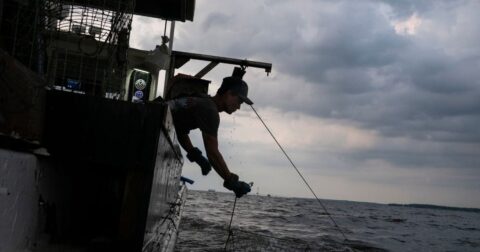
USDA Secretary Brooke Rollins announced on April 15 that the agency has launched a new division, the USDA Office of Seafood, aimed at growing the U.S. seafood industry by integrating fisherpeople into USDA programs and increasing the availability of U.S.-sourced seafood for American consumers. The office’s creation comes almost one year after President Trump alarmed environmental advocates by signing a pair of executive orders to deregulate the American fishing industry, such as allowing commercial fishing in regions where it had previously been banned.
“The Federal government now enters a new era of seafood policy where American fishermen will be recognized by USDA as a key part of the U.S. food supply,” the USDA’s press release said. “The USDA Office of Seafood will play an important role in coordinating with the U.S. Department of Commerce in the development of the America First Seafood Strategy to promote production, marketing, sale, and export of U.S. fishery and aquaculture products and strengthen domestic processing capacity.”
The formation of the office was applauded by the National Fisheries Institute and the Southern Shrimp Alliance, two trade groups that support commercial fishing. The Center for Biological Diversity was more skeptical, however.
“Creating a new Office of Seafood in the same month as proposing $1 billion in cuts to NOAA operations and research that support marine forecasts and fisheries management is only a shell game,” Catherine Kilduff, senior attorney with the Center for Biological Diversity, told Sentient in an email. “West Coast waters are facing an extreme marine heatwave and El Niño predictions, which spell trouble for fish and whales looking for food. It’s unclear what will come out of this new office, but if they hope to help working fishermen, the best thing they can do is invest in science supporting healthy fish populations and ending whale entanglements.”
The Office of Seafood’s goals are in line with President Trump’s longstanding desire to strengthen domestic seafood production. The amount of seafood Americans eat has increased over the past few decades, yet the majority (80%) of the seafood consumed in the U.S. is imported from other countries, according to National Oceanic and Atmospheric Administration (NOAA) estimates.
The goals of the USDA Office of Seafood are clear, but how it plans to accomplish them is not transparent. According to its website, the office will be “coordinating across USDA agencies to ensure fishermen are integrated into USDA programs,” and helping to develop a plan to “promote production, marketing, sale, and export of U.S. fishery and aquaculture products and strengthen domestic processing capacity.”
The policies it plans on creating are also ambiguous, with the press release asserting that “the federal government now enters a new era of seafood policy.”
The office has posted links on its site to various USDA initiatives that can support fisherpeople, such as the Commodity Procurement Program and insurance plans; however, these opportunities were available to them before the Office of Seafood was created.
Sentient contacted the USDA Office of Seafood to ask what material actions it will be taking to promote the U.S. seafood industry and support fisherpeople, but the office was not able to provide an answer in time for publication.
On the first day of President Trump’s second term, he implemented a 60-day freeze on all new and pending regulations, including those related to fisheries. Weeks later, Reuters reported that the president had fired around 5% of NOAA’s fishery-related employees, some of whom were involved in the regulatory process. This led to the overfishing of Atlantic bluefin tuna off the coast of North Carolina, Reuters reported in March 2025.
Three months later, the president issued two executive orders: “Restoring American Seafood Competitiveness” and “Unleashing American Commercial Fishing in the Pacific.” The first order primarily directed agency heads to develop plans that would deregulate the United States’ waterways, but the second order was more substantive. It opened up the Pacific Islands Heritage Marine National Monument, a portion of the ocean west of Hawai’i that had long been a protected area from commercial fishing.
Conservation groups expressed concern that this could lead to overfishing and environmental degradation of the region, and a coalition of them sued to block the order from taking place. That lawsuit was successful, and a federal judge blocked the reopening of the Pacific Islands Heritage Marine National Monument.
A similar back-and-forth played out with the Northeast Canyons and Seamounts Marine National Monument, another protected area of ocean. During his first term, Trump opened that region up to commercial fishing, a decision that was reversed by President Biden, who banned fishing there in 2021. And then in February of this year, Trump opened it to fishing once again.
Fishing wasn’t legal for very long in the Northeast Canyons and Seamounts Marine National Monument because Biden closed it a year after Trump had opened it. However, a 2021 study published in Frontiers in Marine Science found that greenlighting commercial fishing in the region endangered at least eight marine species in the region that were not intentionally being fished, such as dolphins and whales.
Overfishing is just one of the risks of commercial fishing, and it occurs when a species of fish in a given region is caught at a higher rate than it can repopulate. This can lead to countless adverse outcomes for humans, fish and ecosystems alike.
For a fisherperson, overfishing is undesirable because fewer fish are available, and they catch lower yields. For the environment, overfishing disrupts food webs, which can have unpredictable cascading effects on nearby ecology, including animals, aquatic plants and coral reefs.
Seth Millstein is a writer and musician living in the Bay Area. He has helped launch several early-stage journalism startups, including Bustle and Timeline, and his work has been published in Bustle, Huffington Post, The Daily Dot and elsewhere.
News
Policy•5 min read
News
Farmworkers on H-2A visas won a rare victory in federal court. But they are still being paid the wages that were just ruled illegal.
Policy•10 min read

Feature
The agency’s focus on commercial interests threatens fisheries science and over one million miles of protected marine habitats.
Policy•5 min read