Investigation
‘You Feel Like You’re Marked’: Salvadoran Workers at Tyson Foods Face Risks Due to Work Permit Delays
Policy•9 min read
News
Authorities say several dozen animal rights activists broke into a facility in Blue Mounds, Wisconsin on March 15.
News • Factory Farms • Policy

Words by Jessica Scott-Reid
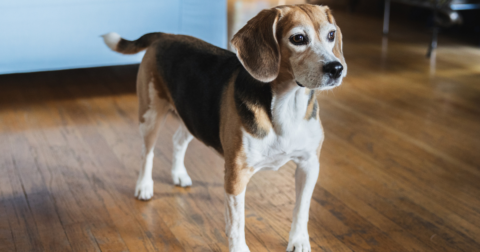
When you think of a factory farm, the animals that come to mind are probably pigs, cows and chickens. But in the U.S. and elsewhere, a number of these operations also breed dogs for use in animal testing and research. This past weekend, Dane County authorities say several dozen animal rights activists broke into one such facility, Ridglan Farms in Blue Mounds, Wisconsin, to rescue 22 beagles from confinement, according to an activist with Simple Heart.
Authorities also say around 20 of the activists were arrested. Some dogs were also taken by police and returned to the farm, according to a statement by the Dane County Sheriff’s office. The activists say eight dogs in total were seized by authorities, and that the remaining dogs have been placed with adoptive families.
Animal rights activists term this type of action an “open rescue,” where activists take animals from confinement in the daylight typically, and without hiding their identity.
On March 15, the activists are alleged to have entered one of the buildings at Ridglan Farms, a dog breeding operation that has been reported to house around 2,500 dogs at any given time.
The action was organized by the Coalition to Save the Ridglan Dogs, led by animal rights activist Wayne Hsiung. Authorities tell local media that around 20 activists were arrested, including Hsiung, after they allegedly cut fencing and broke into one of the buildings.
“The Dane County Sheriff’s Office understands how deeply people feel for the beagles at Ridglan Farms, and we respect their right to express that passion through peaceful protests,” said Sheriff Kalvin Barrett in a March 16, 2026 statement. “Our role is to keep everyone safe and to respond when unlawful activity takes place.” The statement notes that the investigation is ongoing.
Ridglan Farms is one of the two largest facilities in the U.S. where beagles are bred for use in research labs.
According to the U.S. Department of Agriculture Animal and Plant Health Inspection Service, 42,880 dogs were held or used in research, testing, teaching or experimentation in 2024. Several hundred of those dogs were used in a way where pain was “not minimized.”
In 2018, the animal activist organization Direct Action Everywhere, or DxE, told The Intercept that some of the research labs are located at public universities in the U.S., including the University of Wisconsin, the University of Minnesota and some colleges associated with the University of California.
Beagles are the most common breed used for animal testing due to their docile nature. They are used in biomedical research, cosmetic and pharmaceutical testing, as well as toxicity testing, to assess the safety and toxicity of new drugs, chemicals and consumer products. Tests can be invasive, painful and stressful, and often end with the dog being euthanized. In recent years, a number of federal departments and agencies have announced plans to reduce reliance on animal testing.
Ridglan Farms was the target of a previous open rescue in 2017, when activists from Direct Action Everywhere entered the facility and documented beagles confined to cages. Activists later faced felony burglary and theft charges after removing three beagles. These charges were ultimately dismissed in 2024 just before trial.
Activists in turn pushed for a criminal investigation into Ridglan for alleged animal cruelty. Rather than pursue criminal charges however, the case was resolved through a settlement requiring Ridglan to cease breeding and selling dogs for laboratory research by July 2026.
Eva Hamer, now the Executive Director of Pro Animal Future, was one of the activists arrested in 2017. Years later as she was facing the potential of a trial, Hamer told Sentient that at Ridglan, the size of the cages were not unlike what’s used for egg-laying hens. “The size to body ratio is similar to a chicken farm,” she said, describing the size of the cages. “If [the cages] are twice the length of a dog’s body, then the dog never needs to leave that cage.”
The smell was also striking, Hamer said. “You can smell them from a mile away.” And the noise: “At the dog farm, everyone is howling, thousands of dogs, howling.” She described the sound as haunting.
A former music therapist, Hamer said she was aware she was potentially sacrificing her freedom, but was willing to do so to increase public attention on factory farms. Her hope was that rescuing dogs could help people “make the connection” to farm animals. “Once you meet someone and get to know them,” Hamer said, “you feel empathy for them. And we’ve all had that experience with dogs.”
Activists have increasingly pursued open rescues on a range of factory farm operations. In another high profile case from 2023, activist Zoe Rosenberg entered a Perdue chicken farm in California, removing four sick chickens.
Rosenberg was convicted in October 2025 of a felony charge of conspiracy, two misdemeanor counts of trespassing and one count of tampering with a vehicle. She was sentenced to 90 days in jail and ordered to pay over $100,000 in restitution. After serving a partial sentence, she was released on house arrest.
Sentient contacted the Dane County Sheriff’s office to confirm the number of dogs taken by police, and to ask why the dogs were returned to the farm, but did not receive a response. “If the government won’t rescue these dogs from abuse, we will,” said Hsiung in a statement.
This story was originally published March 8, 2024, and has been updated after a subsequent open rescue.
Jessica Scott-Reid is Sentient's Disinformation Correspondent covering disinformation, misinformation and the impact of both on culture. A freelance journalist based in Canada, Jessica has covered animals, the environment and food systems for major media in Canada and beyond, for the last decade. Jessica has been a contributor to Sentient since 2019, and her work also appears regularly in The Globe and Mail, Toronto Star, Winnipeg Free Press and Corporate Knights Magazine.
News
Factory Farms•6 min read
News
In a new poll, 82% of Iowa voters want their elected official to protect clean water and cut pollution from industrial agriculture.
Elections•5 min read
News
But the bill faces steep odds of passage in a sharply-divided Congress
Policy•8 min read