News
Key Iowa Swing Districts in U.S. House Could Hinge on Water Quality and Cancer Concerns
Elections•5 min read
News
As bird flu cases surge, Colorado lawmakers target the practice of killing poultry birds by heatstroke.
News • Factory Farms • Policy

Words by Sophie Kevany
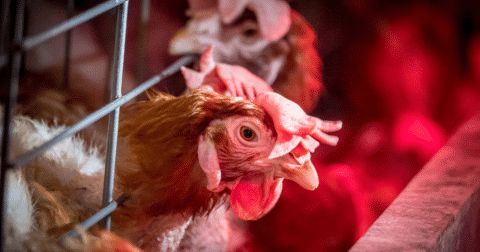
Many Americans would object to putting a critically sick pet in a hot car to put it out of its misery. Yet since the latest U.S. bird flu outbreak began in early 2022, poultry farmers all over America are using heatstroke to kill sick birds en masse. That could change, however, with the introduction of a bill by Colorado lawmakers aimed at banning the killing of poultry with heatstroke, technically known as ventilation shutdown, or ventilation shutdown plus. As bird flu cases begin to surge again, the proposed bill is renewing scrutiny of the industry’s practices for sick or infected flocks.
If the bill passes, Colorado would be the first U.S. state to ban VSD+ and VSD — acronyms used to describe the heatstroke method. Both VSD and VSD+ involve switching off the ventilators that normally cool chicken barns allowing temperatures inside to rise. When VSD+ is used, ventilators are shut down and an additional source of wet or dry heat is added, raising temperatures faster.
“This is really a brutal way of killing animals,” and can take hours or days, says Zack Strong, director and senior attorney of the Animal Welfare Institute, an organization advocating for the end of the use of heatstroke to kill poultry. “It involves sealing up barns that may have tens of thousands or even hundreds of thousands of animals in them and adding heaters which raise the inside temperature of the barn until the animals die of heatstroke.”
“It’s really no different than locking a family pet inside a hot car until they die,” Strong adds.
There is also the risk that the birds might not all die. “When you use VSD+, a really unfortunate consequence is that it doesn’t tend to kill all the animals,” says Strong. “You normally have what can be a significant number of surviving animals who then need to be found and killed later,” prolonging suffering even further.
Using USDA data, the Animal Welfare Institute estimates that between February 2022, when the current bird flu epidemic began, and mid-January this year, about 103 million birds were killed using VSD+. Total bird deaths in Colorado during the outbreak are now over 11 million, says Strong, and nearly six million of those were killed during depopulations that involved heatstroke as one of the methods.
Uncertainties around the numbers killed using heatstroke, Strong says, are partly due to a lack of detail in USDA records, and partly because farms with multiple barns might use multiple methods to kill birds.
The reasons heatstroke is being used with what Strong says is “alarming frequency” are also unclear but might be because the methods do not require much equipment or advanced planning, making it attractive to producers who might not have “taken the steps needed to be prepared to use other higher welfare methods.”
In a USDA preparedness plan from 2016, the guidelines note that ventilation shutdown “requires no specialized equipment or personnel and can be implemented immediately” if recommended by industry and government stakeholders once “all other options have been considered and that no other option will achieve the 24 hour depopulation goal.” A more recent USDA document says VSD+ is allowed in “constrained circumstances” if certain requirements are met, including an inability to access other methods “in a timely manner,” and the risk of further bird flu transmission.
The other factor that could be driving farmers to choose the fastest option is that birds that die before depopulation begins are not entitled to USDA compensation.
The National Chicken Council did not respond to the various heatstroke criticisms in this article, nor to questions about why poultry farmers are so likely to use it.
The proposed Colorado bill outlawing heatstroke would, Strong says, force producers to plan for other methods, a logical step now that the United States is several years into the current outbreak of bird flu. “So when flocks become infected with the disease, we can’t afford to think of these any longer as sort of unanticipated emergencies,” Strong says. “Instead, these bird flu infections are now predictable features of poultry production.”
Strong also argues that because producers receive taxpayer funded compensation for killing infected flocks, “they have a responsibility to take the steps needed to make sure that when depopulations occur, that higher welfare methods are used.”
If the bill passes the Colorado House and Senate, it could be signed into law by May or June. Because the bill allows for a three-year phase out period, that would mean heatstroke could be banned in 2029.
Advocates for the bill should be prepared for industry opposition, says veterinarian and longtime critic of ventilation shutdown Crystal Heath.
“I think it’s absolutely a good idea,” Heath says of the proposed law. Because heatstroke is so often used as a default or emergency method, both Heath and Strong agree the only way to push the adoption of less cruel methods, which include carbon dioxide, nitrogen gas and high-expansion nitrogen-based foam, is to ban it outright.
“But it’s also very clear that the industry will fight it,” Heath says.
In a press release, the Animal Welfare Institute notes that although nitrogen-based methods have not yet been used in the U.S., they are available and approved. Strong argues that Colorado, as a fossil fuel producer, is especially well placed to begin providing nitrogen gas for mass poultry killing. “It’s a major oil and gas producing state,” he says, meaning there are companies already producing nitrogen that the sector uses for various operations including pipeline purging and pressure testing.
Existing nitrogen capacity, combined with the high number of birds depopulated in Colorado, could mean that if heatstroke was off the table, companies would begin making nitrogen gas easily accessible to poultry producers. AWI estimates that during the current outbreak, Colorado killed the fifth-highest number of birds, behind only Ohio, Iowa, California and Pennsylvania.
Two recent developments could signal growing support for the bill’s passage among industry professionals and government officials, Strong says. The first is that at the end of 2025 the U.S. Animal Health Association, a forum where practitioners and government officials can convene to discuss livestock health, voted to approve a resolution calling on the USDA to make nitrogen based methods more accessible for producers in the U.S.
The second is that the American Veterinary Medical Association’s 2026 depopulation guidelines list nitrogen-based methods as a Tier 1 depopulation method, meaning it is the least cruel. Heatstroke is currently listed as a Tier 3 option, the cruelest, or, as the AVMA puts it, one of the methods that has “limited to no evidence to support their use, or evidence may be contrary to good animal welfare.”
Sophie Kevany is a freelance journalist writing for The Guardian, Sentient Media and other publications. She previously worked for Dow Jones and Agence France Presse (AFP) and has a Master’s in Journalism from Dublin City University. She has lived and worked in Ireland, the US, South Africa, France, Peru and Spain.
News
Policy•8 min read

Explainer
Rooted in indigenous stewardship, the NANI Act would have joined a growing movement to grant ecosystems inherent legal rights.
Climate•5 min read

Solutions
A Texas law dictating special labeling requirements for plant-based foods and cultivated meats violates the First Amendment, a federal court finds.
Legal Action•5 min read