Investigation
Meat Processing Plant Complaint Highlights Supply Chain Disruptions — And How the Meat Industry Isn’t Prepared
Food•4 min read
News
Costco’s Nebraska plant turns out contaminated chicken. And the USDA can’t stop it from reaching store shelves.
News • Food • Investigations

Words by Sophie Kevany
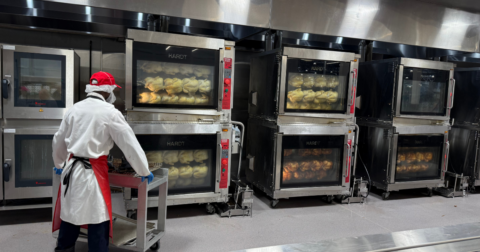
Costco is famous for its five dollar roasted chickens, but customers might want to pay attention to its raw chicken products. A new report finds the retailer’s Nebraska slaughter and processing plant has a remarkably high salmonella risk, even compared with similarly sized U.S. chicken companies.
The report, by advocacy group Farm Forward, is based on an analysis of USDA Food Safety and Inspection Service inspection data from 2020-2024 and focuses on Costco’s Lincoln Premium Poultry chicken slaughter and processing plant in Fremont, Nebraska. The plant slaughters over 100 million chickens annually for its rotisserie chicken and Kirkland Signature raw chicken brand and reportedly supplies about 40% of Costco’s chicken.
Since Costco’s Fremont plant opened in 2019 it has consistently failed the USDA’s monthly rolling tests for salmonella, receiving the worst Category 3 rating 92% of the time, the report says. Over a more recent period, from September 2023 through July 2025, the Fremont plant received a Category 3 rating 100% of the time, the director of Farm Forward, Andrew deCoriolis, tells Sentient, suggesting that contamination rates are getting worse. Consumer Reports also includes the Costco plant among its most contaminated poultry plants in the U.S. based on data collected through July 26, 2025.
When a plant fails the USDA’s salmonella tests, the agency does not have the authority to stop the plant’s operation, stop raw meat from reaching store shelves or recall raw meat products. The contaminated chicken can still be sold in grocery stores across the country. In April this year, the USDA withdrew a proposed framework that would have made it illegal to sell poultry products contaminated with one of three major serotypes, or variations, of salmonella.
“The report shows that the Lincoln plant has been in Category 3 consistently from September 2023 to July 2025,” deCoriolis explains in an email. “The only [U.S.] chicken company with an equally high rate of contamination is Grimaud Farms, which is a custom processor of various poultry, and not a retail chicken company.”
A USDA Category 2 rating allows up to 15.4% of a plant’s products to be contaminated in the case of chicken parts, and up to 9.8% in the case of whole chickens. Any plants whose chicken parts are more than 15.4% contaminated, or whose whole chickens are more than 9.8% contaminated, are given a category 3 rating. A Category 3 rating has no upper limit for salmonella contamination. This means, deCoriolis says, “we wouldn’t know if a plant failed at 15.5% or 99% contamination.”
But when a plant fails the salmonella test with a Category 3 rating, the USDA’s Food Safety and Inspection Service has no authority to stop it from continuing to operate or sell the contaminated chicken. The USDA “does not have the authority to enforce the salmonella standards it sets,” the Farm Forward report says. “Even when levels of salmonella contamination are extreme, it cannot order recalls, stop the sale of contaminated products, or suspend or shut down plants.”
Farm Forward plans to provide comment at a January 14 USDA public hearing on how the agency might improve salmonella regulations going forward.
DeCoriolis says when his team began looking at the salmonella contamination rates, he was taken aback by the levels allowed by the USDA. “As a consumer, if you go into the grocery store, I think you would be surprised, shocked, maybe horrified to learn that one in 10 packages of chicken products” could be contaminated, he says, “and that that is deemed by safety regulators as acceptable.”
The risks to Costco shoppers are more concentrated, deCoriolis says, because of the retailer’s highly integrated supply chain, unlike other chicken plants which sell to a range of retailers.
“No other retailer in the US has a vertically integrated chicken company like Lincoln Premium Poultry,” whose chicken is sold only at Costco, says deCoriolis. By contrast, deCoriolis says that while Perdue, a major US poultry company, had three plants rated as Category 3 in 2023 and 2024, it sells to hundreds of different outlets, diluting the risk at each individual retailer.
The Fremont, Nebraska plant accounts for about 40 percent of the chicken sold at Costco, according to Wattpoultry.com’s poultry companies database.
Costco did not respond to Sentient’s request for comment on the Farm Forward report.
The high level of salmonella contamination in Costco’s Fremont chickens, the report says, could be connected to poor welfare conditions such as overcrowding or stressful transport and handling conditions, which can weaken birds’ immune systems. Farm Forward’s analysis found that “during the same time Costco received Category 3 salmonella ratings, the company was also cited for humane handling violations, supporting evidence that poor welfare contributes to higher contamination.”
Stress in animals has a significant adverse effect on food safety, according to a USDA fact sheet, which says that “exposure of farm animals to stressors will lead to increased levels of foodborne pathogens in the gastrointestinal tract, and increased risk of contamination of their carcasses.”
Costco’s humane handling and transportation violations reported by the USDA included 2,000 chickens freezing to death in trailers on their way to the plant, 1,000 birds that were in a truck dying in a fire and 1,600 birds dying after they were left without food and water “in conditions of extreme overcrowding.”
DeCoriolis says the report’s findings are particularly disturbing given Costco’s control over its supply chain and the power it has to change things for the better. “Costco has 100% control. They get to decide how the birds are raised. They get to decide what genetics are used. They get to decide how the birds are killed. They get to decide 100% of what goes on in those operations. And right now they’re choosing the worst option.”
Sophie Kevany is a freelance journalist writing for The Guardian, Sentient Media and other publications. She previously worked for Dow Jones and Agence France Presse (AFP) and has a Master’s in Journalism from Dublin City University. She has lived and worked in Ireland, the US, South Africa, France, Peru and Spain.
Feature
Food•2 min read
Investigation
As H5N1 infects over 70% of the state’s dairy herds, exposed farmworkers are left without PPE or mitigation training in their native language. And some aren’t informed of an outbreak…
Food•13 min read

Feature
As some high-end restaurants reintroduce meat, young vegan cooks are adapting.
Food•17 min read