Feature
Organic Beef Has a Larger Carbon Footprint Than Feedlot Beef
Climate•4 min read
Perspective
The link between masculinity and meat has long shaped men’s identities. Could redefining these norms help reduce greenhouse gas emissions?
Perspective • Climate • Food

Words by Jessica Scott-Reid
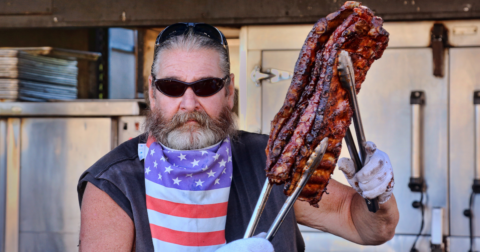
“Real men eat meat.” This gendered stereotype is a long-standing belief seen in many cultures. In the 1950s Mad Men era, marketers pushed the idea that grilling is masculine, and that attitude hasn’t changed much by 2025. Today’s meat-centric movements (such as the Carnivore Diet) are branded as symbols of health, strength and masculinity and backed by influencers like Andrew Tate and Jordan Peterson. On the other hand, vegetarianism is perceived as feminine, and the long-debunked idea that eating soy alters a man’s hormones, and even makes him grow breasts, is still pervasive.
The dietary choices that men make can impact far more than just the image they want to project. Food production is responsible for a third of all global greenhouse gas emissions, with meat being one of the biggest contributors. And because men eat significantly more meat than women, they have a greater climate impact – and this is true all around the world. One study suggests that men’s diets are linked to 41% higher greenhouse gas emissions than women’s.
A 2025 study found that, in France, men are responsible for 26% more emissions than women because men eat more red meat and drive more. “Our results suggest that traditional gender norms, particularly those linking masculinity with red meat consumption and car use, play a significant role in shaping individual carbon footprints,” said Ondine Berland, a co-author of the study and economist at the London School of Economics and Political Science, to The Guardian.
But to reduce barriers that prevent men from trying to eat less meat, it’s important to understand why they don’t want to. Lauren Camilleri, a researcher and instructor of psychology at Victoria University in Australia, says this requires a shift beyond diet alone. According to her, the broader culture needs to rewrite the perceived link between men, meat and power.
A global shift towards a more plant-rich diet is necessary to meet climate targets, feed the growing human population and minimize further environmental damage, according to the 2025 EAT-Lancet Commission. As efforts to reduce meat consumption develop, many researchers have made men a key focus because their eating habits have the potential for greater climate impact.
This is the foundation of Camilleri’s research. Her team sought to understand how men’s identity and cultural norms may play a role in how much meat they eat and how willing they are to eat less. In a 2023 report based on survey data from men in Australia and England, they identified three profiles of men based on their willingness to eat less meat.
The men surveyed were classified as either resistant (to cutting back on meat), meat-averse, or ambivalent. Meat was a strong part of the identity of resistant men, who also held the strongest ties to traditional masculine norms and conservative values. Meat-averse men, by contrast, had weak ties to traditional masculinity and felt no threat to their identity by avoiding meat. Most participants fell into the ambivalent group, who are conflicted between ethical concerns and social pressures, being moderately concerned about animal welfare yet still influenced by the idea that meat symbolizes masculinity.
In 2024, Camilleri and her colleagues reported that how strongly a man identifies with specific masculine norms can predict how much meat he eats and how willing he is to eat less of it. Men who approved of physical violence and placed high importance on sexual virility tended to eat more meat, especially red meat, and men who had more egalitarian views, or more sensitivity to male privilege, were most likely to decrease how much meat they eat.
Camilleri’s team argues that messaging around meat reduction needs to focus on these three profiles separately. Challenging traditional masculine norms may bring about a cultural shift that inspires more men to eat less meat, potentially improving their health and mitigating climate change, they say.
Nearly two years after publishing her latest research on the link between masculine identity and meat-eating, Camilleri’s perspective on those research outcomes has evolved. She now believes it is more critical to consider the broader culture that fosters a toxic form of masculinity. Her forthcoming research “explores how cultural ideals of masculinity contribute to men’s resistance to meat reduction,” she writes, adding onto her previous findings.
“It’s more apparent to me now that the bigger issue or problem is the broader sociocultural environment that we’re in,” says Camilleri, “and the influence this has on cultural norms and notions around masculinity, and what is acceptable and not acceptable behavior.”
Regarding the ambivalent group, for example, Camilleri explains that “even though this group of people in the middle have moral reservations about meat consumption – it bothers them, the ethical issues associated with eating meat – the broader cultural environment makes it incredibly difficult for people to make those individual-level changes.”
So while behavioral science research offers messaging strategies to make eating less meat more appealing to men, Camilleri believes that what’s really necessary is a cultural movement towards more empathy and openness.
The 2025 EAT-Lancet Commission report argues along similar lines, highlighting that shifts in sociocultural relationships with food can affect change in the global food system in order to meet climate targets and safeguard human health.
“We need to create sociocultural conditions that make it easier for people to adopt more alternative eating practices,” Camilleri says, “particularly for men: changing the culture, the dominant forms of masculinity.” The research shows, she adds, that “men who are more open to nonviolence, to equality, gender egalitarianism, feminist ideas and ideologies, they’re more open to reducing their meat consumption.”
Reframing the cultural equation that ties masculinity to meat holds the potential to drive meaningful climate progress. While men who have more accepting attitudes towards being violent are more likely to eat meat, Camilleri believes that “promoting more empathy, principles of nonviolence, gender equality, things like that, in society, in schools, will over time lead to more openness.”
Jessica Scott-Reid is Sentient's Disinformation Correspondent covering disinformation, misinformation and the impact of both on culture. A freelance journalist based in Canada, Jessica has covered animals, the environment and food systems for major media in Canada and beyond, for the last decade. Jessica has been a contributor to Sentient since 2019, and her work also appears regularly in The Globe and Mail, Toronto Star, Winnipeg Free Press and Corporate Knights Magazine.
News
Climate•6 min read
News
Planetary emissions are already in a dangerous phase, scientists warn.
Climate•4 min read

News
Are four years of pro-environment policies about to come to an end?
Climate•8 min read