News
Deforestation Is on the Ballot in Brazil’s Presidential Election
Climate•8 min read
Feature
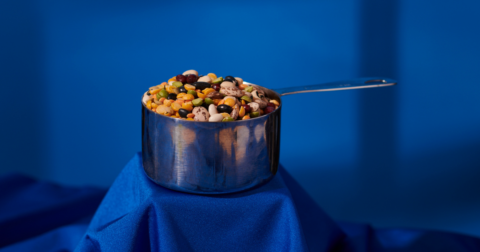
Cheap staples like canned beans and oats are not only easy to prepare, but better for you and the environment.

Words by Sophie Kevany
Do your New Year’s resolutions include eating better without breaking the bank? If the answer is yes, there is good news ahead. Eating better for you and the planet doesn’t have to be complicated. A new study shows that a healthy, planet-friendly diet doesn’t have to require expensive substitutes or dramatic lifestyle changes. The solution: buy cheaper products from each of the main food groups.
The study models rely on the main food groups listed in the Healthy Diet Basket: starchy staples, vegetables, fruits, meat, fish and dairy, legumes, nuts and seeds, and oils and fats. Shopping for cheaper foods in each of those groups, the study finds, can cut food costs in half while reducing the climate impact of a person’s diet from 2.5 kg to 1.6 kg of carbon dioxide equivalent. These foods include whole grains, legumes and smaller fish, the study says, while beef and rice are linked with higher emissions.
A planetary diet calculator developed by the Center for Biological Diversity and the University of California (in beta mode, publication TBA) suggests the ideal food-related greenhouse gas emissions are 1.12 kg per person each day. People in wealthier countries tend to eat more animal-based products, which have higher dietary footprints than people in many low- and middle-income countries.
“Choosing less expensive options within each food group can generally help us find lower emissions foods, and foods that generally have lower environmental impacts,” says Elena Martinez, who works at the Tufts University School of Nutrition Science and Policy and is one of the study’s lead authors.
Shopping based on prices, she explains, is both straightforward and attractive to consumers. “Because when we look at the grocery shelves, we can’t tell what the greenhouse gas emissions are of foods just by looking at them. And we can’t tell a lot of other things about how they’re produced, but we can see how much they cost.”
The differences in price and climate impact between the diets studied are related to which animal proteins and starchy foods people choose. The study suggests selecting cheaper, environmentally friendly animal proteins rather than beef (a switch to chicken can come with tradeoffs for animal welfare). And instead of rice,which is an affordable staple but releases a surprising amount of methane as it’s grown (though less than beef), choose potatoes, wheat, corn or oats. For fruits and vegetables, Martinez says, buy a good variety of the cheapest you can find.
Food can be deeply personal and cultural. There are many cuisines for which rice is central, for example. The study suggests people’s grocery choices are influenced by a wide range of factors. Those can include personal or religious preferences, being too busy to shop and cook from scratch, and some “very persuasive” food marketing that drives people toward “more expensive or less nutritious options.”
Based on her own experience in the grocery store, Martinez says, she tends to look for “those lower cost items that are also mostly unprocessed,” including raw carrots, raw onions, fruits, grains, uncooked flour and oats. In the U.S., she says, that often means looking beyond the main aisles and focusing on the edges of the store where often “those kinds of unexciting but nutritious and inexpensive foods are lying.”
“So when I translate that to practical advice, like when my friends ask me, okay, well, I don’t have time to cook, I’m taking care of my kids or I’m working long hours. What do I do? I think of some key foods that are inexpensive, low emissions and relatively easy to prepare that, again, are not those foods that are getting splashed all over the billboards.” Rather, she says, they can be those “tasty, nutritious foods” that can be turned into good meals, relatively quickly, like canned beans, tinned fish, lentils, milk and oats.
And for those who want to avoid animal proteins altogether, she advises shifting toward “inexpensive, highly nutritious, low emissions plant-source protein foods” like beans, seeds and, of course lentils, which, very importantly for the time-conscious, don’t need soaking.
The New York Times has featured recipes from Nisha Vora, whose YouTube channel Rainbow Plant Life, focuses on plant-based recipes, like crispy beans with juicy tomatoes over tahini yogurt, often made with pantry staples.
A range of healthy eating scenarios was used to calculate the different diet options modeled in the study, including the cheapest, the one with the least emissions and others that used the most common and most popular food products from 171 countries.
The diet that included the most commonly consumed foods was calculated to cost $9.96 per person per day, with 2.44 kg of carbon dioxide equivalents, whereas the cheapest and most environmentally friendly options were $3.68 and 1.65 kg and $6.95 and 0.67 kg, respectively.
Professor Peter Smith from the University of Aberdeen told Sentient in an email that the “common narrative that only the privileged can afford to switch to healthy, low-climate impact foods is simply not supported by the evidence presented here.” Instead, the study shows that “significant cuts” to the climate impact of our daily diets can be made while saving money and eating healthily.
Policy makers, Smith added, could use these findings to help tackle the twin crises of climate change and dietary health problems — and the burden those problems place on public health systems — by providing incentives to support affordable, sustainable healthy diets.
So, what would Martinez tell a policymaker if she had a few minutes of their attention? “I would come back to what I think this study shows us about the reasons that it’s pretty difficult for many people to eat low emissions diets,” and tell them that part of the solution might lie in asking ‘what can we do to make these nutritious options the most appealing and easiest choice to make at the grocery store?’”
The ways to do that, she says, might include “reducing the amount of marketing we see for unhealthy foods, especially for populations at particularly nutritionally sensitive periods of their life, like young children.” Another, potentially simpler, move, she says, would be to take action at the grocery store level to make it clearer which foods are better for you and the planet, and which are less so.
Correction: an earlier link to a planetary diet calculator has been removed as it is not yet live to the public.
Sophie Kevany is a freelance journalist writing for The Guardian, Sentient Media and other publications. She previously worked for Dow Jones and Agence France Presse (AFP) and has a Master’s in Journalism from Dublin City University. She has lived and worked in Ireland, the US, South Africa, France, Peru and Spain.
Feature
Climate•3 min read

News
Animal agriculture drives 71% of biodiversity damage from food production on farmland.
Climate•5 min read

News
Slashing food-related emissions needs varied strategies for different ages and countries, two new studies find.
Climate•6 min read