Feature
What Is Animal Welfare Worth? Economists Have a New Way to Calculate It
Research•7 min read
News
The process plays out separately from photosynthesis, and experts say it could improve reforestation strategies.
Words by Seth Millstein
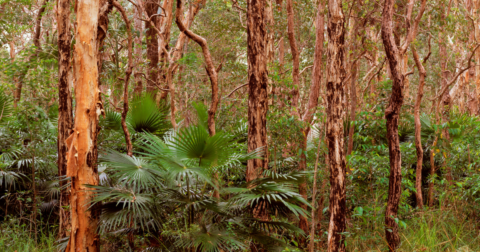
It’s well known that trees take in carbon dioxide from the air via photosynthesis and store it in their branches, roots and trunks, making them an invaluable resource in countering climate change. A new study from Australia suggests that trees may be even more critical than previously thought, finding that microbes in tree bark can trap or release greenhouse gases, depending on the environmental conditions. The discovery may significantly increase the estimated ecological loss from deforestation and could inform more effective reforestation methods.
“There are 3 trillion trees on Earth, and the total surface area of bark is about the same as the seven continents combined. The cumulative amount of greenhouse gases removed by bark microbes is massive. For example, trees and bark microbes may remove megatons of hydrogen from air each year,” study co-author Pok Man “Bob” Leung told Sentient in an email.
The study, published in January in Science, found that microbes in the bark of eight different tree species can trap methane, carbon monoxide, and hydrogen, all of which contribute to global temperature rise, directly and indirectly. The researchers also found that the microbial communities in some tree species were more effective at trapping these compounds than those in others and that under low-oxygen conditions, they could switch from trapping to producing the climate-active gases.
Around 10 million hectares of trees are deforested every year, often through the use of fire. This process increases net greenhouse gas emissions by releasing stored carbon, removing the carbon sink and then converting the land to agricultural use. Three-quarters of tropical deforestation is driven by agriculture, with 41% of tropical deforestation going to expanding pasture for cattle, according to Our World In Data.
Tree-planting initiatives aim to offset this, but they require careful planning and execution to succeed in reducing emissions. That’s one way the recent Australian study could help.
Over five years, the researchers studied tree bark across eastern Australia. They discovered that the microbial populations in the bark have gas-absorbing properties all of their own, completely separate from the photosynthetic process that captures carbon.
Researchers examined the bark of eight tree species across a wide range of ecosystems, including wetland, coastal and upland forests. They found that the bark was teeming with microbes — around 6 trillion microbes per square meter of bark.
“Our study finds that trees not only absorb carbon dioxide through photosynthesis, but the bark of trees harbour trillions of microbes that can remove other greenhouse and harmful gases,” Leung writes.
The microbes did this in two ways: by capturing the greenhouse gases from the surrounding air and by preventing the tree from releasing the climate-active gases when taken up through the soil.
The microbes in question acted as “biofilters” for this process, Leung says, largely preventing the harmful gases from being released.
The study’s findings illustrate one of many reasons why reforestation efforts are often inadequate, Doug Larson, professor emeritus of Integrative Biology at the University of Guelph, tells Sentient. Deforestation often results in the clearing of many different tree species from a single region. As the Australian study shows, each of those species has a unique microbial makeup and, as such, makes a unique contribution to the ecosystem’s overall biodiversity.
However, reforestation initiatives often involve planting a single tree species where many once stood, Larson says, which can never fully compensate for the loss of trees from deforestation. According to the International Union for Conservation of Nature’s Red List, as of this publication, 39% of assessed plant species worldwide are threatened with extinction.
“You put in one species of pine tree, and you say that’s equivalent,” Larson explains. “Well, excuse me. What about the other 4,999 species that were there that aren’t there anymore?”
The Australian study’s insights may offer an opportunity to make reforestation initiatives more effective in the future, Larson says.
“Our study findings show that different tree species have distinct microbes,” Leung says. “Future reforestation efforts could prioritize planting of trees that select for the most active bark microbes in consuming greenhouse gases.” He adds, though, that this shouldn’t be the only factor to consider, as properties like “CO2 absorption and interactions with animals and other plants” are also important to weigh in.
The fact that scientists have only just discovered that tree bark microbes can trap greenhouse gases is a reminder of how much we still don’t know about complex ecosystems like rainforests. This makes it impossible to sufficiently restore their functionality after they’ve been destroyed.
“As these authors have pointed out, until they did this work, they had no idea what those species were doing,” Larson says. “This paper really just opens the door to a fantastic, beautiful world of the role of microorganisms doing something within forests.”
But the Australian study’s insights offer another invaluable key to understanding how these ecosystems function at the micro and macro levels and in doing so, provide another tool for rebuilding them to be a little more effective.
“Trees are a habitat on the outside and on the inside,” Larson says. “The more we can shine a spotlight on these invisible worlds, the better.”
Clarification: The editors replaced the unverified claim that “around 50,000 species of plants, animals and insects go extinct every year due to deforestation” with “39% of assessed plant species worldwide are threatened with extinction,” using data from the IUCN Red List.
Seth Millstein is a writer and musician living in the Bay Area. He has helped launch several early-stage journalism startups, including Bustle and Timeline, and his work has been published in Bustle, Huffington Post, The Daily Dot and elsewhere.
Feature
Culture•7 min read
Perspective
If you’re looking to reduce your water impact, eating less meat is a great place to start.
Culture•8 min read
Feature
New technology can detect pain in farm animals, but critics say it may do more to bolster the system than improve it.
Science•7 min read