Solutions
Bhutan’s Food System Ethos Offers an Alternative to Factory Farming, but Can it Survive?
Farms•7 min read
Feature
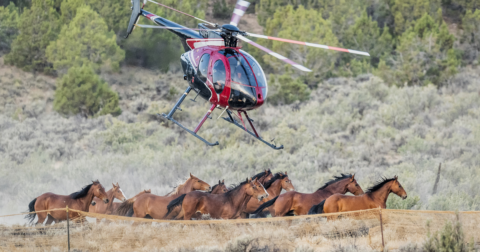
3,700 federally protected wild horses were sold in 2025, and a new investigation reveals some end up at the slaughterhouse.

Words by Jessica Scott-Reid
Update: Sentient’s original coverage below, published on February 4, reported that U.S horses — including pets, workhorses, racehorses and rodeo horses — are still being slaughtered for food after being transported across the border to Canada or Mexico. Wild horses are also being sold and transported beyond U.S. borders. A New York Times investigation, published on August 20, reports that federally protected wild horses sold by the Bureau of Land Management have also entered the slaughter pipeline, transported to slaughterhouses in Canada.
The Bureau sold about 3,700 wild horses in 2025 — more than twice the number sold the previous year, according to the reporting. The Bureau says it does not sell or send wild horses directly to slaughter, but the animals lose their status as federally protected once sold. They can then be resold, allowing some to end up slaughtered for meat.
The Bureau says it removes wild horses from public lands when their populations exceed what it deems sustainable levels for available food, water and land. “Maintaining herd size at the appropriate management level is the best way to ensure healthy horses and burros on healthy rangelands,” it notes on its website. Those same rangelands are also used for livestock grazing, which the Bureau considers when determining how many wild horses the land can support.
Nearly two decades ago, the United States effectively shut down domestic horse slaughter operations with a change to federal funding rules. The North American horse-meat industry has since declined, but it’s not gone entirely. While horse slaughter has ceased within the United States itself, the slaughter of American horses for meat has not. It has simply shifted across borders.
Today, thousands of U.S. horses — including pets, workhorses, racehorses and rodeo horses — are still purchased at auctions and shipped to Canada and Mexico for slaughter, according to a report by the advocacy groups Animal Wellness Action, Center for a Humane Economy and Animals’ Angels.
Advocates and experts cite significant animal-welfare concerns with the industry and have been pushing for it to cease completely rather than relocate. These advocates say that a combination of pending legislation, growing public awareness and tighter export controls could bring this dwindling horse meat trade to an end.
Most Americans may agree. According to a 2022 poll commissioned by the ASPCA, 83% of Americans oppose slaughtering horses for food.
In 2024, nearly 3,000 horses were transported from the United States to Canada for slaughter, and over 17,000 were exported from the United States to Mexico, a stark decline from the 2010s, when annual exports to each country frequently exceeded 50,000 for both Canada and Mexico.
“We have seen those big drops, which is very encouraging,” says Joanna Grossman, director of the equine program at the advocacy group Animal Welfare Institute. “But we’re never going to get to zero, barring passage of federal legislation that would actually prohibit the export of horses to Canada and Mexico for human consumption.”
Since 2021, U.S. advocates have been trying to end the export of horses for consumption by backing the Save America’s Forgotten Equines (SAFE) Act in the House of Representatives. After it failed to pass in 2022, the Act was reintroduced in 2025 in both the House and the Senate. It seeks to permanently ban slaughtering horses and other equines for human consumption, building on an existing ban on dog and cat meat. The Act would also prohibit transporting or exporting horses for the purpose of consumption.
“It’s an issue that continues to attract really strong bipartisan support,” says Grossman. “I think there’s generally this recognition across the political spectrum that Americans don’t want to see horses being butchered for their meat.”
In 2012, the ASPCA urged support for a U.S. ban on the sale and transport of horses for slaughter, citing “inherently cruel” practices, as horses are difficult to stun and often remain conscious during slaughter.
Dr. Nicholas Dodman, a veterinary behaviorist and professor emeritus at Tufts University has reviewed video footage of almost 200 horses being killed by a captive bolt — a gun that releases and retracts a metal bolt into the skull. “It is not a technique that lends itself to slaughter,” he writes to Sentient in an email. “Horses are often spooked and provide a moving target,” and that target — the brain — “is the size of a grapefruit inside a 13-gallon garbage can,” he describes, adding that it is easy to miss.
“Many horses require multiple shots to bring them down. One horse I viewed on video took nine shots. It was pathetic to see this human-trusting animal fall down, get up, get shot again, go down again, get shot again, and so on,” he writes. Dodman was one of 202 veterinarians who signed a letter in 2022 in support of the SAFE Act.
The transport of horses across the border via trailer or truck is also of concern. “Horses are often shipped thousands of miles under inhumane conditions,” writes Dodman, adding that they can be shipped during extreme temperatures, without food or water, for up to 28 hours. In 2025, the advocacy group Canadian Horse Defence Coalition compiled government documentation showing that some U.S. horses do not survive the journey to Canada.
Live horses are exported from Canada to Japan and involve long-haul flights where the horses have no access to food or water and are kept in wooden crates, which advocates have argued lack adequate space. They can be flown for up to 28 hours and an investigation by Animal Justice shows this legal limit is often exceeded. Some cases document horses that are injured, collapse or die en route.
Canada remains one of the top ten producers of horse meat in the world. The country breeds and farms horses specifically for meat, raising them on feedlots much the same as cattle. These purpose-bred horses, along with unwanted horses bought at auctions and those imported from the United States, are slaughtered at two federally inspected facilities in Alberta and Quebec. The meat is then sold mainly to Japan and the United States, specifically to Nebraska.
There are some signals of decline on the export side, however. The amount of frozen or chilled horse meat exported from Canada has been decreasing in recent years, falling by nearly 35% from 2023 to 2024. Switzerland and France also ceased importing horse meat from Canada in 2025. And recent EU Animal Health Law Regulations set requirements that make horse meat of U.S. origin ineligible for export to the EU.
The EU also imposed a moratorium on horse meat imports from Mexico in 2014 due to concerns about traceability and food safety. At the time, most horses slaughtered in Mexico came from the United States.
In 2019, then-Prime Minister of Canada Justin Trudeau included a ban on live horse export as part of his re-election platform. After winning, he instructed the Minister of Agriculture and Agri-Food to carry out the ban in 2022. But due to industry and opposition government pushback, along with a change in leadership, the ban has yet to pass.
Animal welfare advocates in Canada and the United States say that if either the SAFE Act in the U.S. or Canada’s live export ban were to pass, it would bolster the efforts of the other. As to the SAFE Act’s potential passage, “it would have a huge economic impact on our horse slaughter industry,” says Kaitlyn Mitchell, director of legal advocacy for Animal Justice, “because the two slaughterhouses that are still operating in Canada that kill horses rely in large part on horses that are coming up from the U.S.”
And Grossman believes Canada’s proposed live export ban “would absolutely have a beneficial effect.”
Ultimately, “horse slaughter is a business, driven by financial gain and people’s taste in distant lands,” Dodman says, but “business matters should not outweigh our responsibility to treat animals humanely.”
This piece was first published February 4, 2026, and first updated June 4, 2026.
Jessica Scott-Reid is Sentient's Disinformation Correspondent covering disinformation, misinformation and the impact of both on culture. A freelance journalist based in Canada, Jessica has covered animals, the environment and food systems for major media in Canada and beyond, for the last decade. Jessica has been a contributor to Sentient since 2019, and her work also appears regularly in The Globe and Mail, Toronto Star, Winnipeg Free Press and Corporate Knights Magazine.
Feature
Food•6 min read
Feature
Cooke Aquaculture touts the jobs its salmon farms bring to the state, but local critics say the potential costs to their waters, livelihoods and wild Atlantic salmon outweigh the benefits.
Fisheries & Aquaculture•9 min read

Investigation
JBS and Cargill plants across the country are accused of pressuring unions into either accepting the same low wage structure, or mere nickels apart. The result? The largest meatpacking strikes…
Food•13 min read