News
Grasslands and Wetlands Are Being Gobbled Up By Agriculture, Mostly Livestock
Research•4 min read
News
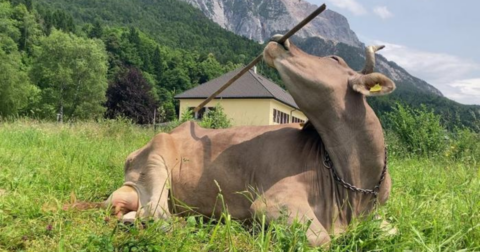
Meet Veronika, a Swiss Brown cow who uses a broom to scratch her back.

Words by Seth Millstein
A cow named Veronika has made headlines around the world after researchers confirmed for the first time that cows are capable of using tools based on observations of her behavior. But Veronika is likely not the only cow whose capacities might surprise us if we only looked a little closer.
The new study, along with several other recent studies, suggests that farm animals’ cognitive abilities are greater than previously thought.
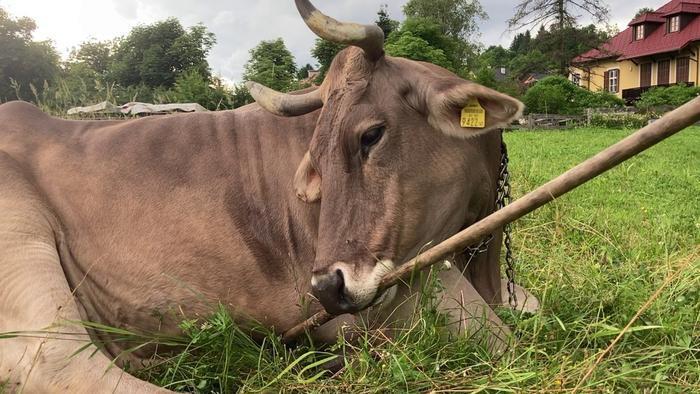
In the study, published in January in Current Biology, Austrian researchers observed a Swiss Brown cow named Veronika picking up a large broom with a horizontal brush with her mouth and using it to scratch various parts of her body. She wasn’t trained to do this; she began doing it on her own.
“The current study is distinctive in that it is, to our knowledge, the first to successfully examine tool use in farm animals,” Christian Nawroth, PhD, who studies animal welfare at the Research Institute for Farm Animal Biology and was not involved in the research, tells Sentient in an email.
“As a society, we appear to consistently underestimate the sophisticated ways farm animals engage with their environment,” he writes.
Veronika, who is kept as a family pet rather than as livestock, used different ends of the broom for different purposes. She scratched the thicker parts of her hide with the bristled side of the brush, but switched to using the smooth wooden handle on her soft underbelly and udders. This is called multipurpose tool use, which hasn’t been previously documented in non-primate mammals, the authors say.
“The only other solid example of multipurpose tool use that we know of belongs to the chimpanzees of the Congo Basin,” Antonio J. Osuna-Mascaró, one of the researchers, told CNN in an email. “It’s astonishing to find that a cow has the capability to do something like this.”
More than ten years ago, Veronika’s owner witnessed her picking up sticks with her mouth, carefully positioning them with her dexterous tongue and using them to scratch herself. When Alice Auersperg of the University of Veterinary Medicine, Vienna, saw a video of Veronika’s behavior, she suspected that it was not accidental, and set out to document it. She and Osuna-Mascaró ran more than 70 trials and concluded that Veronika’s interactions with the brush constituted ”manipulation of an external object to achieve a goal via a mechanical interface,” or using a tool.
While there have been anecdotal reports of cows using tools in the past, this is the first study to confirm such usage through scientific observation. Nawroth tells Sentient that this is in part because the number of research studies on farm animal cognition is “marginal” compared to, for example, the number of cognitive studies on dogs. Cows are often seen primarily as food sources, and previous studies of their minds have typically been aimed at increasing their productivity or welfare.
Continued research is needed on how housing conditions influence farm animals’ development, Nawroth writes. Underestimating farm animals’ full cognitive capabilities likely hinders us from properly adapting husbandry practices to their cognitive needs, he thinks.
Around 75% of cows in the U.S. live on factory farms, according to The Sentience Institute. These facilities, with their cramped enclosures and lack of enriching objects and environments for cows to explore, are not exactly cognitively stimulating.
Veronika’s brain was capable of learning to use a tool, but she might not have been able to develop that potential if she lived in a factory farm environment instead of the free and open life she’s been afforded.
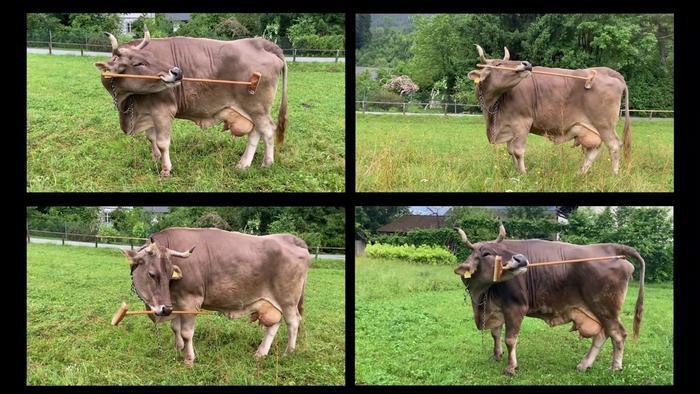
Veronika lives in what Osuna-Mascaró described to Scientific American as “the most idyllic place imaginable for an Austrian cow, like straight out of The Sound of Music.” It’s a lush green pasture with plenty of room to roam. Veronika’s family inadvertently facilitated her use of tools by “providing the special conditions that enabled Veronika to express herself,” Osuna-Mascaró said.
Although studies on farm animal cognition have been scant, that’s beginning to change. Research by Nawroth and his colleagues at the Research Institute for Farm Animal Biology in Dummerstorf, Germany have shed new light on how the minds of pigs, cows, chickens and other livestock animals work.
One study led by Liza Moscovice found that piglets show signs of empathy. They freed each other from a locked enclosure when they had the opportunity, and were more likely to do so if their trapped companion squealed in distress.
Another study found that cows can be potty-trained to pee in an enclosure. This is an important finding that could potentially be put to good environmental use. When cow urine and feces mix, they produce ammonia, so separating out the urine could significantly reduce ammonia emissions on factory farms.
Other studies have found that cows form friendships and social bonds within their herds, and often have one best friend with whom they spend more time than others.
Decades ago, a panel of the popular comic strip “The Far Side” featured a cow standing before several crude-looking and presumably ineffective tools, with the caption “Cow Tools” below. The joke was that the idea of cows using tools is inherently ridiculous, but perhaps the joke was on us. Veronika’s ability suggests that “we, as researchers, still underestimate the cognitive capabilities of these animals,” Nawroth writes.
Seth Millstein is a writer and musician living in the Bay Area. He has helped launch several early-stage journalism startups, including Bustle and Timeline, and his work has been published in Bustle, Huffington Post, The Daily Dot and elsewhere.

News
Research•5 min read

News
People taking blockbuster drugs like Ozempic and Wegovy report eating less meat, dairy and processed foods. These shifts could reshape the food system.
Research•3 min read
News
A study in mice finds avian flu shares trait with the viruses behind some of the worst pandemics, but more research in humans is needed.
Research•5 min read