
Perspective
The Government Wants You to Eat Real Food. But What Does That Actually Mean?
Diet•4 min read
News
Here’s what the new dietary guidelines actually mean for school meals.

Words by Seth Millstein
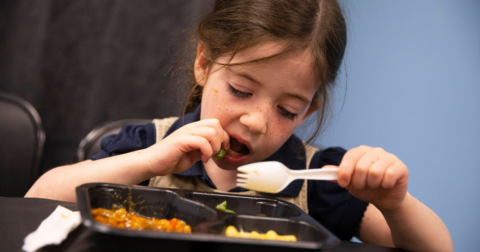
Earlier this month, the Trump administration finally published the long-delayed update to the Dietary Guidelines for Americans. The new guidelines contain some big changes from the previous version, and they’ll have a direct impact on school lunches, which are required to adhere to the guidelines’ standards. But how big will that impact be, and what will it look like?
The changes could manifest in a number of different ways, partly because school administrators have a lot of leeway in how they apply the regulations, Chloe Waterman, senior program manager at advocacy group Friends of the Earth, tells Sentient.
However, because the new guidelines significantly increase the recommended protein intake, schools might have an opportunity to serve more plant-based proteins than they currently do. And though the guidelines slam “ultraprocessed foods,” schools would need more funding to actually replace them with more labor-intensive foods to prepare, Waterman says. In any case, for administrative reasons, it will likely take years for any changes to affect what children are eating at school every day.
The updated guidelines received a lot of attention for introducing a new version of the classic food pyramid. But it’s important to note that this image is intended only to be a rough visual approximation of the guidelines, and doesn’t contain any serving sizes or specific recommendations. The actual dietary guidelines are an eight-page document released alongside the new food pyramid.
This is relevant because the food pyramid image implies some things that aren’t actually reflected in the document. For instance, the most prominent food it displays is a huge slab of steak, but the new guidelines don’t specifically recommend red meat (although they also don’t advise against it).
“If you actually look at the guidelines themselves, they don’t put steak and cheese and whole milk at the top in a priority level in the same way that that visual pyramid does,” Waterman says. “The folks that are going to be updating the [school lunch] guidelines, they’re going to be looking at the text” of the new document, not the pyramid.
The new dietary guidelines retain many of the previous guidelines’ recommendations, but contain a few significant changes. Most notably, the new version significantly increases the recommended protein intake, removes distinctions between lean meats and fatty meats, endorses full-fat milk, advises against ultraprocessed foods, and moves beans, peas and lentils from the vegetable category into the protein category.
School lunches are required to follow the guidelines’ recommendations, but this doesn’t happen overnight. Formalizing the guidelines into school lunch policy usually takes years.
“It took three and a half years from the time the 2020–2025 Dietary Guidelines for Americans were released to the time the school nutrition standards were updated to reflect them,” Waterman writes in an email. “Most of the school meal pattern changes went into effect just this school year, but some changes are still being phased in.”
First the USDA has to write and publish a rule explaining in detail exactly what schools must do in order to adhere to the guidelines. There is no deadline by which the agency must do this. Then the proposed rule is posted for public comment in the Federal Register for between 30 and 60 days.
After that, the USDA writes a new version of the rule incorporating the public feedback, then publishes it with a proposed implementation date. Only then do the new policies go into effect — assuming that there are no lawsuits attempting to halt them, which there often are when new federal regulations are announced.
“It’ll be a years-long process for USDA to revise these guidelines, for the public to comment on them, for school districts to comment on them, for USDA to incorporate that input [and] reissue the guidelines,” Waterman says. “If USDA really does start to move this year on writing new regulations, they will be moving up the timeline a little bit relative to the past.”
Another factor to consider is that the school lunch rules themselves aren’t terribly rigid. Even after they’re formalized via an official regulation, school administrators have wide latitude in interpreting and implementing them.
“You could have one lunch tray that has chocolate milk, canned beans, canned pineapples, chicken nuggets and a dinner roll, and that’s a compliant meal,” Waterman says. “And you could have another lunch tray that has fresh, locally sourced broccoli, a mandarin orange salad, Thai sesame noodles and a tofu stir fry and soy milk, and that’s going to be within the standards as well.”
Waterman doesn’t anticipate the new guidelines restricting the amount of latitude administrators have in crafting their lunches. In fact, they could potentially provide even more leeway.
While it’s too soon to say whether or not this will happen, the guidelines open the door for school districts to serve more plant-based proteins alongside meat. This is due to two interlocking provisions in the new guidelines: A recommendation that Americans eat more protein across the board, and a warning to limit saturated fat consumption.
The new version of the guidelines advises Americans to limit their saturated fat to 10% of their daily calories. But as a protein source, meat is typically high in saturated fat, and plants aren’t. In order to meet the heightened protein requirement without running afoul of the saturated fat limits, schools could opt to serve more plant-based proteins alongside existing meat offerings.
If the USDA’s new directives to schools raise the amount of protein that’s required but keep the 10% saturated fat cap, “schools would have a hard time increasing cheese, or fatty or processed meats without exceeding the saturated fat limit,” Waterman writes in an email.
Plant protein is overall more affordable than animal protein and could be financially more feasible to add more of. But schools could also turn to fat-free dairy products or lean meat products, which have lower amounts of saturated fat, to add more protein without exceeding the saturated fat cap.
The new guidelines contain an advisory against ultraprocessed foods, and many schools serve chicken nuggets, hot dogs, pepperoni and other foods that are typically considered ultraprocessed. Might the new guidelines prompt a shift away from these products?
That’s not a sure thing. To begin with, there’s a lot of disagreement around how exactly to define “ultraprocessed foods”; the USDA doesn’t have an official definition, and while it’s currently working to develop one, that process has already taken longer than planned. There’s no sign of when it will be completed, and it will have to be before schools can introduce any limits on ultraprocessed foods.
Second, as Waterman points out, replacing ultraprocessed foods in school lunches will potentially require significant financial investments in schools, because they will need more equipment and trained staff to adapt to the change.
The upside of ultraprocessed foods, from the standpoint of school administrators, is that they’re quick and low-effort to prepare. “A lot of school kitchens around the country still operate on what we call a heat-and-serve model, where they’re taking packaged foods [and] heating them up and serving them,” Waterman says. “They are not chopping; they are not baking; they are not boiling; and to do those things, the staff need to be trained.”
Many of the foods that would conceivably replace their ultraprocessed counterparts would require “two things that a lot of schools don’t have: ample and trained labor, and kitchen equipment and setups that facilitate scratch cooking,” Waterman says. As a consequence, it would be difficult for schools to switch away from ultraprocessed foods without extra funding to facilitate such a switch.
Under federal law, schools are required to offer milk in school lunches. While past versions endorsed low- and non-fat milk, the new version says that Americans should include full-fat milk as part of their dairy intake.
Just a week after the new guidelines were released, President Trump signed into law the Whole Milk for Healthy Kids Act, which will allow — though not require — schools to serve whole milk. Since 2010, public schools have been forbidden from serving full-fat milk to kids. The new law also allows schools to serve plant-based milks as a standard offering for the first time.
Although the new guidelines cap saturated fat at no more than 10% of calories, the Whole Milk For Healthy Kids Act exempts liquid milk from any saturated fat limits in school lunches. As a consequence, any schools that serve whole milk won’t have to count its saturated fat content towards the 10% limit.
Much of what is currently served in school lunches already conforms with the new guidelines’ recommendations, Waterman says. School lunches already emphasize fruits and vegetables, and prioritize whole grains over refined grains, for instance, in accordance with the previous dietary guidelines.
The new recommendations will likely result in at least some changes to school lunches in America. Those changes could include opting to serve more plant-based proteins to kids, but not necessarily. It will be years until we know how extensive those changes will be and what they will look like.
Given how much leeway schools have in implementing the guidelines, school administrators could use them to make choices based on the best nutritional evidence available. Or they could use them to make choices that are contradicted by that evidence.
Seth Millstein is a writer and musician living in the Bay Area. He has helped launch several early-stage journalism startups, including Bustle and Timeline, and his work has been published in Bustle, Huffington Post, The Daily Dot and elsewhere.

News
Health•9 min read

Analysis
Something unpleasant happens to your body when you stop eating vegetables.
Health•3 min read

News
The sharp one-year increase is raising concerns among public health experts.
Health•4 min read