Explainer
Can ‘Personhood’ Really Protect Nature?
Climate•7 min read
News
The practice of integrating pasture with trees has limited evidence of success for climate mitigation in the eastern United States.

Words by Gaea Cabico
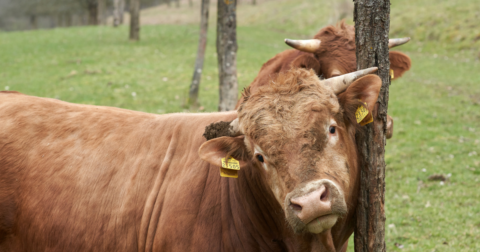
In Latin America, where livestock production and deforestation drive much of the agriculture sector’s greenhouse gas emissions, integrating trees, grasses and grazing animals like cattle on the same land has been touted as a rare win-win solution. Known as silvopasture, the approach is seen as a way to store carbon while at the same time improving livestock productivity and animal welfare.
Silvopasture is slowly gaining traction among researchers, climate advocates and farmers in the United States. Universities are testing how the practice could help Southeast farmers raise sheep and goats while maintaining healthier forests by managing kudzu, as well as how it might reduce wildfire risk and prevent erosion in places like Hawaiʻi.
Silvopasture is often presented as an alternative to raising grazing livestock on industrial-scale operations. One 2023 projection even suggests tens of millions of acres of pasture in the eastern United States could transition to silvopasture.
But some researchers are urging caution. A working paper from the environmental research group the World Resources Institute released on March 11 argues that the climate potential of silvopasture may be overhyped. After reviewing the existing literature, the authors conclude that there is not enough evidence to justify treating it as a major climate solution in the United States — although it can improve animal welfare by providing shade.
“The overclaiming of the amount of acreage for potential silvopasture is to me too lofty and overstated,” Mike Badzmierowski, manager of U.S. agricultural policy at WRI and an author of the paper, tells Sentient. He adds the projections “might be overselling what the potential is” since they focus only on carbon sequestrated by trees and overlook its effects on farm productivity. Higher on-farm productivity can result in lower emissions, though there are often tradeoffs for animal welfare and other forms of environmental pollution.
In the big picture, even advocates of silvopasture are clear that by itself it’s not going to fix the large share of emissions that come from livestock. “There’s no better way to do grazing that’s going to solve emissions from livestock,” says Eric Toensmeier, who studies silvopasture’s climate potential as a senior fellow at Project Drawdown. “We need to change diets, especially from ruminants like cows, and we need to reduce food waste, especially of meat and milk from ruminants.”
Evidence from Latin America shows that adding trees can improve livestock productivity while reducing methane emissions, a major greenhouse gas produced during digestion. Trees provide shade and shelter that lower heat stress while also offering extra forage.
Some tree species used in silvopastures like willow contain compounds that can help suppress methane production, and trees also store carbon. That has led some to think it could work in the U.S. as well. But as Badzmierowski notes that without Latin America’s tropical climate, the effects on productivity vary by season, so the benefits may not fully translate to the U.S.
Currently, silvopasture is not widely practiced in the United States. Only about 1% of farms that practice agroforestry — a land-use system that integrates trees with crops or livestock — are specifically implementing silvopasture, according to Toensmeier. Silvopasture is a subset of agroforestry.
The eastern U.S., with its wetter landscapes that support more cattle and trees, was thought to be emerging as a prime candidate. For instance, a study by regenerative agriculture company Propagate and The Nature Conservancy found that silvopasture in the eastern U.S. could expand by 5.6 to 25.3 million hectares and capture up to 25.6 million tons of CO₂ equivalent per year — about the same as the emissions from roughly six million cars driven for a year.
But WRI researchers say the evidence base in the eastern U.S. is limited and inconsistent. Available studies suggest that adding trees to pasture can reduce forage and livestock output as trees compete with grass for sunlight, water and nutrients. This may not happen where there are few or young trees, but as trees grow or become more dense, this increased competition is likely to reduce productivity.
If productivity falls when farmers turn to silvopasture, “we’re likely to deforest other places to make up for that production,” Badzmierowski says. The paper also notes that most carbon in silvopasture systems is stored in trees rather than soil, meaning it could be released if those trees are later harvested for timber.
Some proponents suggest feeding parts of some trees to livestock to avoid productivity losses. This approach has boosted livestock productivity in Colombia and Mexico. But in the eastern U.S., where pastures already provide sufficient nutrition and farmers can access supplemental feed, the benefits are limited, WRI researchers argue. In some cases, excess protein can even lead to higher emissions, as animals excrete it and it converts into nitrous oxide, a potent greenhouse gas.
Practical and ecological constraints also limit the tree species proposed as fodder for silvopasture. Red mulberry is listed as threatened or endangered in several states. Willow species grow best in moist soils, restricting where they can be planted. Some are also considered invasive or problematic in the eastern United States.
The productivity trade-off makes adoption of silvopasture harder for farmers in the U.S. to justify. The current payments do not make up for the risks and efforts farmers take on when adopting a new system with uncertain returns, Badzmierowski says.
Project Drawdown labels silvopasture as a “highly recommended” climate solution. At one point, it identified it as the “most powerful” agricultural climate solution. “Until this WRI piece, I would have said we’re close to a scientific consensus that it’s a good idea to add trees to grazing land, with the caveat that should only be done in places where trees are supposed to grow, places where there’s enough rainfall and that aren’t supposed to be grassland,” Toensmeier says.
While Project Drawdown’s Toensmeier broadly agrees with WRI’s cautious stance, he argues that “far from driving deforestation, silvopasture actually frees up land because its total production is more than either mode alone.” While individual yields for trees and livestock are lower, he says, the combined productivity is higher.
However, Badzmierowski cautions that this concept, called “over-yielding,” is not fully proven in temperate systems like the United States. He adds that higher combined productivity does not automatically prevent deforestation. “Higher combined productivity can create the opportunity to spare land, but that only becomes a real conservation gain if it is tied to explicit habitat protection or restoration. Otherwise, it can simply increase profitability,” he says, which can even contribute to further expansion.
Only 6% of the world’s grazing land is in silvopasture, Toensmeier says, the same as the combined area of Texas, California and Arizona. But since many people don’t own the land where they graze their animals, silvopasture is not likely to take over all grazing land anytime soon, especially in the United States.
But while it’s not a major climate mitigation tool, silvopasture can still improve animal welfare, especially during hot summers, and potentially diversify farm income through timber or other tree products, according to the paper.
Both Badzmierowski and Toensmeier agree that ultimately cutting back on meat and dairy is key to slashing emissions. About one-third of global greenhouse gas emissions come from the food system, with major sources including methane from cattle burps, nitrous oxide from fertilizers and forest clearing.
Project Drawdown considers reducing ruminant meat consumption an “emergency brake” solution, or a measure that can rapidly slash emissions using tools we already have. Other measures include reducing food waste and halting deforestation.
Gaea Cabico is Sentient's editorial fellow, and an award-winning journalist from the Philippines who reports on climate change, environmental issues and energy through a social justice lens. She is currently pursuing a master's degree in science journalism at New York University.
News
Climate•5 min read
News
Pesticides, fertilizers and habitat destruction are the likely culprits.
Climate•5 min read
Investigation
The state has only 14 inspectors for thousands of hog, poultry and cattle farms known as concentrated animal feeding operations, or CAFOs.
Climate•11 min read