Explainer
Can Black Soldier Fly Larvae Tackle the Manure and Antibiotic Resistance Problems in our Food System?
Climate•5 min read
News
Stanford researchers found serious loopholes in factory farm regulation — and it’s not just in California.

Words by Seth Millstein
Factory farms in California routinely avoid pollution regulations intended to protect the state’s water, finds a new white paper out of Stanford.
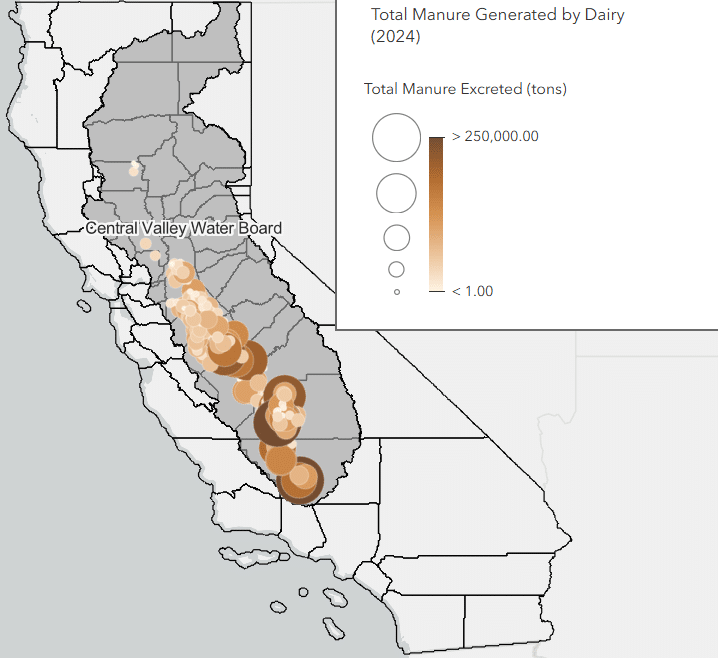
Ten million tons of animal manure in the Golden State are unaccounted for, the report finds, thanks to a combination of non-compliance, non-enforcement and opaque disclosure rules. It is not known from public information where the manure went, says Zoe Robertson, JD candidate at Stanford Law and an author of the white paper, but some may well have ended up directly or indirectly in lakes, streams and other public waters.
Lax regulation of factory farm pollution in the United States isn’t unique to California. Factory farms, also known as concentrated feeding operations (CAFOs), produce enormous amounts of pollution, yet federal laws to reduce it are limited in scope and riddled with loopholes. Even in states with ostensibly stricter regulatory regimes, like California, CAFO pollution frequently goes unchecked and unregulated.
“California has some of the most factory farms in the country of any state, but it’s really not part of our primary identity,” Lewis Bernier, lead researcher at the Factory Farm Watch project, tells Sentient.
But it most definitely is an agricultural state, and the ways in which California’s factory farms have dodged — or in some cases, simply decided not to comply with — pollution regulations is a discouraging, but informative, illustration of how factory farms around the country do the same. Shining a light on these regulatory lapses also offers clues as to how lawmakers, state agencies and farm operators can do better in the future and minimize the destructive impact of their facilities.
California has more factory farms than all but five other U.S. states, according to the Environmental Protection Agency. It’s one of the top five cattle-holding states and top 15 egg-producing states in the country, according to the USDA. Dairy farms are an especially big business in the Golden State: There are more dairy cows and farms in California than anywhere else in the United States, which makes it the top milk-producing state in the country as well.
There’s no doubt that factory farms have a serious presence in California, but the closer you look, the fuzzier the picture gets. For instance, the EPA maintains that there are a total of 1,053 CAFOs in California. But “the EPA is not transparent at all about how they came to that number, and they don’t have a publicly-released list of those 1,000-something farms,” Bernier says.
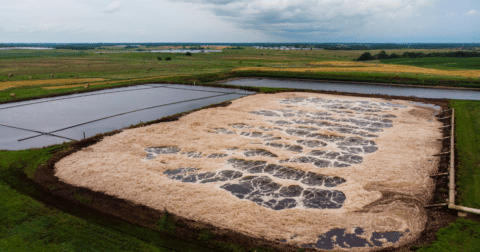
American livestock produce around941 billion pounds of manure every year, and it has to go somewhere. Much of it is applied to fields as fertilizer, which can allow the nitrogen in the manure to leach into the groundwater and end up in lakes, rivers, streams, groundwater and wetlands. According to the National Resources Defense Council, agriculture is the leading source of pollution in streams and rivers in the U.S., and the second-leading source in wetlands.
Agricultural pollution from manure contains certain compounds, like nitrogen and phosphorus, too much of which can contaminate drinking water, cause harmful algal blooms, and harm ecosystems. It can also contain antimicrobial-resistant bacteria that can threaten human lives. For these reasons, efforts to rein in factory farm pollution often focus on manure management.
At the federal level, the Clean Water Act governs water pollution in the United States. It requires certain facilities that dump pollution directly into waters of the US to obtain a discharge permit, which places some limits on the amount of pollution allowed. But federal law allows states to establish their own standards and distribute permits, so long as their standards are as strict or more so than the Clean Water Act.
But less than one-third of all factory farms in the United States actually have a pollution discharge permit, since a number of loopholes allow them to avoid these regulations altogether. Even farms that do have permits are often able to evade their requirements without consequence.
California has opted to distribute discharge permits and enforce the Clean Water Act’s discharge regulations at the state level, which is done by the state Water Resources Control Board. This board oversees nine regional water boards. They develop the permit rules and enforce discharge regulations for their regions of the state — and all too often, they don’t do a very good job at either.
As a major dairy state with several levels of regulation, California is a case study of the ways in which farms can slip through the regulatory cracks, even in states with ostensibly high levels of CAFO regulation.
The water boards do not impose sufficient reporting requirements on factory farms, Robertson tells Sentient. Because of this, “it’s actually difficult to evaluate the full impacts of industrial animal agriculture on state water quality,” she says. Even though the reporting requirements are “minimal,” she says, she sees what she calls an “underwhelming level of compliance” on the part of factory farms.
Each of the nine regional water boards in California have different standards and enforcement mechanisms for the facilities in their jurisdiction. The Stanford white paper looked at the five regions with the most factory farms — covering 99% of the state’s factory farms — in an attempt to determine how well-regulated they actually were. The answer was: not very.
Sometimes, farms didn’t follow the rules; other times, they did follow the rules, but the rules were dubious or questionably lax. And other times, they broke the rules and simply weren’t penalized for it.
California farms frequently underreport the amount of manure their animals produce, sometimes reporting amounts that are biologically impossible, the study found. One farm in the Colorado River Basin reported producing less than 1% as much manure as expected given the number of cows it houses, while another in Santa Ana said that it produced no manure at all — despite housing 570 dairy cows.
When farms do report their manure, each regional board uses a different formula to estimate how much manure a single cow is expected to produce. These formulas aren’t public, and some of them don’t square with federal USDA estimates. The regional water boards in Santa Ana and the Colorado River Basin, for instance, estimate that an adult dairy cow produces 4.1 tons of manure every year — a number just one-fifth of the USDA’s official estimates.
Transparency and compliance is also lacking around where manure goes. ‘Manure manifesting’ is a common practice on farms in the United States, and California is no exception. Manifesting is when large factory farms transfer some or all of their manure to farms that aren’t subject to manure disposal regulations. In some cases, the secondary farm is owned by the factory farm itself.
Three of California’s regions covered in the report don’t require farms to reveal where they’re sending their manure, and even farms in the two regions that do often fail to comply with this requirement. One farm located in the Central Valley, which does have such a requirement, acknowledged that it manifested 1,380 tons of manure in 2023 — but didn’t say where. Omissions of this sort are common, Stanford’s researchers found.
Then there’s wastewater. On farms, this typically refers to water that’s used to wash animals and clean their facilities. It’s not realistically possible to run an animal farm without producing some amount of wastewater, which often contains the same pollutants as the animals’ manure and can contaminate nearby waterways if it’s not disposed of properly.
Yet three of the five regions the study examined don’t require farms to report how much wastewater they create, and in the two regions that do have such a requirement, factory farms frequently underreport it. In 2024, for instance, 14% of dairy farms that the study analyzed reported producing no wastewater at all, even though those farms had an average herd size of 313 cows.
Finally, the researchers sought to identify whether farms faced any consequences when violating these regulations. But even answering this question was difficult, Robertson says, because “the regulations seem to not specify whether the water boards have to record enforcement actions or violations.”
“The water board does have authority to issue civil fines or have hearings, but we didn’t see evidence of those things being done,” Robertson says. There is certainly no public-facing record of them, she says.
Nevertheless, there was some evidence that when farms violate their permitting regulations, they don’t always face consequences. Two of the five regional boards logged zero violations by any of their farms in the last five years, even though Robertson and her colleagues found, in her words, “pretty strong evidence” in the farms’ annual reports that some of them had violated regulations in 2023 and 2024.
Stanford researchers didn’t stop at identifying the lapses in factory farm regulation. They also proposed some concrete solutions for cutting down on them in the future.
“We tried to introduce solutions that are authorized by the law and also relatively feasible,” says Robertson.
First, Robertson and her co-authors recommend that all farms be required to submit annual data on three key aspects of their operations: wastewater, the nutrient content of their manure and the quality of groundwater at nearby wells. The reporting requirements should be standardized across all nine water boards, they say, instead of the current patchwork of different rules for different regions. Furthermore, farms should be required to submit the laboratory analysis and manure tracking paperwork to back up their annual reports, Robertson says.
Statewide, the California Code of Regulations does mandate that factory farms’ annual reports include one of these metrics: their average daily volume of facility wastewater, Robertson says. But “it seems like this regulatory requirement did not trickle down” to all of the regional water boards, she says, because three of the five regional boards that her team examined do not include this on the discharge permits that they issue to farms, and as a result, farms do not report it.
Second, the paper’s authors argue for stricter rules on manure reporting. Farms don’t actually measure all of the manure their animals create; rather, they use a formula to estimate their annual manure prediction based on how many animals they have, how old the animals are, what they’re being used for and other factors. This formula is called a manure conversion factor.
The researchers identified several problems on this front. First, some regions require farms to use a manure conversion factor that’s much lower than what the science suggests regarding cow biology. Regions 7 and 8, for instance, use a factor of 4.1 tons of manure per adult dairy cow, but the USDA estimates that such a cow actually produces 20.34 tons per year. Some regions, meanwhile, allow farms to use their own manure conversion factors and don’t require any evidence of how they arrived at those factors.
To cut down on this, the researchers argue that factory farms in California should all be required to use one scientifically-validated set of manure conversion factors for their animals. If necessary, the regional boards could request additional studies of all the different types of livestock animals in the state in order to craft these factors.
Third, Robertson and her co-authors argue that all of these rules need to be enforced more strictly. They advocate for increased monitoring of farms and their reporting to ensure compliance, and more aggressive penalties for violations.
Finally, the researchers say, all of this information ought to be more readily accessible to the public. Tracking down ostensibly public information, like the farms’ annual reports on their operations, was often a challenge, Roberstson says.
“These reports are difficult to get,” she says. “We had to sometimes email the water boards a couple of times to get the information. Some of the regional boards actually told us that we should come in person to get the annual reports — and we’re in the 21st century — because we had to log on to their on-site computer. So that’s why one of our strong recommendations is to actually make these publicly accessible.”
Ultimately, the ways in which California CAFOs skate past regulations is a microcosm of the country’s generally lax attitude toward factory farm regulation. In addition to all of the loopholes mentioned above, factory farms in the United States are also excluded from federal animal welfare laws, as well as laws that require other facilities to report accidental spillage of hazardous waste. They’re not required to track or report their greenhouse gas emissions, and labor violations at CAFOs are common and widespread.
The Stanford paper illustrates how California’s farms dodge regulations, and Robertson hopes state regulators will take its findings into account as they continue to update and refine their policies.
“The water boards are actually in the midst of a process to reform the requirements on dairies,” Robertson says. “I’m hoping that the water boards will take these suggestions into account.”
Seth Millstein is a writer and musician living in the Bay Area. He has helped launch several early-stage journalism startups, including Bustle and Timeline, and his work has been published in Bustle, Huffington Post, The Daily Dot and elsewhere.

News
Climate•7 min read

Feature
After decades of recovery from commercial whaling, climate change is now threatening the whales’ future.
Climate•6 min read

Review
A new book makes the case for investing in cultivated and plant-based meat.
Climate•4 min read