Investigation
‘You Feel Like You’re Marked’: Salvadoran Workers at Tyson Foods Face Risks Due to Work Permit Delays
Policy•9 min read
Solutions
In the absence of federal leadership on climate emissions from food, US cities are stepping up.

Words by Grace Hussain
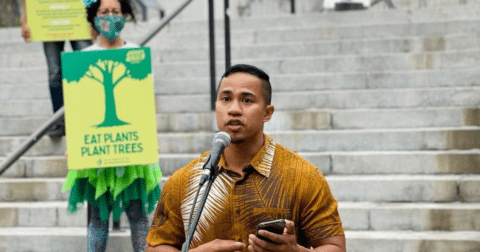
With RFK, Jr. encouraging Americans to eat more saturated fats from meat and dairy and the Trump administration expanding beef imports to meet consumer demand, the current federal government is unlikely to shift policy toward eating more plants — a move climate scientists agree is necessary to mitigate climate change. Organizations like Plant Based Treaty and cities like West Hollywood, California are stepping up into this policy void to sway their constituents’ eating habits and cut emissions.
Endorsed by 63 municipalities worldwide, from Amsterdam to Belém, the Plant Based Treaty is a citywide commitment to encourage eating more plants and less meat. West Hollywood adopted the treaty in October 2024. Since then, the city government has expanded its commitments to plant-based diets and its constituent outreach about dietary changes, for example inviting the community to a Food Day during the city’s climate week.
Moving toward plant-forward diets fit well with West Hollywood’s climate action plan, adopted in 2021, says Mayor Chelsea Byers. The city wanted to make it easier for residents “to buy into this idea of lowering our collective emissions and making more thoughtful choices as individuals,” she tells Sentient. “That was a way that the city’s policies, resolutions and practices could all align.”
Shifting diets away from meat and dairy and toward plants is essential to mitigating climate change. Livestock are responsible for 30% of the food system’s greenhouse gas emissions and the way the world currently eats is enough to push warming past climate goals.
The climate is just one of many reasons to embrace plant-based diets, says Kimmy Cushman, campaigner and scientific advisor at the advocacy group Plant Based Treaty. She also points to the meat industry’s myriad other environmental impacts, including land use, deforestation and pollution.
Signing onto the Plant Based Treaty means making a non-binding commitment to support plant-based eating. The treaty offers 40 different ways to fulfill that commitment across three focus areas: promoting plant-based diets and a transition away from animal-based food systems, halting the increasing production of meat and dairy and restoring ecosystems.
The Plant Based Treaty organization works with each city to create a food action plan tailored to its political and economic situation, says Cushman. “Then we continue to work in the community and with our local grassroots teams to help them implement the food action plan and then also expand upon it.”
The goal is to enact policies to make choosing plant-based options easier, not to tell individuals to change their diets, Cushman tells Sentient. It’s an approach that helped win over West Hollywood’s city council. At a public hearing, Councilmember Lauren Meister, who ultimately voted to endorse the treaty, said that the treaty is not intended to force change to the city’s diet, “but that hopefully it changes because we learn more.”
One of West Hollywood’s largest changes has been purchasing more plant-based foods and less meat. Last year the city catered roughly 20 events that were fully plant-based, such as Transgender Day of Remembrance and an awards reception for women in leadership.
The change has saved the city both money and emissions, says Mayor Byers. The city is currently working with the animal advocacy group Mercy for Animals to calculate the exact savings of their transition. Rough calculations by Plant Based Treaty suggest that, just for the 2,500 meals served during climate week in April, switching from a standard diet containing animal products to plant-based foods prevented about 26,000 pounds of CO2 equivalent emissions.
West Hollywood had actually committed to plant-based default foods at city events several months before adopting the Plant Based Treaty — a decision made after a year of engagement with Mercy for Animals, says Alex Cerussi, senior state policy manager for the nonprofit, who worked on the campaign.
Plant Based Treaty continues to work with city officials and grassroots organizers to support more plant-forward policies. They organized a Food Day during the city’s climate week to build awareness surrounding plant-based diets.
Currently, the city is discussing ways to incentivize co-sponsored events to adopt plant-based menus as well. For example, the city could offer higher financial commitments for events that are plant-based, says Byers. “If you encourage and incentivize people to do it, rather than forcing people to do it, there’s a lot more interest in moving in those directions. So by working more directly with our co-sponsored organizations, we’ll have a huge new realm of partners that are engaging thoughtfully in this work,” she tells Sentient.
West Hollywood also plans to encourage food and nutrition assistance nonprofits in the city to offer more plant-based foods. Grants to such social service organizations are awarded every three years, says Mayor Byers, and the city is exploring how to implement policy change when current grants are up for renewal.
West Hollywood has been one of Plant Based Treaty’s great success stories, but the nonprofit has faced some challenges elsewhere. Ellen Dent, a campaigner with Plant Based Treaty, speaks specifically of Boynton Beach, Florida, the first city in the world to officially adopt the Plant Based Treaty in 2021. Dent says she’s aware of little progress being made since then.
Dent attributes the lack of engagement with the organization to the absence of a grassroots movement within the city. Originally, the city had a champion, but when that person moved, the initiative lost steam and has only recently been gaining momentum again, says Dent.
“It’s all volunteer run,” Cushman says. “It’s community organizing, essentially grassroots organizing, that makes everything run.” While the global campaigns team can offer support, they work with several communities at a time and often don’t live in those communities. Plant Based Treaty now has a new local organizer in Florida who lives near Boynton Beach. They hope that will enable them to pick up momentum and resume building grassroots power there.
A representative from Boynton Beach’s sustainability team responded by pointing to the city’s efforts on overall sustainability rather than on food specifically in the years since 2021. “Since endorsing the treaty, the City has built robust educational and incentive programs on water and energy conservation, waste reduction, tree canopy enhancement, and resilience to ensure that we are reducing environmental impacts,” the representative tells Sentient via email. The city offers links to resources on “greening your plate” on its sustainability website.
West Hollywood has a population of about 36,000 residents. Dietary change needs to happen on a much larger scale in order to reduce emissions significantly enough to mitigate climate change.
“With our local teams, with the local food policy, with the education that we do, the public information campaigns, all of that is about shifting the food environment to make plant-based food the center of our food environment, and make it the easiest choice and the most accessible choice,” Cushman says.
The hope is to scale up these efforts. Ultimately, Plant Based Treaty would like to see an international treaty aimed at shifting the food system to plant-forward diets.
According to Cushman, Plant Based Treaty is currently in negotiations with several countries interested in endorsing the treaty. She declined to confirm which countries, to avoid influencing negotiations.
As a progressive city in a progressive state, West Hollywood is used to leading the way, says Mayor Byers. “It was absolutely significant to me that we would make this sort of adjustment and start to align our food procurement strategy and the way we talk and think about food more in line with climate,” she says, adding that West Hollywood is excited to continue sharing this policy with other cities and hopes to see it spread across the state.
Grace is Sentient's Solutions Correspondent, reporting on alternatives to factory farms and ways to fix the problems they cause. She is a member of the 2024 Solutions Journalism Network climate cohort. Her work has been published by Truthdig and The Guardian and translated into radio coverage by the BBC and Public News Service, reaching millions of listeners. Grace holds her MS in Animals and Public Policy from Tufts University and is currently working on her PhD in Environmental Science and Policy at the University of Miami.
News
Factory Farms•6 min read
News
In a new poll, 82% of Iowa voters want their elected official to protect clean water and cut pollution from industrial agriculture.
Elections•5 min read

News
But the bill faces steep odds of passage in a sharply-divided Congress
Policy•8 min read