Feature
American Horses Are Still Being Slaughtered for Meat
Food•7 min read
News
The largest privately held company in the United States is refusing to concede to workers’ demands for more dignified workplace conditions, including protected bathroom breaks.

Words by Grey Moran
The town of Fort Morgan — just over 5 square miles along the northeastern plains of Colorado, with a population of around 11,900 — has emerged as the center of a pivotal labor dispute with the largest privately-held company in the United States: Cargill.
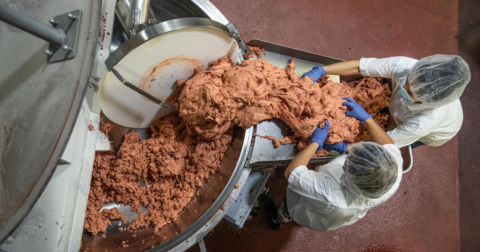
As one of the “Big Four” meatpackers that corner the U.S. market, Cargill produces about one-fifth of the nation’s beef, with six primary U.S. beef processing plants. Its slaughterhouse and processor in Fort Morgan is colossal in its own right. The town’s largest employer, it covers 85 acres and processes around 4,000 cattle a day — at least, it did until recently. This economic engine has shuttered as the company has halted production and indefinitely locked out its workers, putting their livelihoods on the line.
“We’ve got 1,700 union members, and then I look at that as 1,700 families…that’s like 8,000 people that are depending on us to do the best job we can, and set these members up for success in the future,” says Chris Suazo, a business agent for Teamsters Local 455, which represents the plant’s meatpacking workers. “It’s a lot of pressure.”
As negotiations grew tense in late April, Cargill stopped sending cattle to slaughter without notice, leaving workers confused and with shortened hours.
“They stopped production a month before they locked us out,” says Suazo. “We were waiting for the company to come in [for negotiations] and then we were starting to get calls from members at the plant saying, ‘Hey, there’s no cows here today. There’s no cows here.’’’
According to Cargill, this decision to halt production was made in anticipation of a “work stoppage” — i.e., a strike. “Before the lockout began, Cargill adjusted production schedules at the Fort Morgan facility on April 23 because the union had indicated it could call an immediate work stoppage during contract negotiations,” Hli Yang, a senior communications manager at Cargill, tells Sentient in an email.
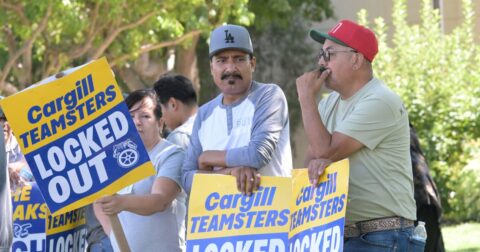
But workers did not initiate a strike. Instead, Cargill locked workers out of their jobs on May 20th, after the company presented the union with a final offer, which didn’t include their core demands: higher wages to keep up with inflation, protections from penalizing workers or replacing them with automated technology and protected bathroom breaks, according to Suazo.
After overwhelmingly voting against this offer on May 19th, the union asked Cargill to modify the proposal or return to the negotiating table, but the company’s “immediate response was to lock us out,” says Suazo. “It feels to me like they’re just trying to bully the membership into taking a substandard deal.”
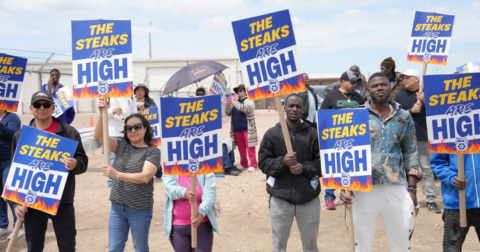
Despite what they see as Cargill’s punitive, escalating tactics, many of the locked-out union members have assembled every day from 7 a.m. to 7 p.m., forming picket lines throughout the town, carrying signs that read “The Steaks Are High.” They are calling to return to their jobs and the negotiating table without scrapping key demands, such as protections when exercising their right to use the bathroom.
“A lot of people don’t believe me when I tell them. Our people are having a hard time just going to the restroom on the line. We literally had to arbitrate this in 2017. The arbitrator ruled with us that our people do have a right to go to the bathroom, just like anybody else in America,” Dean Modecker, the secretary-treasurer of Teamsters Local 455, told a local Denver radio station. Yet the company has not honored this, according to Modecker and Suazo.
This Cargill plant’s bathroom policy, first established in 1987, states that workers “have the right to go to the restroom when necessary.” This comes with the stipulation that “you must, however, first request permission from your supervisor, and give them a reasonable amount of time to find someone to replace you. That reasonable amount of time is specifically stated as five to ten minutes. At that time, if not relieved, you may go to the restroom without discipline.”
Under federal law, all U.S. workers are guaranteed the right to “prompt access” to the bathroom, yet Cargill’s “culture of retaliation and intimidation,” as Suazo puts it, makes it so workers fear exercising this right. “The supervisors threaten to fire them, threaten to write them up, you know, things of that nature,” he says.
As a result, “we had three members since December, you know, essentially wet their pants under this one supervisor,” says Suazo.
“We take any allegation that employees were prevented from using the restroom or threatened with discipline for taking appropriate restroom breaks seriously,” writes Yang. She claims that “employees won’t be disciplined for taking appropriate restroom breaks consistent with facility procedures.”
This lockout follows the first major strike in meatpacking history in 40 years, when 3,800 workers in Greeley, Colorado walked off their job. The 3-week JBS strike ended up resulting in a wage increase of $1.50 over the course of two years and a new policy preventing the company from garnishing wages for personal protective equipment, reported Labor Notes.
Cargill’s lockout has now dragged on for nearly a month. If workers were to concede, it would compromise their pay for the next five years. Cargill has offered a $2.15 boost over the course of five years, according to Suazo. Union members would like about double this increase, comparable to the $4.50 increase in their previous five-year contract, which expired in February.
The union recently filed unfair labor practices charges against Cargill, claiming that the lockout is illegal and an attempt to artificially depress wages.
The lockout has stalled the economy of the entire town. Downtown businesses have suffered. As the Colorado Sun reported, the town’s municipal utility is losing out on revenue from Cargill, which typically consumes “around 2 million gallons of city-owned water per day and about a third of all of the city’s electricity usage during summer.”
The workers have been joined by many locals and their families, carrying food and signs of support, along with a number of local politicians. “You deserve, and this is my message to Cargill, a partner who is at the table working to get this deal done,” Colorado’s Attorney General Phil Weiser said, in a message from the picket line.
“What I saw was really inspiring. I saw families, above all else, dozens and dozens of families, most of them of immigrant backgrounds, from Latin America, from Haiti, from Sub-Saharan Africa,” says Tyler Quick, a former union organizer who is running for Adams County Commissioner and joined Cargill workers in early June.
“Cargill remains committed to reaching an agreement through continued good-faith negotiations and would support a joint meeting with a mediator,” according to Yang. However, she also confirmed that the company has not changed their offer. “While our last, best and final offer remains our position, we continue to be open to discussing how the overall contract economic package could be structured in different ways.”
This dispute comes less than a year after Cargill announced it would invest $90 million in automation technologies in the Fort Morgan plant, as part of the company’s “Factory of the Future” initiative. The company has installed an AI-powered network of cameras to “guide how we cut, so we can keep more of the product where it belongs, in the food supply,” according to Cargill’s Leon Fletcher, in a video advertising the technology, known as CarVE.
Cargill bills this system as reducing food waste and improving efficiency, but the technology’s continual feedback to workers and supervisors has raised concerns among labor advocates about how this tool could be wielded to isolate, overwork and even replace employees. Tyson, another “Big Four” meatpacker, uses AI-powered systems developed by Palantir, which has prompted similar concerns over this technology being deployed to maximize production at the expense of workers’ rights and privacy.
“If Cargill was truly concerned about workers’ productivity they would be equally excited to pay their workers a fair and living wage,” wrote Quick, in a follow-up text message to Sentient. “I’m afraid what they really care about is control. And that alarms me especially when so many of their workers’ immigration status is tied to employment.”
The technology uses a color-based system to constantly monitor and rank each worker’s individual performance. According to Suazo, green indicates that you’re doing well; yellow indicates that there’s room to improve and red means you are not meeting a standard. For instance, if workers leave too much meat on the carcass, their ranking might turn to yellow.
This ranking system is displayed so workers not only see their colors, but also the rest of the crew’s colors. “If you’ve got a person that’s always in red, everybody’s going to see,” says Suazo. “It might not have their name, but you know where that person’s position is.”
CarVE has not been used to penalize workers, but the union is concerned about this possibility. In the contract negotiations, “we pushed for that it not be utilized to discipline members, and as of right now, it’s not, but they wouldn’t commit to that,” says Suazo. Cargill also refused to agree to a provision that protects workers from being laid off if emerging technology replaces their jobs and provides them with other work in the plant, says Suazo.
“The union proposed broad language related to technological changes and cited CarVe as one example. Cargill did not agree to that language,” writes Yang. “It is intended as a coaching and learning tool to help employees strengthen skills and improve consistency — not to monitor, replace or discipline people.”
This may be revisited in future negotiations, but for now, the union is most focused on ensuring the workers’ basic needs are met as picket lines form from dawn to dusk. They are waiting on Cargill to return to the table, ready to talk.
“We’re willing to listen and we’re willing to negotiate. We were willing to work,” says Suazo. “They were the ones that stopped bringing cows, and they were the ones that locked us out. So it’s kind of hard to, you know, be the only person wanting to dance.”
Grey is an award-winning investigative journalist with Sentient who is based in Durham, North Carolina. They have written for Civil Eats, The Guardian, The Atlantic, The New Republic, Al Jazeera, The New York Times, The Intercept, Guernica, The Nation, New York Magazine, Popular Science, Mother Jones, The American Prospect, Teen Vogue, Grist, Autostraddle and The Center for Public Integrity. Their articles have been anthologized in No Planet B, published by Haymarket Books, and The Best American Food Writing, edited by Mark Bittman.

Feature
Fisheries & Aquaculture•9 min read
Investigation
JBS and Cargill plants across the country are accused of pressuring unions into either accepting the same low wage structure, or mere nickels apart. The result? The largest meatpacking strikes…
Food•13 min read
Feature
In Nebraska, Blackshirt Feeders LP is building the country’s largest feedlot for 200,000 beef cattle on a square-mile slab of concrete.
Food•31 min read