Investigation
California Pays Farms to Make Biogas from Hog Waste in North Carolina, Where Locals Say It’s Fueling Pollution
Climate•17 min read
Review
A new book makes the case for investing in cultivated and plant-based meat.
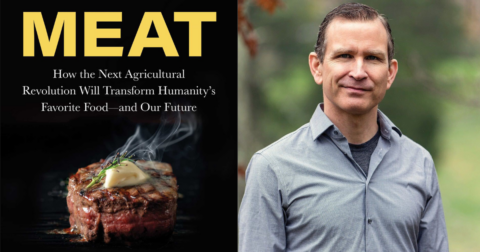

Words by Jessica Scott-Reid
In the last few years, the industry developing cultivated meat, still sometimes referred to as lab-grown meat, has taken quite a few hits. But a new book by Bruce Friedrich, the founder and president of the Good Food Institute, or GFI, a nonprofit think tank that advocates for alternative proteins, is the latest pitch for these foods as a critical part of the solution to the harms of conventional meat.
With deep passion and a touch of desperation, Friedrich has written Meat, How The Next Agricultural Revolution Will Transform Humanity’s Favorite Food — and Our Future. Detailing animal agriculture’s impacts on rainforests, climate, antibiotic resistance, food insecurity, pandemic risk and more, Friedrich precisely catalogues the evidence of meat’s many impacts in a pragmatic plea to readers to give plant-based and cell-cultivated alternatives a real chance.
Friedrich also recognizes that regardless of these facts — even despite them — humans still love meat. The answer to this problem, argues Friedrich, is to change the way meat is made, rather than how much meat people eat. “Eating less meat seems about as appealing as consuming less energy or driving less,” he writes. “But many of us have shifted to an electric vehicle or installed solar panels on our houses.”
Though the book is hopeful overall, Friedrich doesn’t shy away from discussing dilemmas surrounding meat alternatives. In his self-described “alt meats evangelical fervor,” he is sure to note that plant-based and cultivated meats are no silver bullet, at least not yet. Drawing from food science and human psychology, he argues that it will be critical to achieve taste and price parity for these products to succeed. If you can’t reach those benchmarks, nothing else much matters. Because for most people, he writes, “food is not an ethical decision.”
In the early days of GFI in 2016, Friedrich hired senior scientist Liz Specht, who would later become the organization’s first vice president. She started out skeptical, Friedrich writes, of the commercial viability of cultivated meat. But then, “she devoured the science,” of tissue engineering and biopharma. “And after all this research, her mind changed; she emerged optimistic.”
Friedrich also recounts how plant-based pioneers Impossible and Beyond Meat developed their products. “In 2009, two men with the same last name had the same radical idea: ”What if plants could be used to make meat? Not veggie burgers. Not tofu dogs. But food that meat lovers would actually want to eat.”
What really made Beyond’s and Impossible’s products different, writes Friedrich, is their deep investment in dedicated scientific research to create a better-tasting and better-performing product. That’s different from a number of plant-based companies who largely focused on making foods that could be marketed as “clean” and healthier, without much investment in the research or development.
Alternative proteins, Friedrich reminds the reader, were a whole new category of food. “From science fiction to science fact,” he writes, and with that came the challenge of tackling public perceptions around meat alternatives. “The concern is that consumers might not like the idea of meat produced in factories,” he writes (a valid worry that the meat industry has taken full advantage of). But he also says he’s not worried, citing multiple surveys to make the case: “As more people become familiar with the idea and have the chance to taste the product, consumer enthusiasm will only grow.”
Finally, Meat ends with an appeal to the thinkers, marketers, investors and policy makers. Get on board, he urges, with the commonsense climate solution that is not only necessary but inevitable. “At the end of the day alternative meats will scale through the private sector,” Frederich argues. “Alt meats represent a multi-trillion-dollar opportunity for savvy entrepreneurs,” with ample spaces for growth, he adds. “I’d like nothing more than to see some of them taken up.”
If this sounds far-fetched, Friedrich reminds us of other innovations that took a few decades to become mainstream, like the automobile. Even today’s EVs are still a small share of the marketplace, yet their role in bringing down emissions is clear. Alternative proteins are just as critical, even if there are still technological, economic and cultural barriers to overcome before they can become not the meat alternatives of the future, but just . . . meat.
Jessica Scott-Reid is Sentient's Disinformation Correspondent covering disinformation, misinformation and the impact of both on culture. A freelance journalist based in Canada, Jessica has covered animals, the environment and food systems for major media in Canada and beyond, for the last decade. Jessica has been a contributor to Sentient since 2019, and her work also appears regularly in The Globe and Mail, Toronto Star, Winnipeg Free Press and Corporate Knights Magazine.
News
Climate•9 min read

Investigation
Nitrate pollution is straining small water facilities in Iowa, even when they have advanced filtration systems.
Climate•8 min read
Feature
The Department of Natural Resources division responsible for environmental oversight of 8,000 CAFOs hasn’t received a budget increase since 2016.
Climate•9 min read