Investigation
Trump Made Meatpacking Investigation a Campaign Promise but Antitrust Staff Has Been Gutted
Policy•12 min read
Explainer
Rooted in indigenous stewardship, the NANI Act would have joined a growing movement to grant ecosystems inherent legal rights.

Words by Seth Millstein
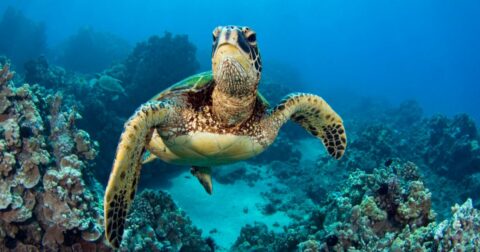
Can a coral reef be a person? It might sound absurd, but over the last 20 years, ecosystems around the world have been granted legal personhood, giving them stronger legal protections than existing regulations offer. New Zealand’s Whanganui River, the Mar Menor Lagoon in Spain and the Klamath River in California are just a few habitats that are now people, in the eyes of the law.
Earlier this month, Hawai’i lawmakers voted down the Nā ʻĀina no Iʻa Act (NANI Act), a bill that would have granted legal personhood to coral reefs and watersheds and given their respective “ecosystems inherent and inalienable rights to exist, flourish and naturally evolve,” Hawai’i State Sen. Mike Gabbard, chair of the Agriculture and Environment Committee, tells Sentient in an email.
“It would have qualified watersheds and coral reef ecosystems to be represented in court, similar to how animals can be represented under the Endangered Species Act,” Gabbard adds.
Hawai’i is home to around 85% of all coral reefs in the United States. The reefs support around one-quarter of all marine life and provide refuge, food and nursery for over a million marine species. Coral reefs also supply tangible benefits to human communities as a source of food and medicine and by driving local tourism.
Because of their complex structure, coral reefs provide natural protection for coastal communities from storms and flooding by absorbing a significant amount of a wave’s energy. This safeguards an estimated $836 million worth of property and economic activity in the state every year, the U.S. Geological Survey estimates.
But in Hawai’i and elsewhere, coral reefs are under threat on several fronts. Carbon emissions are causing the ocean’s temperature to rise, and hotter oceans can cause coral bleaching, in which coral expel the symbiotic algae they host, a process that can be lethal to the coral. Ocean acidification from global warming is weakening coral structures, and overfishing is depleting local fish populations and disrupting the balance of the ecosystems that coral reefs provide. At the same time, coastal development and runoff from industrial farming are physically damaging the corals and polluting their waters.
Environmental personhood is a legal tool that can provide additional protections to natural habitats and ecosystems when existing regulations fail. It falls under the broader rights-of-nature movement, which seeks to grant ecosystems the legal right to thrive and persist in their natural state without any interference or damage.
“Right now, what we have is environmental regulations,” Ben Price, education director at the Community Environmental Legal Defense Fund, tells Sentient. “If they were working great, then we wouldn’t need rights-of-nature.”
Critics have long accused environmental regulations of being weak, inconsistent or poorly enforced. But Price, who helped craft one of the first rights-of-nature laws in the U.S. almost 20 years ago, argues that the problems run even deeper. A regulation places limits on the amount of pollutants a facility may release into the environment. In other words, they explicitly allow permitted facilities to cause pollution and environmental damage, as long as it’s within certain limits.
Take water pollution by factory farms, for example. Even though agriculture is one of the leading causes of water contamination worldwide, the EPA doesn’t prohibit, and instead limits, the amount of specific pollutants allowed in discharge and runoff. And the permits issued to regulate the pollution are often unenforced.
“Environmental regulation says, ‘we’re going to put a limit on how much harm can be done by any permit holder,’” Price says. “What we’re regulating is the rate of destruction of nature, how fast we’ll do it. Not whether or not we will, but how fast.”
In contrast, environmental personhood “aims to give ecosystems legal standing to defend their rights in court,” Maxx Phillips, attorney at the Center for Biological Diversity, tells Sentient in an email. “While such frameworks vary in detail, they share the goal of enabling accountability for harm and strengthening opportunities for long-term ecological protection.”
Environmental personhood laws around the world often draw on local Indigenous principles of land stewardship, and the NANI Act was no different. The bill stated that coral reefs and watersheds would be allowed to flourish in accordance with “Kanaka Māoli traditional and customary cultural values, practice, and worldview, including the notion and practice of malama aina.” Kanaka Māoli are the Indigenous people of Hawai’i, and Mālama ʻĀina refers to their practices of caring for and sustainably using natural ecosystems.
“In [the NANI Act], watersheds and coral reefs would be given rights to exist, flourish, and naturally evolve, and courts could issue injunctions or require restoration when those rights are violated,” Phillips says. “The bill frames these rights in a way that draws on Native Hawaiian concepts of stewardship, accountability and reciprocal responsibility to place.
If and when these rights were violated, individuals would be allowed to sue on the reef’s behalf, and courts would have the power to issue injunctions and order that the reef be restored, to the greatest extent possible, to its previous state.
“Any individual, public agency, or private entity may bring an action against another individual or entity that violates or attempts to violate the rights of an ecosystem person in the State,” the bill read, “and courts may order injunctive relief, moratoria on harmful activities, restoration plans, monitoring, penalties proportionate to harm, and long-term stewardship obligations.”
Although the NANI Act didn’t succeed, it offers a radically different way of viewing ecosystems and our relationships with them.
“This approach is not about treating nature as property, but about creating legal tools that recognize and protect ecosystems as living systems integral to community wellbeing,” Phillips says.
Gabbard’s office tells Sentient that, although the NANI Act is dead for now, there’s a chance it could be reintroduced in the next legislative session.
Seth Millstein is a writer and musician living in the Bay Area. He has helped launch several early-stage journalism startups, including Bustle and Timeline, and his work has been published in Bustle, Huffington Post, The Daily Dot and elsewhere.

News
Factory Farms•4 min read
News
Riverview’s mega-dairy expansion in Morris would store 250 million gallons of liquid manure and use water volumes equal to 75% of the local supply.
Climate•4 min read
News
The administration says animal welfare laws in California are raising egg prices nationwide.
Policy•6 min read