Feature
What Is Animal Welfare Worth? Economists Have a New Way to Calculate It
Research•7 min read
Feature
The genetics sales event, where embryos are sold for $200K, is a stark contrast to the ‘natural’ image the meat and dairy industry wants consumers to believe.


Words by Jessica Scott-Reid
Amid the cow-shaped ice sculptures at the 20th annual Embryos on Snow event in Colorado, buyers in cowboy hats bid on the genetics shaping the future of America’s cattle industry, from frozen embryos to semen. Auctioneers tout breeding programs, semen collection company sponsors and even “pregnancies for you to purchase” from a steadily growing sector of the livestock industry: assisted reproductive technologies.
At the National Western Stock Show, this premier event sold cattle embryos for an average of $2,760, up to $26,000, this year. Bull semen sold for an average of nearly $10,000 a unit, with the highest lot going for $200,000.
What happens at Embryos on Snow and other genetics sales is a stark contrast to how meat and dairy are marketed today. Portrayals of food and farming in the U.S. often emphasize the “naturalness” of meat and dairy, yet in reality, much of the industry is shaped by intensive confinement, genetic manipulation and assisted reproductive technologies.
Proponents say that assisted reproductive technologies in animal agriculture, including in vitro fertilization, artificial insemination and embryo transfer, can improve efficiency, increase sustainability, benefit animal welfare and boost the odds that high-value genetic traits are inherited, such as increased calf and milk production. However, some bioethicists and animal advocates worry these benefits only tell part of the story.
“It is quite difficult to really distinguish between the nice words and the ideals and aspirations” of assisted reproductive technologies, Koen Kramer, bioethicist and assistant professor in animal ethics at Utrecht University, tells Sentient, “from what’s actually happening.”
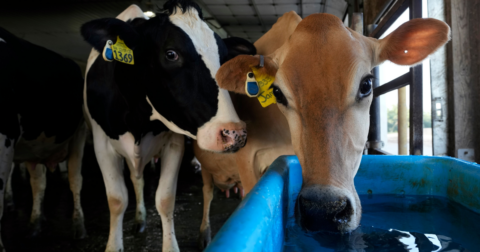
Despite the familiar image of cows on grassy, open fields, living and perhaps breeding in natural ways, the reality is different. High-tech assisted reproductive technologies are a growing agricultural sector for farmers seeking higher milk production and more and higher-value offspring. These methods of selective breeding typically include in vitro fertilization, artificial insemination and embryo transfer. In vitro fertilization is when the embryos are developed outside of an egg “donor” cow’s body before inserting one or more of the embryos into a surrogate female’s uterus. Embryo transfer is performed when a “donor” cow’s embryos are fertilized by artificial insemination, flushed out of her, and then inserted into a surrogate cow to carry to term. This way, a high-value cow can produce more calves. Flushed embryos sold for as high as $50,000 at Embryos on Snow.
Global bovine genetics was a booming $3.9 billion market in 2025 and is projected to reach $6.7 billion by 2033. North America held the largest share of the market in 2025 at about 40%, with the United States leading the region.
More than 60% of dairy cows in the U.S. in 2025 were bred using artificial insemination.
Proponents of these technologies say they help farmers rapidly multiply an animal’s best traits, producing more high-value offspring from top animals. “You can amplify those elite genetics,” Alison Van Eenennaam, animal biotechnology and genomics specialist at the University of California Davis, tells Sentient. “If you look at the improvement in genetics over time, that has these knock-on effects,” she adds, citing efficiency, or needing “less animals to produce the same amount of product.”
Research on California dairy farms does show that producing a glass of milk in 2014 results in about half the emissions than it did in 1964.
Andrew Hunt, founder of The Bullvine, highlights several advantages of cattle embryo transfer. These include improved breeding success under difficult conditions, such as heat, and giving producers global access to “top-notch genetics” without moving live animals or risking disease spread to another herd.
Peer-reviewed research has also shown that embryo transfer can improve pregnancy success rates in heat-stressed cattle. Whether or not embryo transfer gives cattle breeders “top-notch genetics,” however, is up for debate. A 2023 review in the journal Animal shares the successes of embryo transfer in improving genetics, but suggests that in vitro-produced embryo transfer technology has obstacles to address before it will be efficient enough to meet the needs of the industry.
The livestock industry primarily promotes the production benefits of assisted reproductive technologies, but some critics are concerned about how they affect animal welfare, biologically and behaviorally.
Kramer and bioethicist F. L. B. Meijboom argue in their 2021 Journal of Agricultural and Environmental Ethics research paper that these tools may enable more intensive production systems that “speed up selective breeding for economically viable traits that affect welfare negatively.”
There are also bioethical concerns about magnifying biological and genetic issues through assisted reproductive technologies, such as an increased risk of abnormal development of the fetus and difficult births. A 2023 literature review in Animal suggests that in vitro reproduction may be linked to large offspring syndrome, a condition involving abnormal overgrowth, organ enlargement, congenital defects, as well as increased risk of difficult birth and low survival.
Meijboom and Kramer suggest in their research paper that these technologies could potentially reduce suffering by breeding animals more resistant to disease and stress, and could conceivably eliminate the need for painful practices such as disbudding (burning off calves’ horn buds) or de-beaking (common in egg and poultry production) “by breeding hornless cows and chickens with blunt beaks.” In the Netherlands, for example, there is movement toward phasing out disbudding and dehorning as part of broader animal welfare reforms. A key ambition in this, Kramer, who is Netherlands-based, tells Sentient, is breeding cattle to be hornless or polled. The hornlessness trait is a target in some breeding programs using artificial insemination, and Van Eenennaam led a research collaboration with Tad Sonstegard, Chief Scientific Officer at Asseligen, to develop hornless cattle via genome-editing technology.
But Meijboom and Kramer also raise ethical concerns about how assisted reproductive technologies — and animal breeding in general — affect animal welfare and innate behavior. They argue that there is also a risk of undermining welfare by altering animals’ true nature. In other words, even if these technologies can reduce physical suffering, changing animals’ capacities and behaviors may compromise their ability to live natural, or to be more precise: species-typical lives. For example, though horns can hinder livestock production, particularly in intensive confinement systems, research shows that horns play a role in cow social behavior. “Polled animals may have greater difficulties in establishing stable social dominance relationships and may engage in more physical agonistic interactions.”
“It is about productivity,” writes author and activist Carol J. Adams via email, “the hormonal manipulation of the cow is a necessity, so they get to fuck with her, with another bodily intrusion.” She adds that “the cow is not seen as having bodily integrity. That would require the farmers to stop and ask ‘What right do we have to be plunging our arms into her orifice? What right do we have to force any cow to become pregnant?’’’ Adams has long studied and written about the sexual politics of meat and dairy, and argues that reproductive technologies used in these industries are “scientific manipulation of reproduction in the service of profit.”
Van Eenennaam sees it differently. Breeding animals in a way that makes them more profitable also lends itself to breeding animals who are healthier and live longer, she argues. For example, she points to the U.S. dairy industry’s “Net Merit” indices, which rank animals and their traits, such as milk production, fertility, udder composition and disease resistance, generating a dollar value based on the combination of traits. Though it is designed around economics, it also incorporates wellness traits linked to animal welfare, including mastitis resistance, calving ease and mobility.
This commodification of traits, though, can also be seen as objectifying and instrumentalizing animals, argues Kramer. As female animals in particular are used as tools in this way, he adds, they become even more vulnerable to abuse and exploitation. During the 2025 Embryos on Snow event, viewable on YouTube, embryos are promoted based on the parents, described by the auctioneers as “milestone producers,” “one of the hottest bulls” and “proven matings.” And when a female embryo is up for sale: “Come get her, boys,” the auctioneer shouts.
At another genetics sale in Oklahoma earlier this year, the auctioneer refers to a cow, stating, “Great udder quality. Proven factory.”
“What we’re talking about is using, more discretely, the very best animals to have more offspring, and not having the bad animals have any offspring,” argues Van Eenennaam. “You could say it’s eugenics, and I would argue, well, that’s kind of what animal breeding is.”
At the Oklahoma sale, the auctioneer tells attendees, “We’ve got a few live lots, a great set of eggs, and some semen as well.” First up, a red angus bull, whom the farmer “built” from the ground up. “He comes from an incredible cow family,” the auctioneer announces, describing the mother as an “excellent donor there in their program. Great udder; just a beautiful spine; got a lot of look; very maternal.” His name is Cosmic Cowboy. Then the bidding begins.
Editor’s Note (May 13, 2026): This article was updated to clarify Meijboom and Kramer’s argument and to make clear that their ethical questions also apply to traditional breeding in the paragraph that begins, “But Meijboom and Kramer also raise ethical concerns about how assisted reproductive and other breeding technologies affect animal welfare and innate behavior.”
Jessica Scott-Reid is Sentient's Disinformation Correspondent covering disinformation, misinformation and the impact of both on culture. A freelance journalist based in Canada, Jessica has covered animals, the environment and food systems for major media in Canada and beyond, for the last decade. Jessica has been a contributor to Sentient since 2019, and her work also appears regularly in The Globe and Mail, Toronto Star, Winnipeg Free Press and Corporate Knights Magazine.
Feature
Culture•7 min read
Perspective
If you’re looking to reduce your water impact, eating less meat is a great place to start.
Culture•8 min read
Feature
New technology can detect pain in farm animals, but critics say it may do more to bolster the system than improve it.
Science•7 min read