Feature
What Is Animal Welfare Worth? Economists Have a New Way to Calculate It
Research•7 min read
News
A Swedish study reveals carbon losses up to 8 times greater than previous estimates, suggesting that protecting primary forests is more critical for climate mitigation.

Words by Seth Millstein
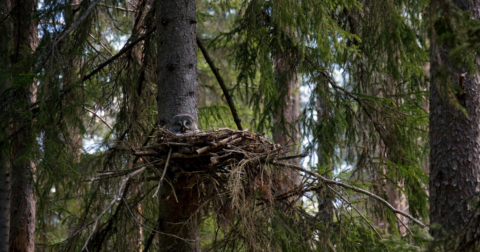
We’ve known for some time that forests are crucial to fighting climate change, but scientists are still learning just how much. A new study published in Science on March 19 finds that old, undisturbed forests in Sweden store up to 72% more carbon than replanted, managed secondary forests. The research suggests that earlier studies may have underestimated the climate cost of turning old-growth forests into managed secondary ones, and that preserving European boreal forests may be more important for climate mitigation than previously thought.
Trees, soil and plants play an important role in curbing the damage of carbon emissions, because they capture carbon dioxide from the air through photosynthesis and then store the carbon, sometimes for centuries. When forests are burned or cleared, much of that stored carbon is released back into the atmosphere and fewer trees are left to absorb carbon.
In the last 10,000 years, around one-third of forested land on the planet has been destroyed for uses ranging from timber production to agricultural expansion. Managed secondary forests are often promoted as a climate solution. They are replanted or regenerated to help restore local ecosystems, provide raw materials like timber, and offset industrial emissions through carbon sequestration.
For the study, researchers looked at over 200 plots of old-growth boreal forests in Sweden over the course of three years. Also called “primary forests,” these are old forests with diverse ecosystems and have not experienced significant human disturbance, such as significant logging or land conversion.
The researchers measured the carbon in these old-growth forests, not just in the trees but also in the soil, leaves, deadwood and other vegetation. They then combined these field measurements with Sweden’s national forest and soil data to estimate the carbon storage in primary and managed secondary forests. They found that the primary forests stored 72% more carbon per acre than managed secondary forests, mostly in their soil.
While it was already known that old-growth forests store more carbon than their secondary counterparts, the Swedish study found that previously reported data-driven models significantly underestimated the climate cost of turning an old-growth forest into a secondary one. According to the researchers’ estimates, this cost is between 2.7 and 8 times greater than previously thought. The study’s findings come just months after a different research publication revealed that microbes in tree bark can sequester carbon dioxide. The lead author of that study, Pok Man Leung of Monash University, tells Sentient in an email that the Swedish study’s findings are “very important.”
“This demonstrates not only does tree coverage matter, but age and undisturbed nature are critical for forest ecosystem value to humans and the environment,” Leung writes. “This work lays a foundation to understand how forest management practices are impacting our current and future climate and rethink the value of forest conservation.”
But Douglas Larson, professor emeritus of Integrative Biology at the University of Guelph, takes a more cautious view of the study’s findings. In an email to Sentient, he writes that looking solely at how much carbon is stored in old-growth forests paints an incomplete picture; what’s more important, Larson writes, is the “turnover,” or how long that carbon stays stored in forests before it returns to the atmosphere as carbon dioxide.
“If that 72% recycles [back into the atmosphere] every year or every 5 or 10 years, it’s certainly better than a smaller percentage,” Larson writes. “But it’s still returning the CO2 generated by decomposition right back to the atmosphere.”
However, Larson doesn’t blame the researchers for not measuring the long-term storage of carbon in these old-growth forests, as he writes that doing so would be “very expensive, time-consuming and difficult.”
For his part, Leung writes that the Swedish study “raises interesting questions of whether other ecosystem services provided by primary forests are also compromised by conversion to managed forests.” He cites the carbon-trapping microbes in tree bark and soil as an example: might the microbes in secondary forests be less efficient at sequestering carbon than in primary forests? More research will be needed to answer that question and others surrounding the carbon-trapping properties of forests.
The researchers of the present study conclude that conservation of Europe’s boreal forests should be given more consideration. More broadly, they point out the need for more regional studies to better understand how various forest management practices and environmental characteristics influence carbon capture in specific locales.
“Our results show that protecting the few primary forests that remain has a much larger potential to slow climate change than previously thought,” said study author Anders Ahlström, senior lecturer at Lund University in Sweden and former postdoctoral scholar at Stanford University, according to a Stanford University press release.
Seth Millstein is a writer and musician living in the Bay Area. He has helped launch several early-stage journalism startups, including Bustle and Timeline, and his work has been published in Bustle, Huffington Post, The Daily Dot and elsewhere.

Feature
Culture•7 min read
Perspective
If you’re looking to reduce your water impact, eating less meat is a great place to start.
Culture•8 min read
Feature
New technology can detect pain in farm animals, but critics say it may do more to bolster the system than improve it.
Science•7 min read