News
There’s a Complicated Gap Between Our Values and What We Actually Eat, Research Shows
Research•5 min read
News
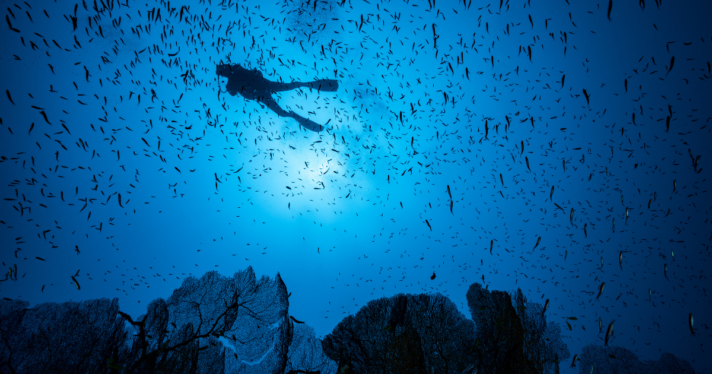
Twilight zone fish help regulate carbon and are critical to the food web. Yet they are being caught in massive amounts, and scientists say the impact is unknown.

Words by Gaea Cabico
The ocean’s twilight zone lies in the vast, dimly lit waters 200 to 1,000 meters below the surface and has long been considered an unexploited final frontier. However, biologists at the Woods Hole Oceanographic Institution suggest that industrial fishing has already been reaching deep into these ecosystems “in plain sight” for decades.
This month, in a recent Global Change Biology publication, the biologists present evidence based on decades of catch data and research across the globe that exposes major knowledge gaps around twilight zone fish. “There is a huge swath of the open ocean that we thought was not yet fished, but it turns out the tactics that different fisheries have used over the years have made the deep-water large fishes of this ecosystem more and more susceptible to being captured,” Martin Arostegui, lead author of the publication, and a research associate at Woods Hole Oceanographic Institution, tells Sentient.
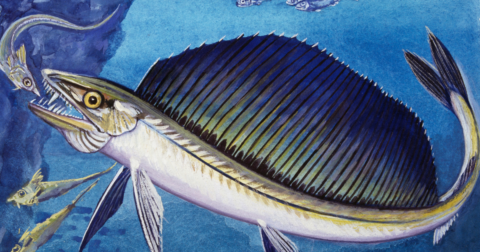
These larger fish inhabiting the twilight zone — like opahs, snake mackerels and lancetfish — are collectively called the “dark web” by the authors because of the crucial, yet long unseen, role they play in the food web. These “dark web” fishes have been poorly studied, but they play an important role in ecosystems by helping regulate and store carbon.
Exactly how this fishing impacts the twilight zone’s role in regulating the carbon cycle and supporting marine food webs is unknown. “It’s something that we need to desperately start getting data on,” Arostegui says, especially since most midwater species are not covered by mandatory catch reporting.
Despite being beyond the reach of sunlight, the twilight zone teems with life, ranging from microscopic organisms to some of the largest creatures on the planet. The biomass of mesopelagic fish has been estimated at 10 billion metric tons, but scientists say the true figure is unknown.
Historically, Arostegui tells Sentient, research has focused on small midwater fish and squid, while large, fast-swimming fish have remained understudied because traditional scientific gear is poorly suited to catching them. While nets used by researchers efficiently capture small, slow-moving species, the nets are easily evaded by larger fish. This makes monitoring large midwater fish difficult.
To fill in some of this gap, researchers turned to the National Oceanic and Atmospheric Administration bycatch database on landed catch brought back to port and sold, and discards that are thrown back at sea. The findings reveal that large twilight zone fish make up a substantial amount of the overall catch of industrial fisheries worldwide, particularly those using longlines, trawls and gillnets.
Since the mid-2000s, the Hawaiian longline fishery alone has caught around 30,000 tons of “dark web” fishes. Pomfrets and opahs are sold, while lancetfish and snake mackerels are usually thrown back into the sea, where they most likely die from capture stress or injuries.
For comparison, the region caught 140,000 tons of target fish like tuna and swordfish during the same period. While the intentional catch of tuna and swordfish averaged a hefty 22 pounds each, the midwater species caught alongside them ranged from 1 to 22 lbs.
This is not unique to Hawaiʻi. Industrial fishing operations are also fishing deeper in the Western and Central Pacific. Because the Hawaiian fishery accounts for less than 2.5% of the world’s longline fishing, and this publication reports evidence limited to the one state, the researchers point out that estimates of the total global “dark web” catches over the last two decades could have surpassed 1 million tons.
The fish of the twilight zone serve as a critical food source for many species like tuna and swordfish, as well as threatened or endangered predators.
They also play a vital role in regulating the planet’s climate. Some “dark web” fish migrate daily between the deep ocean and the surface — traveling upward at night to feed and heading back down during the day. This physical movement of the fish from the water surface and then downward helps transport carbon absorbed from the atmosphere into the deep ocean, a process that helps mitigate climate change.
However, Arostegui says it is still unknown exactly how much carbon these organisms move. There are major uncertainties surrounding their total biomass and the true extent of their vertical travel.
Scientists have long worried that industrial fishing of small twilight zone fish could disrupt the daily migrations that move carbon into the deep sea, with some even calling for a global moratorium on mesopelagic fishing to prevent future harms.
Arostegui goes further, arguing that concern should not be limited to hypothetical future fisheries and that scientists and policymakers should pay attention to past and present extraction of large midwater species. “You should be equally concerned about what has already been happening for the last few decades at a minimum.”
Meaningful policy change to protect the twilight zone species, Arostegui says, will likely need to come through regional fisheries management organizations — bodies that collect and analyze fisheries data and coordinate joint management strategies across international waters. He adds that some fisheries organizations have already started shifting to management approaches that consider the health of the broader ocean ecosystem, rather than focusing only on a handful of commercially important fish species.
To better understand what is needed to preserve vital twilight zone populations, Arostegui calls for more research, better catch reporting and closer collaboration with commercial fishers who encounter these species on a regular basis. “Without the information to inform [management], we can’t make informed, accurate, effective decisions.”
Gaea Cabico is Sentient's editorial fellow, and an award-winning journalist from the Philippines who reports on climate change, environmental issues and energy through a social justice lens. She holds a master's degree in science journalism from New York University.
Solutions
Research•6 min read
Feature
A new framework estimates the economic value of animal welfare for policymakers across the globe.
Research•7 min read

Feature
At the center of protein maxxing, whey products require energy-intensive processing and emissions-intensive milk and cheese production, with climate consequences if unchecked.
Culture•7 min read