Feature
Organic Beef Has a Larger Carbon Footprint Than Feedlot Beef
Climate•4 min read
Explainer
Insects have a lot of protein, but the industry faces many challenges in becoming mainstream


Words by Seth Millstein
Are insect burgers the next big thing? In recent years, insects have gained increased attention as an underutilized protein source. Some argue that swapping burgers for bugs could help save the planet and feed it in one fell swoop — all while reducing the suffering of non-human animals. But is the climate promise of eating insects realistic, or is all the buzz destined to be a bust?
A new report from the Stockholm Environment Institute suggests the latter. After analyzing the industry and existing studies, researchers concluded that insect protein may be overblown as a climate solution, and urged caution before declaring insects the next big alternative protein.
“Insect farming is often framed as a sustainability solution,” writes Camilo Garzón, research associate at the institute. “But the benefits depend on how insects are produced and what they replace in our diets. On current evidence, the environmental case is far less clear-cut than often assumed.”
Arnold van Huis, professor of tropical entomology at Wageningen University in the Netherlands, is more optimistic. While he acknowledges some of the challenges and uncertainty facing insect proteins, he stresses that the industry is still very young, and that researchers are regularly learning new things that could help overcome those hurdles.
“It’s rapidly evolving,” van Huis tells Sentient.
Insects might not sound like a very appetizing meal to the average 21st century American, but humans have been eating them for thousands of years at least, according to archeological evidence. Insects were eaten by ancient Romans, and to a lesser extent by ancient Greeks, while sections of the Bible dictate which insects are and aren’t suitable for human consumption.
In many parts of the world, people still eat insects regularly. In Japan, aquatic fly larvae are sautéed in sugar and soy sauce and served as a delicacy, while winged termites are roasted, fried or turned into bread in a number of countries. Giant grubs are a popular insect cuisine in many parts of the world as well, and larvae are commonly used to flavor mezcal. All told, humans around the world consume over 2,200 species of insects.
It’s been suggested that insects could potentially serve not just as an occasional snack or delicacy, but as an alternative to meat as a primary source of protein. Bringing down global meat consumption is a top priority for fighting climate change, as industrialized meat production contributes nearly 60% of the food sector’s climate emissions, and also damages the air, water, natural habitats and harms wild animals.
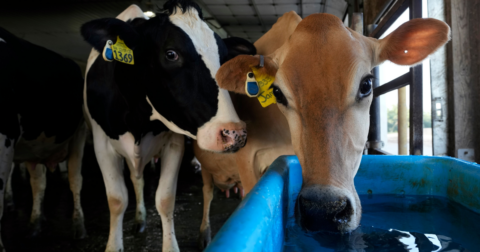
Insects have several advantages as an alternative protein. Some species have just as much protein as meat. Insects require much less land and water than mammals and in many cases emit far fewer greenhouse gasses — although this is dependent on the species of both insect and mammal.
Livestock is responsible for a large share of global ammonia emissions, and “insects hardly emit any ammonia,” van Huis says. He adds that insects also produce far less carbon dioxide than beef — a point that the Stockholm report acknowledges.
In addition, many insects can subsist on organic waste, such as compost and manure from animal farms. As a result, insect farms can theoretically serve as food production centers and waste disposal facilities at the same time.
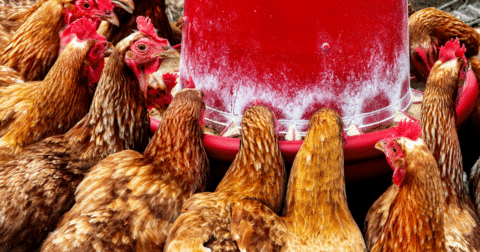
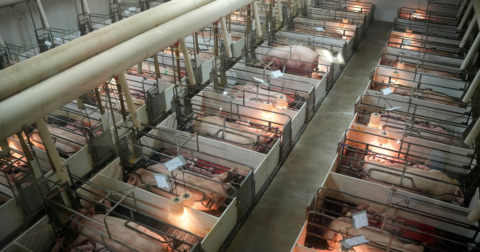
And finally, there’s the animal welfare aspect. Every year, roughly 80 billion land animals are killed for food. Around three-quarters of them die in factory farms, often after living in harsh confinement and undergoing painful mutilations like beak slicing, tail removal, wattling and mulesing. In theory, insects offer a way to farm protein without all of that suffering.
But how much of this is actually feasible? Could insects one day replace animal protein? And would that really make an impact on animal suffering? The devil is in the details, and the authors of the Stockholm report argue that insect protein may not actually be ready for prime time.
Take the claims regarding the environmental impacts of insect farming. Studies do suggest that insects themselves emit fewer greenhouse gases than mammals, but this needs to be balanced against the potentially higher energy needed to maintain insect farms. Insects are ectothermic: unlike mammals, their bodies generate little to no heat themselves, and are thus dependent on higher-temperature environments to survive.
Sometimes this can be solved simply by building insect farms in warm climates, and some of the studies purporting to show lower greenhouse emissions from insect farms were conducted in warm, tropical regions. But in colder places, heating insect farms takes energy, which could offset the gains of reduced emissions from the bugs themselves.
The Stockholm report also pushes back against claims regarding organic waste as a feed for insects. While insect farms could theoretically play a valuable role in waste disposal, that’s not how they’ve played out so far: existing insect farms still often rely on grain-based feeds. The authors cite a 2017 survey that assessed 13 insect farms in the United States and Europe. Not one of them used organic waste as a feed.
A number of obstacles stand in the way of using organic waste as insect feed on a wide scale, the report’s authors claim, such as regulatory hurdles and competitive demand for organic waste from bioenergy companies and other sectors.
The authors also note that, despite the popularity of insect-based food in many parts of the world, consumers in the West “have shown limited interest” in eating bugs, which could mean there’s a ceiling on the industry’s growth and consumers might not accept insects as a replacement for animal meat.
Finally, the authors argue more broadly that existing studies into the environmental impacts of insect farming — also known as life-cycle assessments — are “outdated and regionally-limited,” having only been conducted in certain climates.
“To date, commercial insect farming in temperate, high-income countries has frequently fallen short of its environmental potential,” the authors write in the report’s conclusion. “The sector faces a range of sustainability challenges, including the use of outdated or region-specific life cycle assessments.”
However, van Huis pushes back against a number of the Stockholm report’s concerns. For instance, while there are indeed challenges in scaling organic waste as insect feed, van Huis and his co-authors point out in a 2025 paper that none of these challenges are inherent to insect farming itself, and are potentially surmountable.
For instance, some jurisdictions do have regulations that restrict the reintroduction of animal byproducts back into the food chain, which would prevent animal waste from being used to feed protein insects. But regulations can be changed, and many of the ones relevant to organic waste are exclusive to North America and Europe.
Meanwhile, competition is common in all industries, and the fact that two sectors might have to compete for the same resources doesn’t mean that either of those sectors is intrinsically unsustainable, van Huis says. And while it’s true that the 2017 survey of insect farms found that none used organic waste, that was 9 years ago, and even the author of that study wrote that “this is expected to change as the industry matures.”
Insofar as heating insect farms goes, van Huis acknowledges that “energy may be a problem.” But he also notes that this is in large part dependent on what type of energy is used to provide the heat. In addition to the possibility of using green technology like solar panels, emerging research suggests that in some cases, insects can be heated by…themselves.
Although insects produce little heat endogenously, they do produce a small amount of metabolic heat as a result of their own digestive processes. And while it’s still an emerging field of study, there’s some evidence that this metabolic heat could be captured and used to heat insect farms, at least partially.
“They produce metabolic heat, and you can use that heat [from older larvae] to grow up the small larvae,” van Huis says. “Those kinds of things are currently being investigated.”
In response to the report’s claim that studies into insect proteins’ environmental impacts are too limited to draw any firm conclusions, van Huis notes that this research is not only ongoing, but accelerating. He tells Sentient that when he entered the insect protein space ten years ago, there were “maybe a few 100 articles a year” published in academic journals on insect proteins.
“Now we are up to between 200, 300 articles a month,” he says. “It’s absolutely amazing.”
As for Western attitudes around eating bugs, van Huis doesn’t dispute the report’s claims. He says he’s talked to chefs who speculate that it could take a generation or more for Westerners to come around to the prospect of eating insects. “The reaction of disgust is one of emotion, and to undo emotions, that is extremely difficult, almost impossible,” he says. So he’s not holding out hope that fast food chains will start serving bug burgers any time soon.
But there are other ways for insects to serve as a protein source that don’t involve biting into a grub or chewing on fly larvae.
“There are two ways of preparing insects,” he says. “You can dry them, grind them and put them in all kinds of food products, that is one way. But the big companies are doing it differently.” They isolate the proteins, fats, and chitin from the insects, and use those directly in all kinds of food products. “I think that is the way to go,” van Huis says.
This is already being done in one space: Insect protein is increasingly being used in protein bars, and van Huis says that it could also be used to fortify other foods like bread and pasta. In that way, “you really don’t recognize the insect anymore” in the food, thus circumventing the disgust factor.
This, however, gets to a key distinction in the insect protein debate. It’s one thing for bug protein to be used as an ingredient in protein bars and pasta, and another thing entirely for insects to actually be eaten as a substitute for meat. The first has already happened; the second, however, is a long way off.
Lastly, there’s the animal welfare component. Insect farming only reduces animal suffering if insects don’t feel pain, and while research into this question isn’t conclusive, the totality of data suggests that there’s a non-negligible possibility they do. And if they do, farming them as a protein source would arguably be even worse than the status quo, because feeding a human with insects requires killing a whole lot more of them than, say, chickens or cows.
Van Huis believes that it’s “correct” to consider the welfare of insects in this conversation, although he notes that everyone eats plants, and even in plant agriculture, “billions of insects are killed with pesticides.”
The insect protein debate, much like the insect protein industry itself, is still very much in its infancy. As research progresses and companies continue to experiment with new and emerging technologies, there will undoubtedly be many setbacks, breakthroughs, discoveries and challenges in the insect protein space.
Where all of that will lead is anybody’s guess. But given how small the industry is at this point, it’s got nowhere to go but up.
Seth Millstein is a writer and musician living in the Bay Area. He has helped launch several early-stage journalism startups, including Bustle and Timeline, and his work has been published in Bustle, Huffington Post, The Daily Dot and elsewhere.
News
Climate•6 min read

News
Planetary emissions are already in a dangerous phase, scientists warn.
Climate•4 min read

News
Are four years of pro-environment policies about to come to an end?
Climate•8 min read