News
Farmed Salmon May Not Be as Nutritious as It Once Was, New Research Suggests
Health•5 min read
When faced with uncertainty, some turn to conspiracy theories for answers.

Words by Jessica Scott-Reid
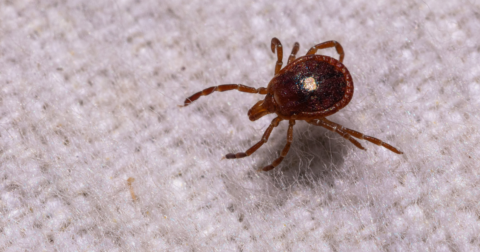
The concept of a blood-sucking critter causing its human hosts to develop an allergy to some of their favorite foods, like hamburgers and pepperoni pizza, sounds like the stuff of science fiction. But alpha-gal syndrome, or the tick borne allergy to meat and sometimes dairy, is very real — and on the rise, in part due to climate change. How allergies develop after a lone star tick bite is still being researched, but in the meantime, uncertainty about this condition has enabled a certain conspiracy theory to flourish.
In the case of alpha-gal syndrome, some conspiracy theorists link the source of the condition to one of the internet’s favorite conspiracy scapegoats: Bill Gates. These conspiracy theorists believe the meat allergy conspiracy adds to the “evidence” that Gates is working to force everyone to stop consuming meat. “People started noticing the timing,” claimed social media user @HustleBitch to his over 700 thousand followers. “The tick problem gets worse, alpha-gal cases increase, warnings spread, maps expand and at the exact same time Gates and his network keep moving deeper into the business of replacing traditional food. Coincidence?”
These theories “take that complex and confusing reality and explain it in a simple and understandable way,” explains Michael Barkun, professor emeritus of political science at Syracuse University and author of the book “A Culture of Conspiracy,” to Sentient.
Gates is a recurring figure in conspiracy theories — particularly about meat — due to his many investments in alternative-protein companies and his advocacy for climate change mitigation strategies, including reducing greenhouse-gas emissions from the agricultural industry.
But is Gates really behind the rise in ticks spreading alpha-gal? No. The ironic and inconvenient truth is that climate change is linked to increasing cases of alpha-gal syndrome — and the meat and dairy industries are top contributors to climate change. Animal agriculture accounts for at least 16.5 percent of global greenhouse gas emissions, largely driven by cattle burps and land use.
In most regions of the United States, tick-bite-related emergency room visits were at their highest this April compared with the same time of year since 2017, according to health officials. This April, 105 emergency room visits, up from 69 in 2025, were recorded per 100,000 total emergency room visits.
The U.S. Centers for Disease Control and Prevention (CDC) estimates that 31 million Americans are bitten by ticks each year, and that up to 450,000 people may have developed alpha-gal syndrome between 2010 and 2022. And the number appears to be climbing. A 2025 analysis suggests that the likelihood an individual will develop alpha–gal syndrome increased 55-fold, and the number of cases increased 56-fold, between 2015 and 2025 and are expected to keep rising.
If you’re a social media user, you might also notice a recent increase in videos “explaining” the growing tick populations. This includes circulating claims around springtime that farmers were discovering mysterious boxes of ticks in their fields, suggesting they were deliberately released there. According to fact-checking website Snopes, the idea traces back to a self-described holistic doctor whose post was viewed over 10 million times. However, when contacted by Snopes, the poster could not provide any documentation or firsthand sources. The site also contacted hundreds of state officials from the area and found no confirmed reports of boxes of ticks being discovered by farmers.
Another viral video shows a helicopter supposedly dropping ticks onto a farm — a conspiracy particularly popular in the Canadian province of Ontario. Various news outlets have debunked the video, finding no evidence to support the claim. According to Toronto outlet CP24, Ontario’s Ministry of Natural Resources distributes edible rabies vaccine baits to wildlife via helicopter or airplane. “We mention this simply to provide some context and possibly explain where the confusion and conspiracy theory came (from), not legitimize it,” reads a statement from the Ministry.
So why are tick populations increasing? And where did alpha-gal really come from?
Scientists say one of the main reasons tick populations are spreading across the United States is climate change. Warmer winters allow ticks to remain active through the season and more ticks to survive from year to year, and then earlier springs and longer, hotter summers give them more time to feed, reproduce and expand into new areas. Other contributors include changes in humidity and rainfall patterns, reforestation, growing deer populations and suburban developments in wooded areas, which increase opportunities for ticks to be in contact with people and the animals they eat.
As climate change alters ecosystems, its effects can influence the distribution of disease-carrying parasites and insects. For example, as forests are cleared and fragmented for farming, habitats are broken into smaller patches that favor adaptable wildlife such as white-footed mice and deer, both prime hosts for ticks. The loss of biodiversity, combined with increased contact between wildlife, ticks and people, has been linked to higher tick densities and an increased risk of tick-borne diseases.
Spread primarily through bites by the lone star tick, and in a few cases by blacklegged ticks, alpha-gal is named after galactose-α-1,3-galactose, a sugar found in the tissues and milk of most mammals other than Old World monkeys and great apes, including humans. A lone star tick can transfer the sugar to a person through a bite and trigger a meat and dairy allergy. If someone has alpha-gal syndrome and consumes the products of animals that contain the sugar, such as cows, pigs and lambs, they could have a delayed immune response, which can include hives, stomach upset and even life-threatening anaphylaxis.
The allergic condition was actually first uncovered through unusual reactions to a cancer drug in clinical trials. Researchers were able to pinpoint the alpha-gal sugar as the likely allergen and noted that prior exposure through ticks or other parasites could be relevant.
Exactly why some tick bites lead to the allergy and others don’t remains an area of research. Other types of ticks in different parts of the world have also been found to spread the syndrome, such as the Asian longhorned tick in parts of Asia.
So why is Bill Gates often at the center of conspiracy theories, and particularly those about food, health and climate? Rather than attributing issues to complex factors, conspiracy narratives frequently focus on or blame powerful individuals or groups, even — and often — when there is no proven connection.
“There’s a long tradition of conspiracy theories revolving around wealthy and powerful men, going back to theories about the Rockefellers,” says Barkun. “So a conspiracy theory around Bill Gates is not in itself surprising.” Barkun adds that after the rampant spread of conspiracy theories regarding Gates during the COVID19 pandemic — including unsubstantiated claims about using vaccines to depopulate the planet and controlling people with microchips — connecting him now to alpha-gal would just be easy for believers to tack on. This is also supported by research that suggests believers of conspiracy theories are highly motivated to seek patterns and closure where explanations are lacking. “Usually a person who’s a believer in one sort of conspiracy theory is a believer in other sorts of conspiracy theories,” explains Barkun.
Some conspiracy theories are driven by fears of contamination, Barkun notes. Believers are often concerned with the distinction between the “pure and the impure,” he says. “They’re obsessed with the fear that they’re being subject to some kind of contamination, some kind of poisoning, or that somehow something that is insidious or impure or defiling will get into their system, whether it’s an idea or a substance.”
Ultimately, says Barkun, by reducing complicated political, scientific or social issues to a clearer and easier-to-understand narrative, conspiracy theories, including those about alpha-gal syndrome, offer a simple alternative to complex truths. It also makes such stories more enticing to click and share.
Jessica Scott-Reid is Sentient's Disinformation Correspondent covering disinformation, misinformation and the impact of both on culture. A freelance journalist based in Canada, Jessica has covered animals, the environment and food systems for major media in Canada and beyond, for the last decade. Jessica has been a contributor to Sentient since 2019, and her work also appears regularly in The Globe and Mail, Toronto Star, Winnipeg Free Press and Corporate Knights Magazine.

News
Health•5 min read

Monona County officials and residents fear a repeat of the communication gaps and loopholes that left them caught off guard by a plan to import treated slaughterhouse manure.
Health•9 min read
News
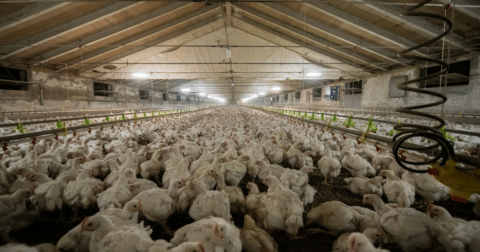
The rapid growth of chickens — now, 31 billion globally — has sped up pathogen evolution, boosting persistence, antibiotic resistance and spillover to humans.
Health•3 min read