News
McDonald’s, Subway and Taco Bell Fail to Meet Antibiotic Reduction Commitments
Health•5 min read
News
Additives can give plant-based foods the taste, texture and mouthfeel of hamburgers, ice cream or other meat and dairy products.


Words by Gabriella Sotelo
Not all food additives are created equal. Some help foods maintain texture or color, while others help preserve freshness or add nutrients. In dairy and meat alternatives, additives can play a crucial role in emulating characteristics people expect, like the juicy mouthfeel and chewy texture of a burger using textured proteins that might include protein isolates or polysaccharides. And while a long list of ingredients may raise eyebrows for some, the number of additives in a product says little about its nutritional value.
That is a key takeaway from research conducted in the UK that examined 71 plant-based alternatives sold at a major supermarket and found they contained nearly twice as many food additives as comparable meat and dairy products, even though the number of different additives documented was relatively similar.
But the researchers are quick to caution against drawing broad conclusions from those numbers.
“Our study wasn’t assessing whether these products were healthy,” Joseph Whittaker, one of the researchers of the study, said in a press release. “It was assessing whether they had more additives in, and a greater diversity of them.”
Echoing this, Thomas Galligan, principal scientist for Food Additives and Supplements at Center for Science in the Public Interest in the U.S., writes to Sentient in an email that “You need to know which additives are being used (some are harmful and some aren’t), and you need to know which animal products you’re comparing them to.”
Meat and dairy alternatives are trying to recreate foods that have naturally occurring ingredients with specific functions when they are prepared for food. For example, interactions between proteins and fats are what hold a beef burger together or make cheese melt and stretch. Plant-based burgers and cheese would need ingredients that produce those same qualities.
It’s also worth noting that plant-based food companies don’t all share the same nutritional aims — some are focused on making healthier options, while others prioritize animal welfare, environmental impact or even all three.
The unfamiliar names on plant-based foods ingredient lists often perform those functions. Methyl cellulose helps bind plant-based burgers, gellan gum helps keep plant-based milks smooth and evenly mixed and sodium alginate acts as a thickener. Color additives such as carotene help plant-based cheeses achieve a familiar yellow color, while calcium carbonate can make products appear whiter while also adding calcium.
The study also challenges another common assumption: that animal products are free of additives or processing.
Like with plant-based alternatives, these additives are typically used for a specific purpose. Some help preserve freshness, while others maintain texture, moisture or appearance. For example, sodium metabisulphite and ascorbic acid can help prevent oxidation and extend the quality of meat and fish products, while diphosphates are often used in processed meats such as sausages to help retain moisture and improve texture.
People may interpret longer lists as having more additives, making ingredient list length a quick mental shortcut for judging whether a product is good for you, says Vivienne Alexa Robinson, a nutritional expert and researcher on the study. But she points out that those assumptions do not always hold up. Longer ingredient lists do not necessarily mean more additives. For example, plant-based milks and cereals may be fortified with added nutrients, such as iron and folic acid, to meet nutritional requirements.
Consumers also consider far more than nutrition when choosing what to add to their shopping cart. Robinson says people often enter the grocery store with different priorities. This could be health, budget, environmental sustainability or animal welfare.
“It’s very difficult when we’re shopping,” she says. “We have so many decisions that we’re making whilst we’re choosing our food, and so we find I think mental shortcuts to help us prioritize that decision-making process.”
For some shoppers, the priority is familiarity, taste, cost or nutritional value. For others, plant-based alternatives are appealing because they align with their values, like improving animal welfare and mitigating environmental harm caused by the agricultural industry. For example, meat production is responsible for a disproportionately large share of food-related greenhouse gas emissions, accounting for nearly 60% of emissions from the global food system.
For those most focused on a nutritious diet, Robinson says the goal is moving away from making decisions about what to eat based on simple plant- and animal-based labels and evaluating the quality of individual foods.
“It’s not having this binary approach of, ‘I can eat meat or I can’t,’ or ‘I can have animal products or I can’t,’” Robinson says. “It’s being able to look at the quality of them.”
“Consumers looking for healthy plant-based alternatives to meat have plenty of unprocessed and minimally processed options to choose from already, like beans and lentils,” Galligan writes. “We know those are good for you and don’t contain additives, harmful and otherwise.”
Gabriella is Sentient's Fact Checker, steering the outlet's fact check process and team. Prior to this, she was an Editorial Fellow at Sentient. Her journalism background is in both environmental and science reporting, and her work has appeared in The Guardian, Gizmodo and National Audubon Society. She holds her MSc in Science Communication from Imperial College London.

Health•9 min read
News
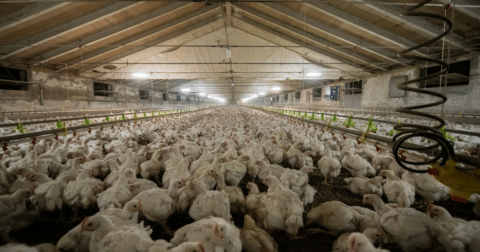
The rapid growth of chickens — now, 31 billion globally — has sped up pathogen evolution, boosting persistence, antibiotic resistance and spillover to humans.
Health•3 min read

Explainer
Research links hurricanes and drought with increasing risks of antibiotic resistance genes, which are concentrated in manure.
Health•5 min read