Feature
Gray Whales Are Starving as the Arctic Warms. Will the US Protect Them?
Policy•7 min read
News
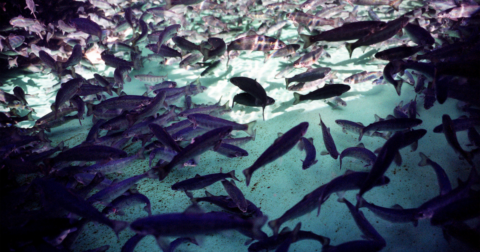
Mama Bear allegedly uses misleading branding on Atlantic salmon cubes sourced by Australis Foods, an aquaculture operation accused of harming Chile’s sensitive marine environment.
News • Legal Action • Policy

Words by Gaea Cabico
For consumers browsing grocery store shelves, Mama Bear salmon products appear to be a wholesome choice. The packaging features cheerful branding, with a cartoon family of bears and labels promising “sustainably farm-raised” salmon.
But a new lawsuit alleges that Mama Bear’s “sustainably farm-raised” claims are misleading, arguing that the products come from industrial salmon farming operations that are damaging some of Chile’s ecologically sensitive waters. The case also points to a broader problem of “greenwashing” — the practice of using false or misleading claims about their environmental and animal welfare benefits to market products and practices.
Marketing that highlights sustainability claims has helped the farmed fish industry, particularly salmon, build its reputation as an environmentally friendly food.
“The industry claims to be sustainably feeding the world, but in reality it is exacerbating environmental harms and flooding western markets with sick fish that isn’t needed in our diets,” Laura Lee Cascada, director of the Aquaculture Accountability Project, writes to Sentient. She points out that “today’s fish farms operate on a massive scale, replicating the problems of land-based animal factories in water.” Aquaculture Accountability Project, an organization that challenges the myths of “sustainable” seafood, is not involved in the lawsuit.
The putative class-action lawsuit, filed in federal court in Illinois late last month, was brought by consumer Cathryn Harris against Miami-based Trapananda Seafarms LLC, the North American sales arm of Chilean salmon producer Australis Seafoods. Trapananda sells Mama Bear frozen Atlantic salmon cubes, portions and burgers.
Harris regularly bought Mama Bear products because she trusted their “sustainably farm-raised” labels and paid a premium for what she believed was a more environmentally responsible product, according to the complaint. The lawsuit claims that Mama Bear’s marketing of the salmon products as sustainable is in violation of consumer protection laws.
Fish farming is often promoted as a way to mitigate overfishing of wild populations, to reduce the environmental footprint of seafood production while meeting the growing global demand for protein. Aquaculture is the fastest-growing food production sector, now supplying more than half of the world’s seafood and the vast majority of the salmon consumed worldwide. As the industry expands, so have concerns about its environmental and animal welfare impacts.
The complaint states that Australis — Mama Bear’s sole farmed salmon supplier — operates 74% of its net pens in legally protected national reserves and parks in Chilean Patagonia. These areas are home to wetlands that can store carbon and support protected marine species including blue whales and the endemic Chilean dolphins.
The suit lays out a list of alleged environmental harms tied to Australis’ farmed salmon production: permit violations from producing too much salmon; nutrient pollution severe enough to create oxygen-free “dead zones” that cause mass fish die-offs; discharge of pharmaceuticals, chemicals, fecal waste, dead fish and trash into surrounding waters; and overcrowded pens that caused stress, disease and welfare problems among farmed salmon.
The complaint also cites the deaths of a humpback whale and an endangered sei whale after the animals were entangled in Australis’ net pens. It also includes concerns for disease transmission from escaped farmed salmon to wild aquatic species.
“Both the routine and acute incidents of environmental harms were pretty mind-blowing, and of course, all of that is hidden from the public. The product is being represented as sustainable,” Kelsey Eberly, a senior attorney at the fair food system advocacy organization FarmSTAND, tells Sentient. FarmSTAND represents Harris in the lawsuit.
Sentient reached out to both Trapananda and Australis but did not receive a response.
Mama Bear is not the industry’s first brush with this kind of claim. In 2021 and 2022, separate lawsuits accused supermarket chain Aldi of marketing farmed Chilean salmon as “Simple. Sustainable. Seafood.” The two lawsuits were dismissed after Aldi agreed to remove the claim that the salmon was sustainable.
In 2023, the average American ate 19 pounds of seafood. For consumers looking for food that aligns with their environmental and animal welfare values, seafood producers have launched marketing materials that suggest their products are sustainable and sourced via responsible, environmentally friendly methods. But it can be difficult to independently verify these claims.
“We rely on companies to tell the truth when they’re making those statements and when they don’t, it harms consumers and other producers who are investing the money and taking the time to actually improve their practices,” Eberly says. The information gap can be particularly pronounced for farmed salmon, she adds, because the production takes place thousands of miles from the grocery stores.
The meaning of sustainability in farmed seafood is further complicated by the fact that terms like “sustainable” and “responsible” have no legal definition in the United States, Cascada says. “Companies can use these terms without anyone ever verifying that fish aren’t suffering from disease, that the water is clean or that prohibited antibiotics are not used.”
With no reliable way for consumers to verify a fish’s production history themselves, most are left relying on third-party certifications that underpin many sustainability claims. Logos from Best Aquaculture Practices (BAP) and the Aquaculture Stewardship Council are intended to signal that a farmed seafood product meets environmental and social standards.
Mama Bear says its products come from BAP-certified facilities. Global Seafood Alliance administers the Best Aquaculture Practices, which it describes as the “most comprehensive certification program for farmed seafood,” covering processors, farms, hatcheries and feed.
The Global Seafood Alliance has not responded to Sentient’s request for comment as of the time of publication. time.
But groups like FarmSTAND and the Aquaculture Accountability Project are skeptical of those certifications. Eberly describes these certifications as “largely a box-ticking exercise” in which companies meet documentation requirements without necessarily following the standards.
Cascada is even more critical. She argues that farmed seafood certifications function more as marketing tools than genuine guarantees of sustainability, and could remove any incentive to adopt more stringent standards.
Part of the problem is regulatory, according to a paper by lawyers Hira Jaleel and Saylor Soinski of the Center for Animal Law Studies at Lewis & Clark Law School. Since the Food and Drug Administration has jurisdiction over marine animal products, Jaleel and Soinski suggest that the agency should assert its authority by clarifying what terms like “sustainable,” “responsible” and “humane” mean in marketing these products, as well as require companies to substantiate such claims.
The lawsuit is seeking damages for consumers who bought Mama Bear products based on sustainability claims. Another purpose, Eberly says, of filing the lawsuit is to bring it to the attention of the public and encourage others to “look skeptically” at sustainability claims in stores and restaurants.
Gaea Cabico is Sentient's editorial fellow, and an award-winning journalist from the Philippines who reports on climate change, environmental issues and energy through a social justice lens. She holds a master's degree in science journalism from New York University.
News
Policy•5 min read
News
Farmworkers on H-2A visas won a rare victory in federal court. But they are still being paid the wages that were just ruled illegal.
Policy•10 min read

Feature
The agency’s focus on commercial interests threatens fisheries science and over one million miles of protected marine habitats.
Policy•5 min read