News
Iowa’s Water Crisis Crashed the Midterms
Elections•5 min read
News
The ballot measures passed overwhelmingly this midterm election, with 73% of DC voters and 66.55% in Denver voting in favor.


Words by Jessica Scott-Reid
Two U.S. cities, D.C. and Denver, have now voted to approve ballot measures that ban foie gras, a high-end poultry product made from the fattened liver of ducks or geese by force-feeding them before slaughter.
In both Washington, D.C. and Denver, Colorado, voters passed ordinances prohibiting the practice of force-feeding ducks and geese to produce foie gras, as well as the commercial sale, distribution and importation of such products. Denver’s ordinance goes even further, prohibiting the transportation and receipt of foie gras. Both measures are slated to take effect July 1, 2027, barring any successful legal challenges.
Animal protection group Pro-Animal Future led the campaigns to put these measures on midterm ballots in both cities. In D.C., 73% voted in favor of the ban, while 66.55% voted yes in Denver. Both measures were initiated by citizen petition.
Eva Hamer, a spokesperson for Pro-Animal Future and the organization’s executive director, tells Sentient the reason she thinks foie gras hit so successfully with voters is because “It’s so visceral. We’re talking about one practice that is so cruel and is so unnecessary, and that is so associated with the wealthy elite.” She believes people really understood “just how intense the suffering of animals is for this industry, and how completely unnecessary and gratuitous.”
Foie gras, which means “fat liver” in French, has long been considered a delicacy. The dish costs around $40-$100 per pound in the United States. Produced by a process called gavage, birds are force-fed through a metal or plastic tube inserted down their throats, typically several times a day over the final weeks of their lives, in order to enlarge their livers. The birds are fed more and fed more often than they would eat naturally, causing their livers to swell to as much as 10 times their normal size. The force-feeding process can cause the birds to suffer injuries, stress and damage to the esophagus, and the resulting fatty liver can cause difficulty walking and breathing.
Animal advocates have long opposed the production and sale of foie gras, pursuing undercover investigations, public demonstrations, corporate pressure campaigns and legislation.
In 1991, an investigation by People for the Ethical Treatment of Animals, or PETA, at a New York foie gras farm helped push the practice into the public eye. By 2004, California became the first state to pass a ban on force-feeding and the sale of products made through the practice, although a 2022 ruling now allows consumers to buy foie gras directly from out-of-state sellers for personal consumption. In 2006, Chicago became the first U.S. city to ban foie gras sales, although its city council repealed the measure two years later. New York City then passed a sales ban in 2019, but that ban was later struck down in court (New York’s formerly plant-based restaurant Eleven Madison Park recently put foie gras back on its menu). Pittsburgh then followed with a city sales ban in 2023, then Brookline, Massachusetts in 2025 and Portland, Oregon in June of this year.
Ballot measures aimed at factory farming practices are not new. Previous initiatives include California’s Proposition 2 in 2008, and Proposition 12 in 2018, which established restrictions on animal confinement on farms. In Denver, Pro-Animal Future sponsored another two ballot initiatives in 2024: one to prohibit the sale of certain fur products (Ordinance 308) and another to ban slaughterhouses within city limits (Ordinance 309). Both were rejected by voters.
At least one foie gras producer has promised a legal challenge. “I’m already working with my lawyers,” Marcus Henley, vice president of Hudson Valley Foie Gras in New York, one of the country’s two major producers, told Axios in late October. “There are no ducks that are being fed for foie gras in D.C.,” he said. “And they’re telling me as a New York farmer that I can’t sell my products in D.C. That’s unconstitutional on several grounds.”
D.C. chef Bart Hutchins has also commented publicly, telling Washingtonian “that he is also exploring legal options.”
Hamer believes the bans’ opponents don’t have grounds for legal challenges, particularly “given how strong the initiatives are.” She thinks the legal threat may just be posturing but adds, “We will see, and we’re prepared to fight them if legal challenges come up.”
Pro-Animal Future is now planning to push city officials to allocate funds for enforcement, Hamer says. “That’s the next step in D.C.,” she says.
Jessica Scott-Reid is Sentient's Disinformation Correspondent covering disinformation, misinformation and the impact of both on culture. A freelance journalist based in Canada, Jessica has covered animals, the environment and food systems for major media in Canada and beyond, for the last decade. Jessica has been a contributor to Sentient since 2019, and her work also appears regularly in The Globe and Mail, Toronto Star, Winnipeg Free Press and Corporate Knights Magazine.

Investigation
Elections•7 min read

News
According to the litigation, the agency ceased all communication with subcommittee members without explanation.
Policy•4 min read
Feature
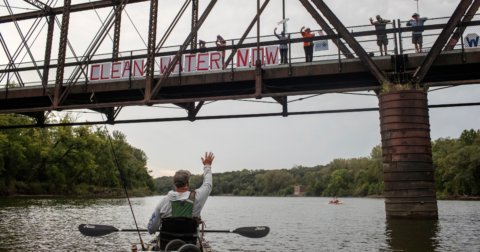
How water, cancer and factory farming are fueling a grassroots political campaign in Iowa for Chris Jones.
Elections•15 min read