Explainer
Where Iowa’s Gubernatorial Candidates Stand on Water Quality
Climate•10 min read
Feature
Beyond environmental risks, advocates say the move reflects a continuing pattern of federal authorities disregarding meaningful consultation with local communities.

Words by Gaea Cabico
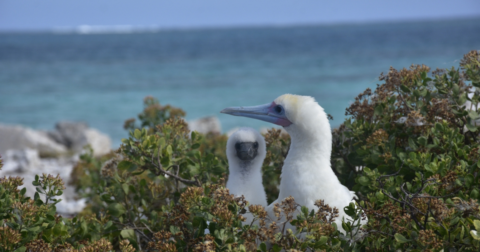
When Sabrina Suluai-Mahuka, an Indigenous educator and environmental advocate from American Samoa, visited Rose Atoll several years ago, she found herself standing alone on the small island while blacktip reef sharks swam through the shallows. She describes that moment as “the most amazing experience.” The water was clear. The reefs teemed with life. White sand stretched across one of the most intact coral ecosystems in the world.
“Muliāva is one of the few places that still allows us to see what a thriving marine ecosystem looks like without the destruction of commercialization,” Suluai-Mahuka writes to Sentient in an email, using the traditional name for the atoll. Beyond providing critical habitat for seabirds, turtles and fish, she says it represents “what future generations stand to inherit if we make wise decisions today.”
Now, she fears her daughter and the next generations may not experience the atoll as she has.
On June 11, President Donald Trump signed a proclamation attempting to reopen nearly 500,000 square miles of previously protected waters in the Pacific Ocean to commercial fishing by U.S. vessels. The order lifts fishing restrictions in parts of the Rose Atoll Marine National Monument, the Mariana Trench Marine National Monument in the Commonwealth of the Northern Mariana Islands and the Papahānaumokuākea Marine National Monument in Hawaiʻi.
The administration frames the decision as expanding opportunities for the U.S. fishing industry and increasing domestic seafood production. But Pacific Islander communities and conservationists say it puts at risk some of the world’s most pristine, biodiverse marine ecosystems — while continuing a long history of making federal decisions without meaningfully consulting with the people who have long served as stewards of these waters.
“Conservation decisions should be grounded in science, precaution and meaningful consultation with affected communities,” Suluai-Mahuka writes. “Once commercial interests are introduced into a protected area, it becomes increasingly difficult to ensure that the original conservation objectives remain intact.”
The new proclamation allows commercial fishing in waters between 12 and 50 nautical miles surrounding Rose Atoll’s distinctive pink reef. Designated a national monument in 2009, the atoll is an important nesting site for green sea turtles and critically endangered hawksbill turtles. It also supports species that have declined sharply elsewhere, including giant clams, Maori wrasse and reef sharks.
With Rose Atoll already threatened by ocean warming and coral bleaching, the government should be “increasing protections, not stripping them,” Suluai-Mahuka writes.
And for Samoans, the atoll represents more than a protected area. It is part of their heritage, identity and responsibility as stewards of the moana, or ocean, Suluai-Mahuka adds.
Further north, in Hawaiʻi, scientists and native Hawaiians warn that the rollback jeopardizes one of the world’s largest marine protected areas. Trump’s proclamation disregards nearly two decades of community advocacy and broad public support for protecting the Papahānaumokuākea Marine National Monument, Kekuewa Kikiloi, an associate professor of Hawaiian studies at the University of Hawaiʻi at Mānoa, tells Sentient.
Located in the northwest region of the Hawaiian archipelago, Papahānaumokuākea is one of the “last really wild places” left in the world, Kikiloi says. The monument is home to more than 7,000 marine species, a quarter of which are found nowhere else on Earth.
The monument’s protections have even benefited fisheries. A 2022 study by researchers at the University of Hawaiʻi at Mānoa found that the no-fishing zone increased yellowfin tuna catch rates in nearby waters by 54%, bigeye tuna catch rates by 12% and overall fish catch rates by 8%.
Kikiloi questions the need to expand commercial fishing grounds, noting that Hawaiʻi’s longline fleet, which primarily targets bigeye tuna, has historically met its federally regulated catch quotas. He also warns that opening the monument to industrial fishing could remove large numbers of fish from the ocean, disrupt coral reef ecosystems and increase bycatch of other marine wildlife, while adding to the problem of marine debris. Discarded or lost fishing gear such as nets and lines can entangle marine mammals, sea birds and turtles.
Papahānaumokuākea is also central to native Hawaiian origin stories, spirituality and cultural identity. “It’s a place that is totally alive with what we believe is the spirit of our ancestors,” says Kikiloi, who also serves as the co-chair of the Papahānaumokuākea Native Hawaiian Cultural Working Group. “Anything that tries to disrupt that balance is attacking one of the last refuges for us to try to have those types of spiritual connections to our homeland and to our ancestors.”
Angelo Villagomez, a senior fellow at the nonpartisan policy institute Center for American Progress focused on Indigenous-led ocean conservation and a Chamorro from the island of Saipan in the Northern Mariana Islands, was “extremely annoyed” but not surprised when he learned about the proclamation. The fishing industry, he says, has been trying to reopen protected waters since the monuments were created. Villagomez describes the move as part of a broader “fire sale of our natural resources.”
The proclamation would allow commercial fishing in the Islands Unit of the Mariana Trench Marine National Monument. The unit includes the waters surrounding the remote islands of Maug, Uracas and Asuncion, which the Commonwealth of the Northern Mariana Islands Constitution designates as uninhabited areas to be preserved for the conservation of birds, wildlife and native plants.
Isolation has kept these ecosystems intact, Villagomez says. “The fish are big, the fish are old, the fish are fat. There are sharks. There are giant clams as big as a cooler.” The monument protects some of the deepest ocean environments on Earth and contains highly diverse seamount and hydrothermal vent ecosystems, as well as one of the richest collections of stony corals in the western Pacific.
The Commonwealth government supports the proclamation. Governor Daniel Apatang tells Sentient that the move presents an “opportunity to strengthen local fisheries, improve food security and support future economic opportunities for our islands.”
The Western Pacific Regional Fishery Management Council — which manages fisheries in federal waters around Hawaiʻi and U.S. territories in the Pacific — argues that “fishing was sustainable prior to the closures and can or will be after the restoration,” its fishery analyst Joshua DeMello tells Sentient in an email.
Reopening parts of the monuments, DeMello writes, would help American Samoa’s longline fleet track fish and ensure supply for the cannery that drives the local economy, create economic opportunities for communities in the Northern Mariana Islands and allow Hawaiʻi fisherfolk to fish closer to port while maintaining protections for endangered species and ecosystems.
Villagomez, however, says the proclamation is unlikely to lead to a significant increase in fishing around the Mariana Trench monument because of existing longline exclusion zones, high fuel costs and the area’s remoteness. Instead, he argues that allowing commercial fishing does little to benefit Indigenous Chamorro and Refaluwasch fishers. “What this actually does is it opens up the area to wealthy people who can afford to go there,” he says.
DeMello argues that the new rules will not affect locals’ connection to the waters. “It happens out of sight of land, has no or low impacts on resources, and is in areas far away from human population centers, which means interaction between fishers and anyone else is near zero,” he writes.
The biggest concern, according to Villagomez, is political. “Decisions [about] the territories are being made thousands of miles away,” he says, with no public hearings or consultations.
As U.S. territories, American Samoa and the Northern Mariana Islands have limited influence over decisions made in Washington D.C., even though federal policies can have significant impacts on their lands and waters. These include military activities and proposed deep-sea mining. While the territories each have a delegate in Congress, these representatives cannot vote on legislation. And although residents are U.S. citizens, they cannot vote in presidential elections.
The Western Pacific Regional Fishery Management Council said its recommendation to restore commercial fishing was made through a public process, including meetings leading up to and during the decision to lift the commercial fishing ban.
Suluai-Mahuka says that many people in the Manu’a Islands, where Rose Atoll is located, oppose the proclamation not because they oppose local longline fishing, but because it opens the waters around Muliāva to any U.S.-flagged commercial fishing vessel. Tuna fishing is the primary economic driver in American Samoa and supporters of the proclamation argue it would allow local fishers to utilize investments in a new generation of longer-range fishing vessels.
Communities across the Pacific say they plan to challenge the legality of the proclamation in court. David Henkin, deputy director of Earthjustice’s Mid-Pacific Office, tells Sentient in an email that the Constitution gives Congress, not the president, the authority over federal lands and waters. He adds that under the Antiquities Act, the president’s authority only goes in one direction. “A president can create a monument and protect its resources but cannot eliminate a monument or strip protections from it. That power resides with Congress alone.”
This is not the first time the Trump administration has sought to reopen protected areas to industrial fishing. Earlier this year, President Trump lifted certain fishing restrictions in the Northeast Canyons and Seamounts Marine National Monument off the coast of Cape Cod, prompting environmental groups to sue in an effort to block the move. The lawsuit is ongoing.
The administration issued a similar proclamation reopening protected water in the Pacific Islands Heritage Marine National Monument to fishing in 2025. Earthjustice and other groups challenged that action, and in August 2025, a federal district court ruled that commercial fishing could not legally resume in the monument.
Whether the new proclamation will survive the expected legal challenge remains to be seen. For Suluai-Mahuka, however, the debate extends beyond fishing policy or economic development. It’s about deciding whether places of exceptional ecological and cultural importance will be preserved for future generations.
“As someone who has stood on those shores, taught young people about stewardship, and now raises a daughter who will inherit the consequences of our decisions, I believe we have a responsibility to err on the side of protection,” she writes.
Gaea Cabico is Sentient's editorial fellow, and an award-winning journalist from the Philippines who reports on climate change, environmental issues and energy through a social justice lens. She holds a master's degree in science journalism from New York University.
Feature
Elections•11 min read
News
Mama Bear allegedly uses misleading branding on Atlantic salmon cubes sourced by Australis Foods, an aquaculture operation accused of harming Chile’s sensitive marine environment.
Legal Action•6 min read
Feature
Thousands of them have died in the last decade, and environmental groups might sue the Trump administration for ignoring their plight.
Policy•7 min read