Explainer
A Handful of Cooperatives Control the U.S. Milk Market
Food•1 min read
Feature
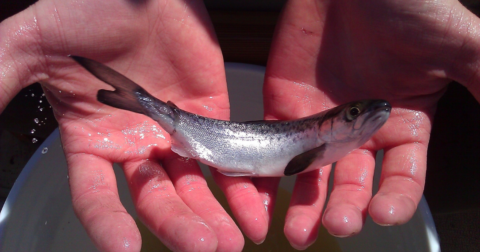
Cooke Aquaculture touts the jobs its salmon farms bring to the state, but local critics say the potential costs to their waters, livelihoods and wild Atlantic salmon outweigh the benefits.

Words by Gaea Cabico
Update: On September 30, a federal judge ruled that the Conservation Law Foundation’s Clean Water Act lawsuit against Cooke Aquaculture can proceed. The foundation says the decision “brings us one step closer to protecting the health of Maine’s waters and the ecosystems, industries, and communities that rely on them.”
For more than three decades, Dwayne Shaw has fought to keep wild Atlantic salmon from disappearing in Maine. As the executive director of the Downeast Salmon Federation, he helps operate hatcheries and restore rivers and watersheds where the last remaining wild Atlantic salmon in the United States exist. The Atlantic salmon fisheries closed in the 1940s after dams, pollution and overfishing drove the population into decline. “We have secured them, to an extent. However, they remain at critically low levels,” Shaw tells Sentient.
Now, Shaw worries that the recovery of Maine’s endangered wild salmon could be jeopardized by other salmon: those raised in open-net cages along the coast.
Shaw is part of a growing group of Maine residents, fisherfolk and environmental organizations pushing back against Cooke Aquaculture, the Canadian company that operates all of the salmon farms in the state. Cooke is also the world’s largest privately held seafood company. Its critics are concerned about the salmon farms, their potential impacts on the environment, wild salmon population and the livelihoods of marine harvesters.
Raising questions over how Maine’s coastal waters should be managed, these groups are also urging state regulators to reject the renewal of Cooke Aquaculture’s existing leases. Cooke currently holds 23 active aquaculture leases in Maine and nine are up for renewal. The company acquired Maine’s salmon farming operations in 2004, becoming the state’s sole commercial salmon producer.
“Given the track record of violations of this particular company, we feel that they cannot be trusted to comply with the restrictions that have been placed on them,” Shaw says. “We also observe the lack of capacity — enforcement capacity and follow-through from the regulators,” he adds.
On its website and other public statements, Cooke points out that it employs 230 people and brings economic activity to coastal communities in Downeast Maine. The area is a relatively undeveloped and economically underserved region, according to Shaw. And residents say those benefits pale in comparison with the damage to the environment and the livelihoods that depend on those waters.
As the Trump administration pushes to expand domestic fishing and aquaculture, there are concerns that fish farming could become the ocean’s version of industrial chicken production. The concern is that as aquaculture grows, it could adopt the same intensive practices used in industrial chicken farming, which have raised environmental and animal welfare concerns. Salmon aquaculture is promoted as a way to reduce pressure on overfished wild stocks, but it can also cause significant environmental problems, raising the question of whether regulators can keep up with the growth.
One of Cooke Aquaculture’s freshwater hatcheries sits roughly two miles upstream from the Downeast Salmon Federation’s facility, according to Shaw and he worries that escaped domesticated fish could undermine decades of work to recover Maine’s remaining wild salmon.
He says that farmed salmon that enter rivers could breed with wild fish, potentially introducing genetic changes that affect their “long-term viability and fitness.” Escaped salmon can also spread diseases and parasites to wild populations, he adds. Since farmed salmon are packed at high densities in net pens, parasites like sea lice and pathogens spread quickly between fish.
Escapes have already occurred at Cooke’s Maine operations. In 2021, four salmon from the company’s Black Island South site were caught at Brookfield Power Dam weir near Penobscot Bay. In 2023, Cooke Inc. reported that more than 50,000 salmon escaped from two sites near Cross Island after cage damage that the company attributed to a seal attack.
This is why the state of Washington banned the farming of non-native fish and commercial finfish net-pen aquaculture in its marine waters. Back in 2017, a net pen broke and released an estimated 250,000 non-native Atlantic salmon into Puget Sound.
The Maine Department of Marine Resources does not consider salmon aquaculture a major threat to the recovery of wild Atlantic salmon. As part of the state’s recovery program, salmon collected from Maine rivers for broodstock are genetically screened, which allows officials to detect and exclude fish that came from aquaculture operations, Jeff Nichols, the agency’s communications director, tells Sentient in an email.
Excess feed, fish feces and dead salmon can accumulate on the seafloor beneath open-net pens during routine aquaculture operations and large die-offs. As the waste decomposes, it removes oxygen in the sediment, and oxygen-free microbes break down the fish waste even further and release hydrogen sulfide — a noxious compound with a smell described as rotting eggs. Hydrogen sulfide is toxic to a range of aquatic organisms.
Pollution like this prompted the New England environmental organization Conservation Law Foundation to file a legal complaint against Cooke Aquaculture in 2025 under the Clean Water Act, alleging violations at 13 of the company’s salmon farming sites in Maine.
Conservation Law Foundation conducted its own investigation after hearing complaints from Maine residents. Sulfide pollution — which can appear as black sludge — was “absolutely toxic to all marine life” underneath and near a net pen, Heather Govern, the foundation’s vice president for clean air and water, tells Sentient.
According to the nonprofit, sulfide concentrations of 17 ppm or more in wastewater effluent can harm invertebrates living in the sediment as well as crustaceans and bottom-feeding fish like cod, flounder and haddock that feed on them. The resulting conditions, Govern says, can drive crabs and other marine organisms away. Conservation Law Foundation also cited Cooke’s own reports documenting sulfide levels above that threshold at several sites.
Conservation Law Foundation also alleged that Cooke’s operations contribute to nutrient pollution that can fuel algae blooms. The farmed salmon themselves can carry sea lice and pathogens such as infectious salmon anemia virus, which the nonprofit says could threaten wild Atlantic salmon. The complaint also raised concerns about plastic waste and other debris from the farms, including floating ropes, that can interfere with boat propellers and become entangled with lobster traps.
Cooke has not responded to a request for comment as of publication. But in response to Conservation Law Foundation’s lawsuit, Cooke said on its website that the allegations were “false, misleading and lack any substantiating evidence.” The company said it complies with the requirements of the Maine Department of Environmental Protection and Department of Marine Resources and its permits. It added that state regulators routinely inspect and monitor its salmon farms. Cooke Inc. filed a motion to dismiss the lawsuit in September last year.
There are also concerns about animal welfare at Cooke’s operations. In May, animal advocacy group Animal Outlook released undercover footage from one of the company’s salmon hatcheries that showed fish with fungal infections and workers clubbing fish to death. The group also alleged that workers acknowledged ignoring containment protocols, allowing farmed fish to potentially escape into surrounding waterways and pose risks to wild salmon.
Maine is the country’s largest lobster-producing state, with more than 5,600 independent lobstermen and an industry that contributed $575 million to the state’s economy in 2024. And some of the state’s fisherfolk and lobster harvesters say nearby salmon farms are threatening their business.
According to Govern, lobster harvesters complain they are forced to spend more on fuel to reach fishing grounds because they “have had to move their traps farther away from Cooke’s cage sites.”
Some fishermen report losing income, while others say aquaculture leases interfere with navigation, says Crystal Canney, executive director of Protect Maine’s Fishing Heritage Foundation, a coalition that opposes industrial-scale aquaculture.
Marine harvesters are also worried about losing access to fishing grounds as aquaculture leases increasingly take up more space in Maine’s waters. Cooke Inc. leases more than 600 acres of Maine waters, some of which are periodically fallowed — left without fish between production cycles.
Nichols, who works for the Maine Department of Marine Resources, argues that Atlantic salmon farming, which began in Maine more than 40 years ago, has been an “important component of the working waterfront in Washington and Hancock counties,” alongside fisheries such as groundfish, lobster, urchin and scallops.
Still, some farmers and producers express concern that the growing environmental impacts of aquaculture could damage their reputation.
“The brand that we are selling is that this is a clean place and the product that we’re selling is a wild product and we’re here in a remote place,” Severine Von Tscharner Welcome — who runs a farm in Washington County, growing produce and farming wild seaweed and oysters — tells Sentient.
Welcome has harvested seaweed from sites near Cooke’s net pens in Cobscook Bay, where she says she observed scum and foam in the water. “Nobody wants to eat seafood that’s growing in a muck of shit.”
Cooke’s discharge permit expired on April 10, 2019 — but remains in effect through administrative continuance according to the Conservation Law Foundation’s complaint. Govern, the foundation’s vice president, points out the permit doesn’t even set limits on nutrients and fish waste discharged into the water. She also says the permit is based on “old and outdated science.”
Govern and Canney also argue that the state lacks sufficient independent sampling and inspections beneath the net pens, while Shaw points to gaps in monitoring escaped farmed salmon.
In response, Nichols says salmon farms are subject to monthly surveillance and reporting, while vessels, equipment and net pens must undergo biosecurity audits and comply with restrictions on movement. The agency’s aquaculture division has seen increased staffing and a more stable budget under the current administration, he adds.
The Maine Department of Environmental Protection tells Sentient it cannot comment on pending litigation.
The lawsuit filed by Conservation Law Foundation is not intended to shut down Cooke, Govern stresses, but to hold the company accountable. She says that Cooke should strengthen monitoring and inspections as well as mitigate its environmental impacts. “That’s what an environmentally conscious company does. But they seem to not care, and that’s really our concern here,” Govern says.
Another concern is there are more limited opportunities for public participation in Cooke’s lease renewals, both Welcome and Shaw say. Last year, Maine eliminated the option for the public to request an adjudicatory hearing for lease renewals.
Nichols responds that renewals requiring a public hearing could take up four years to process, and this creates challenges for aquaculture businesses. The public can still submit comments on renewal applications, he adds.
Ultimately, Shaw wants to see Maine continue to restore and manage its wild fish stocks rather than become “farmers of the sea.”
Protect Maine’s Fishing Heritage Foundation has developed a model ordinance to help coastal towns regulate industrial-scale aquaculture. So far, nine Maine towns have adopted versions of the ordinance. “It slows it down, but it’s not the total answer,” Canney says of the ordinance. What Maine needs, she says, is a long-term, science-based plan for managing its coastal waters.
This piece has been updated to include a comment from the Maine Department of Environmental Protection and to note Protect Maine’s Fishing Heritage Foundation’s full name.
Gaea Cabico is Sentient's editorial fellow, and an award-winning journalist from the Philippines who reports on climate change, environmental issues and energy through a social justice lens. She holds a master's degree in science journalism from New York University.
Feature
Fisheries & Aquaculture•4 min read
Solutions
While the country’s farms tend to have high animal welfare standards, Bhutan also imports most of its meat.
Farms•7 min read
Feature
Fewer than 15% of veterinary school graduates are opting to care for farm animals.
Food•6 min read