Feature
American Horses Are Still Being Slaughtered for Meat
Food•7 min read
Feature
Fewer than 15% of veterinary school graduates are opting to care for farm animals.

Words by Jessica Scott-Reid
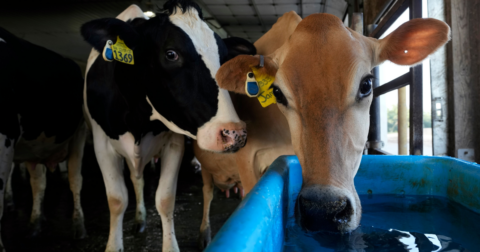
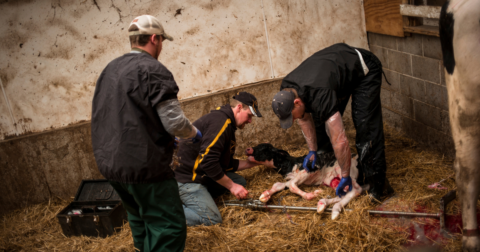
There is a crisis growing across the U.S., leaving many farmers without the support they need, and many animals without adequate care. Amid the Trump administration’s vow to “rebuild the Great American Beef herd,” a shortage of veterinarians willing and able to treat farm animals is causing concern for food safety, public health and animal welfare.
In 2024, the U.S. Department of Agriculture identified 240 areas across the country experiencing a shortage of farm vets. Fewer than 15% of veterinary school graduates take jobs that include care for farm animals, citing lower pay and tougher working conditions.
The consequences are significant. Concerns have been raised across government, food production and public health sectors over food safety and economic impacts, as veterinary care is a crucial first line of defense for disease prevention. Farmers can also lose income when their animals die due to a lack of available care, while others have had to sell off herds.
The vet shortage also gives rise to animal welfare concerns — the U.S. raises around 10 billion land animals each year for meat, and experts report that the shortage of farm animal doctors can cause premature death and increased stress and suffering.
In Ohio, there are seven vets caring for 57,200 cattle in one region. In another area, 12 vets for 71,500 cattle, according to the USDA’s National Institute of Food and Agriculture.
In another shortage area, in Iowa, the state vet reported that more than 5.1 million farm animals are served by just 60 veterinarians — that’s an average of more than 106,000 animals per vet.
The Ohio Newsroom reported in April that “oftentimes, owners of sick livestock have to load their large animals in a trailer and travel for care —– which can be costly for families and risky for animals.”
There are similar reports in Illinois, too. In Pike County, for example, state veterinarian Dr. Mark Ernst reports that some farmers have to drive more than an hour for basic veterinary care. And some livestock have actually died due to veterinary service being unavailable, he adds.
Loading up ill, injured or simply large animals for transport can come with welfare risks. “In some cases,” Ernst tells Sentient, “it may be pretty difficult to load some of those animals, even if they are mobile, into a trailer if they’re not used to being handled.”
And if an animal is able to be loaded up and transported to a vet, California-based veterinarian and animal activist Dr. Crystal Heath asks: “What’s the weather like out there? Is this an animal who is used to being transported?” For animals already lame or sick, “trying to balance down the road while you’re getting transported somewhere — that’s stressful too,” she tells Senient.
Heath is the executive director of Our Honor, a non-profit organization that helps veterinarians challenge practices they believe are harmful to animals. She tells Sentient she has seen evidence firsthand of “animals on farms who are suffering because they don’t have access to appropriate veterinary care.”
For large animals who are downed and immobile, loading up for transport might not be possible at all. “There’s no way you’re going to get a 1000 pound animal loaded into a trailer if they’re down,” says Ernst, “but they still need to be treated.” So what happens when there is no vet available? “In the worst case scenario, the owner may elect to have that animal euthanized,” says Ernst, “if they can’t find anybody that can treat it.”
But who does the euthanizing of sick or injured animals on farms? “There are cases where producers may have to euthanize an animal,” Ernst says, “but it’s much preferred that they have a veterinarian come out and do that.”
In 2024, nearly 73% of new U.S. veterinary graduates entered companion-animal practice, compared with just 9.6% entering mixed practice and 3.3% entering food-animal practice, according to the American Veterinary Medical Association.
Heath chose the companion animal track, although she started out wanting to work with large animals. She tells Sentient part of the reason was that work in shelters and clinics offered better hours, pay and conditions than rural farm animal practice.
Heath’s experience is not unique. A recent report published by the USDA cites a number of factors for the shortage, including high student debt and better pay and working conditions in urban and companion-animal practices.
In Texas, where there are eight designated farm vet shortage areas covering dozens of counties, the state veterinarian reports that “it is becoming more difficult each year to find livestock veterinarians to perform this work, much less finding emergency or after-hours care for their herds.” Without that necessary veterinary support, “producers make less informed decisions with their herds.”
A 2025 Texas A&M study noted similar findings, as several vets interviewed by the researchers “expressed some frustration in noting that producers have varied knowledge and skill sets when it comes to taking care of their animals.”
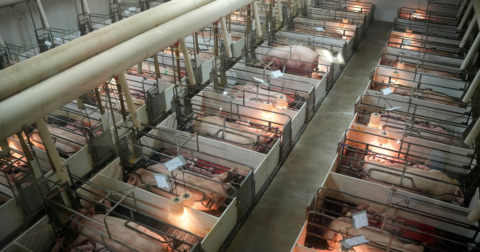
“Years and years ago, swine producers would have the veterinarian come out to process baby pigs,” as Ernst explains, “but that’s pretty much all done at all levels of production now by the producers.” Processing piglets typically involves ear notching, injections, castration, tail docking and teeth clipping. Some procedures are better left to the animal healthcare provider, says Ernst, who says, “The veterinarian is better trained, really, to do some of those things.”
Under the American Veterinary Medical Association’s guidelines, there is room for veterinarians to be responsible for healthcare and treatment decisions and farmers to follow their veterinarian’s instructions on the farm. However, a 2023 report published by Johns Hopkins University states that not all producers have this option when there is a shortage of veterinarians.
The consequences can be serious, the report finds, as the farmers “may self-diagnose, illegally obtain antibiotics, and administer medications on their own.” The report notes that this may lead to the “adulteration of antibiotics,” and even potential antibiotic resistance.
“Those workers may have years of experience with their herds,” says Heath, “but they don’t have the veterinarian’s medical training.”
To ensure farms can meet animal welfare standards, Ernst says more vets are needed. In Christian County, Illinois, for example, he reported to the USDA that emergency veterinary services and even regular farm calls have not been available in the area for years.
Heath argues that the problem is not only too few vets, but also too many animals.
There are over 1.7 billion chickens, pigs, cows and other animals being raised for food across the U.S. at any moment, according to USDA data compiled by Food and Water Watch.
“Treatment becomes focused on populations rather than individual patients,” Heath says. “As a shelter veterinarian, I know how difficult it is to provide individualized care to hundreds of animals, even when they’re all confined on one premise. For farmed-animal veterinarians, the challenge is exponentially greater.”
Jessica Scott-Reid is Sentient's Disinformation Correspondent covering disinformation, misinformation and the impact of both on culture. A freelance journalist based in Canada, Jessica has covered animals, the environment and food systems for major media in Canada and beyond, for the last decade. Jessica has been a contributor to Sentient since 2019, and her work also appears regularly in The Globe and Mail, Toronto Star, Winnipeg Free Press and Corporate Knights Magazine.
Feature
Fisheries & Aquaculture•9 min read
Investigation
JBS and Cargill plants across the country are accused of pressuring unions into either accepting the same low wage structure, or mere nickels apart. The result? The largest meatpacking strikes…
Food•13 min read
Feature
In Nebraska, Blackshirt Feeders LP is building the country’s largest feedlot for 200,000 beef cattle on a square-mile slab of concrete.
Food•31 min read