Solutions
Bhutan’s Food System Ethos Offers an Alternative to Factory Farming, but Can it Survive?
Farms•7 min read
Feature
As wild salmon decline, the province becomes more dependent on the fish farms that may harm them.

Words by Danielle Beurteaux
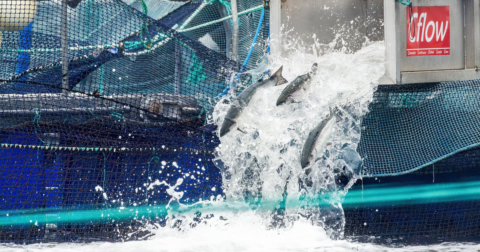
When British Columbia’s wild salmon fisheries declined in the 1990s, leaning hard into the province’s aquaculture industry and its existing infrastructure and labor force seemed the obvious solution. British Columbia’s salmon aquaculture primarily uses open-net pens — netted enclosures placed in the ocean that allow the surrounding water to flow in and out, along with anything in the water small enough to pass through the nets. Of particular concern are pathogens because the cramped living quarters of farmed salmon increases the spread of disease, which can then pass to wild salmon. In a recently published perspective in the Canadian Journal of Fisheries and Aquatic Sciences, ecologist Martin Krkošek questions whether wild salmon populations will recover from the growing aquaculture industry.
“You put a bunch of animals together, it is a spa for their parasites and diseases,” Krkošek tells Sentient. An associate professor and biologist at the University of Toronto’s department of ecology and evolutionary biology, he has been studying disease transmission between wild and farmed salmon for 25 years.
Krkošek believes that British Columbia’s wild and farmed salmon are caught in what he refers to as a “disease trap,” where a drop in wild salmon populations drives more investment and reliance on farmed salmon, which in turn harms wild salmon through the spread of disease, and the cycle keeps repeating.
“You get stuck in this trap where you can’t get your fisheries back because they’re suppressed by the diseases of aquaculture and policy’s not going to take a risk to close aquaculture because all the economic incentives are pointing in that direction,” he says.
In 2023, his research team published the results of a former master’s student’s model used to figure out what factors might help wild salmon populations and aquaculture co-exist and even thrive.
“It’s been a concern that maybe this is a zero-sum game between fisheries and aquaculture because of these interactions,” Krkošek tells Sentient, “and we’re not actually helping ourselves at all from the perspective of restoring or maintaining fisheries.”
Aquaculture isn’t the sole cause of wild salmon’s precipitous decline in British Columbia. In fact, it began before the province’s fish farming industry was even established, due to overfishing, climate change and pollution, as well as damage to the rivers and streams where the fish go to spawn.
“Now we’re in the situation where we’ve been really struggling in British Columbia to rebuild wild salmon populations,” says Krkošek.
Krkošek’s argument adds the socio-political context of the issues surrounding aquaculture that goes beyond the problems of disease transmission, Charles Mather tells Sentient. He researches the political economy and ecology of salmon aquaculture in Canada at Memorial University of Newfoundland. The promotion of aquaculture in British Columbia is itself a barrier to the recovery of wild capture fisheries.
In the wild, Krkošek points out, diseases naturally wax and wane. However, he says the salmon are continuously declining.
The Government of Canada is working with affected First Nations, the Province of British Columbia and coastal communities in a commitment to closing all open-net pen aquaculture operations by 2029 — a deadline already pushed back from the 2019 commitment to close them by 2025. Over the past five years, open-net pen fish farms have been removed from the Discovery Islands — an important salmon migration route near Vancouver Island.
“What everybody wants to know is if getting rid of the fish farms is going to bring us our wild fish back. So that’s the big question,” Krkošek tells Sentient. “Are we going to get recovery?”
That’s something he and his team are working to find out. While it’s too soon for a definitive answer, Krkošek says that after the pens were removed, the parasites and pathogens in the water declined and shifted toward more generalist species, not just those that attack salmon. He and others, including fishermen and whale boat tour operators, have also seen the reappearance of herring, followed by humpback whales, then salmon and orcas in the region.
But whether this will lead to a real recovery of wild salmon is uncertain. The aquaculture industry has pushed back on the removal of open-net pens. Other methods of fish farming, such as closed containment, are more expensive because they require more resources. It’s also a local economic driver that some communities don’t want to lose, Krkošek says.
“What I’m seeing is the door is still open to the net pen model continuing, but maybe with some more sustainability wrapping around it like better monitoring or that sort of thing,” Krkošek says. “Which isn’t very satisfying.”
Danielle Beurteaux is a freelance journalist based in Montréal whose work on science, food and wine have appeared in The Guardian, The New York Times, National Geographic and many more outlets.
Feature
Food•6 min read
Feature
3,700 federally protected wild horses were sold in 2025, and a new investigation reveals some end up at the slaughterhouse.
Food•7 min read
Feature
Cooke Aquaculture touts the jobs its salmon farms bring to the state, but local critics say the potential costs to their waters, livelihoods and wild Atlantic salmon outweigh the benefits.
Fisheries & Aquaculture•9 min read