News
Farmed Salmon May Not Be as Nutritious as It Once Was, New Research Suggests
Health•5 min read
News
New facility in southern Mexico will crank out 100 million sterile screwworms a week.
News • Health • Public Health

Words by Seth Millstein
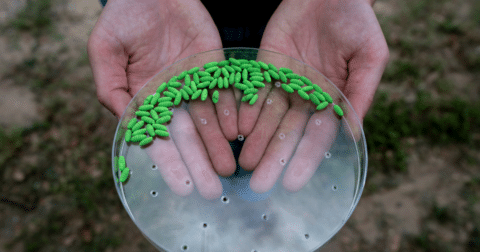
U.S. cases of the flesh-eating parasite called New World screwworm are growing by the day, endangering the nation’s cattle herds. In an effort to combat screwworm, the U.S. and Mexico have opened a sterile fly production facility in Mexico — the second in the world, after one in Panama.
On June 27, USDA Secretary Brooke Rollins and Mexican President Claudia Scheinbaum held a joint event in Metapa in southern Mexico to announce the official opening of the facility. By the end of the year it will be able to produce 100 million sterile flies every week, significantly aiding authorities in their efforts to stop the pest’s spread.
“From the moment I met President Sheinbaum, I knew she understood and was fully focused, and would be such an extraordinary ally for the United States,” Rollins said. “And this plant, this inauguration ceremony today, is an example of how this alliance can work beautifully together.”
The Trump administration has received criticism for its handling of the screwworm threat. Politico reported that the spending freeze Trump implemented in January 2025 delayed the construction of the Metapa facility by several months. Additionally, Agri-Pulse reported that Trump’s appointee Elon Musk cut funding from several screwworm-monitoring programs in March 2025.
The screwworm is a parasitic fly that lays its eggs in the open wounds of mammals. Unless treated early, screwworm infections are usually fatal, and the pest was a major problem for the U.S. cattle industry for the first half of the 20th century. It was largely eradicated from the United States by the late 1960s, but there was an outbreak in Panama in 2023. The fly slowly made its way northward, and in June of this year was detected in U.S. cattle for the first time since the 1980s.
To date, the USDA has confirmed 34 cases of screwworm in American animals, mostly in cattle, though also some goats, sheep and dogs. All of the cases have been reported in Texas.
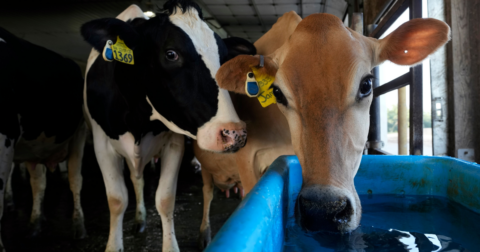
The screwworm’s return is a menace to the health of both beef and dairy cattle and comes at a time of record-high beef prices. The spread of screwworm, along with the measures taken to combat it, threatens to raise the price of cattle commodities even further.
A crucial tool for fighting the screwworm’s spread is releasing sterile male flies. Female screwworms only mate once in their lives, so by creating sterilized male flies and releasing them into screwworm populations, officials can effectively stop the bug from reproducing.
The strategy, called the sterile insect technique, requires two different types of facilities: Production facilities, which breed hordes of sterile flies, and dispersal facilities, which distribute the sterile flies via truck or plane.
There are several dispersal facilities up and running in North America, including two in Mexico and one at Moore Air Force Base in Texas. They have been dispersing millions of sterile flies into Mexico and the southern United States since the pest was detected in Mexico in 2025. They have the capacity to release even more.
But until last week, only one factory in the world produced sterile screwworms. It’s located in Panama, run jointly by the U.S. and Panamanian governments, and has been on the front lines of the fight against screwworm for decades. That facility can produce up to 100 million sterile flies every week and disperse them or ship them to other dispersal facilities.
“I think they did a good job slowing the progression through Mexico, considering what they had was 100 million flies,” Maxwell Scott, an entomologist at North Carolina State University who’s worked extensively on screwworm, tells Sentient.
But thanks to the new facility in Mexico, authorities will soon have a lot more flies to disperse. The Metapa facility will initially be able to produce around 28,000 flies per week, but is expected to be pumping out 100 million sterile flies weekly by the end of the year, effectively doubling the number of sterile flies in circulation.
“It takes a while for these facilities to start building up to maximum capacity,” Scott says. “There’s usually a few kinks to work out.”
While the two facilities will collectively be able to produce 200 million sterile flies per week, only half of those will be the sterile males that help to eradicate screwworm. The other half will be sterile female screwworms that actually get in the way. When sterile females are present, they compete with fertile females for mates, so some of the sterile males are wasted by mating with already-sterile females.
The current technology used to produce sterile flies doesn’t allow for male-only batches to be developed. This inefficiency may soon be a thing of the past, however. With USDA funding, Scott and his team have developed a way to produce male-only batches of sterile screwworm, which he says will make eradication efforts “much more efficient.”
“We worked for over a decade producing male-only strains” of sterile screwworm, he says. “They carry a gene that is lethal to females, but switched off by adding tetracycline to the diet.” In the factory, Scott and his team raise generations of flies on a diet including the antibiotic tetracycline, so the females don’t die, until the population is large enough. For the last generation — the one they want to release — they remove the antibiotic to activate the lethal gene and kill all the females. “So we’re left with only males,” he explains.
This new strain of sterile fly, known as the NovoFly, is currently under environmental review by the EPA.
Seth Millstein is a writer and musician living in the Bay Area. He has helped launch several early-stage journalism startups, including Bustle and Timeline, and his work has been published in Bustle, Huffington Post, The Daily Dot and elsewhere.

News
Health•5 min read

Monona County officials and residents fear a repeat of the communication gaps and loopholes that left them caught off guard by a plan to import treated slaughterhouse manure.
Health•9 min read
News
The rapid growth of chickens — now, 31 billion globally — has sped up pathogen evolution, boosting persistence, antibiotic resistance and spillover to humans.
Health•3 min read