Feature
Organic Beef Has a Larger Carbon Footprint Than Feedlot Beef
Climate•4 min read
Feature
The manure-to-energy field has a new sales pitch. Critics warn it could mean even more factory farms.

Words by Marin Scotten
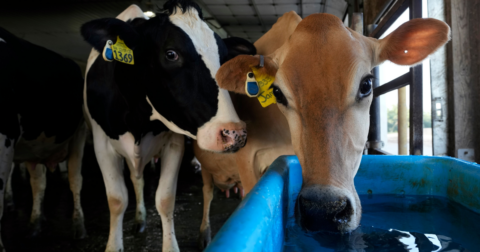
At first glance, Lent Hill Dairy Farm in Steuben County, New York, looks like most other industrial dairies. There are red buildings that house some 4,000 cows, a staggering manure pit and two gigantic dome-like structures that serve as anaerobic co-digesters.
These giant machines break down manure and local food waste to produce biogas. This renewable natural gas, or RNG, is then typically transported for use as electricity, heating and fuel. But at Lent Hill, the gas produced isn’t just heating homes or running tractors. It’s also powering an on-site cryptomine.
The operation, run by Pennsylvania-based Ag-Grid Energy, is the first of its kind in the country. The company claims the anaerobic digestion of manure and food waste could be a game-changer, not only in powering crypto, but data centers, which currently use 4.9% of the country’s electricity, a figure that could double by 2030.
“At the end of the day, our model is providing value to the rural area that we are in,” Rashi Akki, the founder and CEO of Ag-Grid Energy, tells Sentient.
The project claims to recycle more than 45,000 gallons of food waste per day and the manure of 4,000 cows. “What we want to do is also provide, if possible through fiber optics, [the] value of the AI computing capacity to that same regional area,” Akki says.
While Ag-Grid Energy wants to work with mid-sized dairies to create on-site power generation for small-scale data centers, the world’s largest technology players have bigger visions. Tech giants are increasingly searching for fossil-fuel alternative fuel sources to power hyperscale data centers that won’t put a strain on the grid.
Biogas proponents — a broad coalition of industries, including agriculture, fossil fuels, utilities and waste management — are pushing renewable natural gas, sourced in part by manure digesters, as a sustainable way forward.
In California, Microsoft has partnered with Enchanted Rock to use RNG for backup data center power. Vanguard Renewables, a waste management company and portfolio company of Black Rock, has touted RNG as “the fuel of the AI age.” Critics, however, fear the digester-to-data-center connection will give digesters an economic lifeline at a time when they’re struggling to stay online.
Renewable natural gas from digesters are touted as a drop-in energy solution, Sarah D’Onofrio, a scholar and advocate who works with digester-impacted communities across the country, tells Sentient. This means the RNG can be used without changing existing fossil fuel based infrastructure, and can be added to other fuel sources like natural gas so companies could claim they are fueling data centers sustainably, according to D’Onofrio.
But researchers like D’Onofrio argue that to truly reduce emissions, we need to transition to clean energy fuels rather than rely on renewable substitutes for fossil fuels.
“Why would you want to incorporate that [RNG] into our fuel system during the period of climate change?” she says.
D’Onofrio has helped communities in Wisconsin, Pennsylvania, Michigan, Georgia and North Carolina defeat proposals for large-scale co-digesters. She fears data centers are creating a new, massive market for the manure-to-energy industry, which could in turn incentivize the further proliferation of factory farms.
“It attaches these industrial food operations into our energy system and makes us really dependent on them over time, because the more it becomes intermingled with agriculture, the more it’s going to concentrate agriculture,” says D’Onofrio.
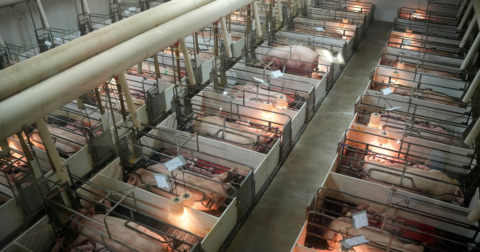
Animals raised on factory farms in the U.S. produce an estimated 941 billion pounds of manure each year, which pollutes air and water in communities all over the United States. In addition to problems with leakage, digesters do not make the manure disappear. The digested waste, or digestate, is meant to be recycled, potentially into a range of products, such as fertilizer and animal bedding. But there are a number of challenges with these downstream products: from economic to environmental. Digested manure can be more polluting than manure that hasn’t been digested, according to USDA research.
In 2023, Victoria Gehrke, a community organizer who owns recreational property in Lind, Wisconsin learned that a leader in the waste-to-energy field had proposed a co-digester in the town, touting it as a way to manage manure and reduce waste.
Gehrke and her fellow organizer Laurie Knutzen quickly discovered the impacts a co-digester would have on the community: hazardous air emissions, trucks going in and out delivering industrial food waste — and few restrictions about where that waste would come from — and water pollution. The project intended to send about 41,000 gallons of waste per day into a tributary of Walla Walla Creek, which empties into Lake Michigan.
“These are manure and industrial food waste processing and biogas producing facilities, they are not ag accessories,” Gehrke says of co-digesters. “They don’t belong on ag land,” she explains, “and what they’re really doing is having our small rural communities — because we’re so vulnerable — we become sacrificial dumping grounds for the industrial waste that other big places don’t want to put in their communities.”
After more than a year of relentless community opposition, the town of Lind denied Vanguard’s application in the spring of 2024. The organizers celebrated the decision as a win for Lind, but Vanguard is still “developing and operating” more than 50 co-digesters across the country. It aims to have more than 100 completed projects by the end of 2028.
Patrick Serfass, the executive director of the American Biogas Council tells Sentient that biogas is an “excellent fit” for data centers in search of a reliable and high-capacity fuel source.
“We’re really excited about the prospect of biogas systems being able to provide power to data centers, because they can provide that reliability,” Serfass says.
Data center demand could lead to the expansion of co-digester buildouts across the country, he says. Serfass estimates that the U.S. has only built about 10 to 15% of the biogas market’s capacity.
“The data centers are going to be so hungry for power that they could eat up pretty much all of the supply that the biogas industry could create,” Serfass says.
Vanguard Renewables makes a similar pitch. “As energy demand from data centers continues to grow, there is increasing interest in solutions that are both reliable and lower carbon,” Vanguard Renewables tells Sentient in an email statement.
The company is yet to partner with any data centers directly, but they have partnered with energy delivery companies like TotalEnergies and Enbridge, and both of these companies have relationships with hyperscalers and data center operators. In November 2025, TotalEnergies signed a 15-year deal with Google to provide solar energy to support the company’s data center operations in Ohio.
Anaerobic digesters are not new. They have long been hailed as a way to reduce emissions, capture methane and manage waste — a solution to agriculture’s methane problem with few tradeoffs.
The technology has received billions in subsidies at both the federal and state level. The California Low-Carbon Fuel Standard, a climate program implemented to incentivize the production of alternative fuels, funds nearly 200 digesters across 16 states; in 2023, Joe Biden’s Inflation Reduction Act provided over $150 million in funding to biogas projects across the country; and the Michigan Strategic Fund has approved more than $100 million in private bonds for digesters.
Akki says tax credits are incredibly important in making Ag-Grid Energy’s projects a reality. While most of the subsidies given to digester projects have been to support electricity and fuel for transportation, she wants to see fiscal support specifically for co-digesters that power AI.
“Tax credits — just like what we had with the Inflation Reduction Act — for electricity production for AI would really support our projects,” Akki says.
But using tax-payer dollars to support digesters has lost favor with the Trump administration’s Department of Agriculture. In May, the USDA extended a 90-day moratorium on loans for anaerobic digesters through the end of the year amidst environmental concerns and delinquent loans. According to a review of USDA lender data by Inside Climate News, 11% of the 746 project lenders across the country were considered over 90 days delinquent.
On top of this, a growing body of research raises questions about whether digesters make economic or environmental sense.
Government subsidies for digesters create a “perverse incentive where the value of manure or animal waste starts to compete with the value of the milk,” Brent Kim, a researcher at the Johns Hopkins Center for a Liveable Future, tells Sentient. In other words, farmers are incentivized to produce waste for profit, not to produce milk for human consumption.
Kim and his colleagues published a scientific review of the touted benefits and downsides to the controversial technology. “The reality is nuanced,” he says of digesters. While they can reduce methane emissions in the short term, they may also lead to an increase in ammonia emissions, toxic by-products and other pollutants released into the environment, a phenomena Kim calls “pollution swapping.”
“So sure, all else being equal, you do have a reduction in methane, but if they’re incentivizing growth in the industry, the larger herd size is going to release more methane,” Kim says.
Some research suggests digesters aren’t always effective at reducing methane either. As Sentient has previously reported, research from the World Resources Institute found that digesters offer limited climate benefit given their cost. Digesters reduce methane from manure storage by only about 25%, the WRI research finds.
A report from Friends of the Earth found that dairies with digesters increased herd sizes by 3.7% annually, or 24 times the growth rate of dairies without digesters. In Kewaunee County, Wisconsin, herd sizes grew by about 58% since they were installed.
The trend comes as no surprise to Lynn Henning, a soybean farmer in Michigan who lives near a Chevron-owned co-digester. When manure becomes “more valuable than the milk,” it creates incentive for growth, and changes what farming is all about, she tells Sentient.
“The system is changing farming. They’re shifting from producing food for people instead to producing manure so they can be paid more by the government,” Henning says.
Kathy Morrison, a farmer in Fremont, Michigan, has similar concerns. She lived next to a co-digester for years, and it significantly impacted her quality of life. The smell was unbearable, sometimes so bad it woke her up in the middle of the night. She describes it as being at a giant music festival and all the porta potties are overflowing. That smell was digestate, the liquid solid waste that’s left over and spread on fields after the digestion process.
Morrison is not against the technology of digesters themselves, particularly at the local level, but with so many private companies looking to make a profit, equitable implementation and scale is hard to control. Data centers (which come with their own environmental impacts) would likely expand those opportunities for profit.
“I would be all in favor of small, very controlled, community size digesters, but when they’re large scale like this, and they’re operating for profit, corners get cut,” she says. But this is something else, she says. “All the different industries that have come together to turn this into something insanely profitable…There’s just so many industries behind this. It’s wild.”
Marin Scotten is a New York-based journalist covering climate, agriculture and the food industry. Her work has been published in The Guardian, The New Republic, Sierra Magazine, Salon, Baltimore Banner, The New Lede, Floodlight News and more.
News
Climate•6 min read

News
Planetary emissions are already in a dangerous phase, scientists warn.
Climate•4 min read

News
Are four years of pro-environment policies about to come to an end?
Climate•8 min read