News
Republicans’ New Farm Bill Takes Aim at Animal Welfare and Pesticide Regulations
Policy•8 min read
News
A newly-passed Senate bill would remove the federal restriction on serving non-dairy milks in school lunches.
Words by Seth Millstein
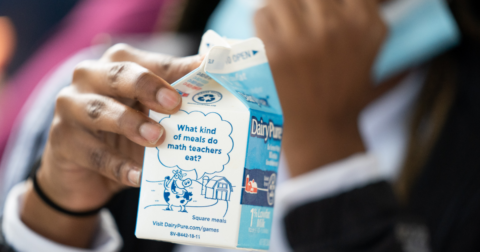
For almost 80 years, the National School Lunch Act has required public schools to serve cow’s milk at lunch. But that may be about to change: Last month, the Senate passed a bill that would allow schools to include non-dairy milk alternatives on their lunch menus for the first time. It would also entitle students to dairy-free milk if a parent requests it, instead of requiring a doctor’s note.
The Whole Milk For Healthy Kids Act, which the Senate passed unanimously on November 20th, would significantly expand access to dairy-free milk for millions of students. It now heads to the House of Representatives, where its prospects for passage look good.
Health advocates cheered the bill, which would make it significantly easier for lactose-intolerant students to access milk that they can digest. The bill’s passage was also celebrated by environmentalists and animal rights activists, who’ve long denounced the climate impacts of dairy production and the painful practices that cattle endure in the industry.
“The amendments to the Whole Milk bill allow for a dramatic broadening of milk options for kids, including plant-based milks,” Dotsie Bausch, whose organization Switch4Good partnered with Animal Wellness Action to lobby for the bill, said in a press release. “It’s been a long-term ambition of our organization to end the cow’s milk mandate and monopoly in the National School Lunch Program.”
As its name implies, the Whole Milk For Healthy Kids Act would allow public schools to serve whole milk at lunch, which they’ve been banned from doing since 2010. Thanks to an amendment added during the legislative process, however, it would also expand access to non-dairy alternatives in public schools in two big ways.
First, it would give schools the option to offer non-dairy milk alternatives as a standard menu item, which they’ve never been permitted to do before. Secondly, it would require schools to serve non-dairy milk to students who present a note from a parent or guardian, as opposed to requiring a note from a doctor. Previously, parents could send in a note, but schools were not required to comply.
Though meat and dairy are still the norm in school lunches, schools have slowly been increasing their plant-based offerings in the last five years. The Whole Milk For Healthy Kids Act would provide a major boost to schools that wish to do this, as it would permit them to include soy milk, for instance, as an everyday offering to students alongside cow’s milk.
Activists have been pushing to expand access to non-dairy milk in schools for a number of reasons.
On the health front, between 30 and 50 million Americans, and 65% of people worldwide, are lactose intolerant. Rates are especially high among Black, Asian, Jewish, Latino and Indigenous Americans, so the restrictions around non-dairy milk in schools effectively mean that millions of minority students must jump through extra hoops to have a beverage they can digest at lunch.
Eighty percent of Black and Indigenous Americans and 90 percent of Asian Americans are lactose intolerant, according to Boston Children’s Hospital. As U.S. Representative Jamal Bowman said in the documentary ‘The Price of Milk’, “It’s just an insane stat.”
“All students should be able to access the nutrition they need to thrive and receive beverages they can actually drink,” Chloë Waterman, Senior Program Manager at Friends of the Earth, said in a press release. “Removing barriers for students to access non-dairy milk options will help school meals align more with dietary science, expand healthy choices for families, and reduce food waste.”
Dairy production also takes an enormous environmental toll. Cows emit methane, a highly potent greenhouse gas, as part of their natural digestive process, and manure from dairy cows often leaks into nearby streams, contaminating local drinking water and killing aquatic life. Although plant-based milks differ in their environmental impacts, all of them are much better for the climate than cow’s milk.
Finally, dairy cows often experience significant health issues leading up to their slaughter. Mastitis, a painful condition in which the mammary glands become swollen and inflamed, is commonplace on dairy farms, as is lameness. Dairy farms also require a constant supply of pregnant cows to provide milk, and as part of the artificial insemination process, male bulls must undergo an invasive procedure known as electroejaculation, which studies have concluded is “stressful and painful.”
There’s one caveat to the new bill: Any non-dairy alternatives that schools serve would have to meet certain nutritional requirements, ostensibly to ensure that they’re “nutritionally equivalent” to cow’s milk. Currently, fortified soy milk is the only plant-based milk that meets these nutritional requirements, although the specifics of the requirements may change with the upcoming update to the Dietary Guidelines For Americans. It’s also important to note that cow’s milk isn’t quite as healthy as the dairy industry claims.
The provisions regarding non-dairy milk originated in a separate bill, known as the Freedom In School Cafeterias And Lunches Act, or FISCAL Act, that was proposed earlier in the year. But lawmakers folded that bill into the Whole Milk For Healthy Kids Act during the debate process, and it was included in the final bill as passed.
The bill is now headed to the House of Representatives, and while its passage in the lower chamber isn’t a done deal, its prospects look good. Rep. Glenn Thompson of Pennsylvania, the powerful chairman of the House Agriculture Committee, cheered the bill’s passage in the Senate, and an earlier version of the bill already passed the House in 2023.
In anticipation of the bill becoming law, Bausch tells Sentient that Switch4Good will be launching a nationwide tour engaging 6th-10th graders on the climate benefits of dairy-free diets. The tour’s goal, Bausch says, would be “educating schools, teachers, kids and parents” regarding access to non-dairy milk in public schools.
Seth Millstein is a writer and musician living in the Bay Area. He has helped launch several early-stage journalism startups, including Bustle and Timeline, and his work has been published in Bustle, Huffington Post, The Daily Dot and elsewhere.

Explainer
Climate•5 min read
Solutions
A Texas law dictating special labeling requirements for plant-based foods and cultivated meats violates the First Amendment, a federal court finds.
Legal Action•5 min read
Feature
Undercover footage reveals some drivers falsify logbooks, while rules for livestock protections and driver fatigue can also be at odds, raising public safety concerns.
Factory Farms•7 min read