Explainer
Where Iowa’s Gubernatorial Candidates Stand on Water Quality
Climate•10 min read
Explainer
The practice called ‘manifesting’ lets CAFOs make manure pollution legally invisible and evade liability.

Words by Seth Millstein
Factory farms produce staggering amounts of manure and, in theory, there are strict regulations in place to keep it from contaminating nearby waterways. But in practice, many of these companies have found a hidden way to make millions of gallons of waste effectively disappear — at least, in the eyes of the law — with no oversight or accountability as to where it ends up or what pollution it causes. Welcome to the world of manifesting.
Also known as “distribution and utilization,” manifesting is a process whereby large factory farms transfer their manure to smaller farms that aren’t subject to manure disposal regulations. These secondary farms are often shrouded beneath complex layers of Limited Liability Companies (LLCs), making their ultimate ownership difficult or impossible to determine. Some of them are owned by the factory farms themselves.
In effect, manifesting is a regulatory shell game that allows large factory farms — also known as concentrated animal feeding operations, or CAFOs — to sidestep environmental regulations and avoid legal responsibility for their manure polluting the water, all while staying within the bounds of the law.
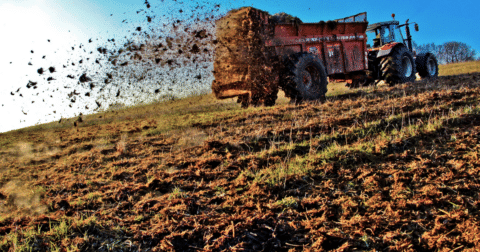
Livestock in the U.S. produce an estimated 885 billion pounds of manure every year. This manure is typically dealt with in one of two ways: it’s either stored in some type of container or applied to cropland as fertilizer.
Both methods can result in manure leaking into nearby waterways. Storage containers can leak. Manure spread on fields can be carried into lakes, streams and rivers by rain and other weather conditions, a phenomenon called runoff. The form of pollution is a major problem, and it’s the one that the process of manifesting enables.
Manure contains high concentrations of nutrients that can break down into greenhouse gases and other toxins that can pollute water, degrade soil and imperil public health if it’s not managed properly. Agriculture is the leading source of water pollution in the U.S., according to the National Resources Defense Council.
There are a number of regulations at the federal, state and local levels aimed at preventing and limiting this type of pollution from CAFOs. The primary one is the Federal Water Pollution Control Act, often referred to colloquially as the Clean Water Act.
Very broadly speaking, the Clean Water Act requires people and operations that pollute certain waters of the United States to obtain permits from either the EPA or, more commonly, state-level EPA equivalents. These permits place rules and limits on how operations are allowed to manage and dispose of their pollution, in this case manure.
The nature of these restrictions differ from farm to farm and state to state. In theory, discharge permits only allow farms to apply as much manure to fields as the crops and soil are able to absorb. Permits might prohibit CAFOs from using manure as fertilizer during the winter months, as manure is more liable to leak into waterways in cold temperatures, or require them to have a buffer zone between their manure-treated fields and any nearby body of water.
In addition to these practical restrictions, discharge permits also require covered farms to create and present a Nutrient Management Plan — a system of practices to ensure their compliance with the permit’s requirements. The plan typically includes protocols for manure disposal and storage, as well as testing the soil before manure application to determine what is a safe amount to apply.
On paper, these may sound like good measures to prevent pollution from CAFOs. But there are a number of small loopholes that add up to the enormous loophole known as manifesting.
First, CAFOs aren’t automatically considered polluters, and thus aren’t automatically required to obtain discharge permits under the Clean Water Act. They’re only considered polluters if, according to their own attestations, they discharge their manure and other waste into certain types of waterways — the ones that count as ‘Waters of the United States’.
Secondly, not all animal farms qualify as CAFOs in the first place. Federal CAFO designation depends on how many animals a farm has, what purpose those animals serve, and what type of waste disposal system the facility uses.
Finally, crop farms and farms that are not CAFOs are not automatically required to obtain discharge permits. Federal pollution discharge regulations only apply to what are called point-source polluters. The EPA defines a point source as “any single identifiable source of pollution from which pollutants are discharged, such as a pipe, ditch, ship or factory smokestack.” CAFOs are also automatically considered point-source polluters if they discharge into Waters of the United States. But many small, non-animal farms are not point-source polluters. Indeed, the Clean Water Act states that agricultural stormwater discharge and surface runoff from irrigation do not count as point sources.
The upshot here is that many U.S. farms that create or apply manure aren’t legally required to obtain discharge permits. They don’t have to follow the standard EPA restrictions on manure management or develop and implement Nutrient Management Plans. It’s an enormous loophole, and one that manifesting takes advantage of.
Manifesting can take several different forms, but the core idea is simple. CAFOs will transfer some portion of their manure to a second farm that doesn’t raise animals, isn’t considered a point source or otherwise isn’t subjected to permitting restrictions. The operators of this second field will use the manure as fertilizer, freely and without restriction.
“CAFOs can just give away their waste to somebody else, and then the way that waste is disposed of is out of their hands and out of their responsibility,” Katie Garvey, senior attorney at the Environmental Law and Policy Center, tells Sentient. “When they do that, they are no longer responsible for how that waste gets applied.”
Because that second field isn’t required to abide by any permitting regulations, it’s legally free to, say, apply much more manure than a field’s crops can handle, or apply it on fields right next to waterways.
If a CAFO transfers a portion of their manure to unpermitted farms, it’s still responsible for the manure that it retains on-site, and is thus still required to obtain a discharge permit. Only the portion of the manure that’s manifested is able to escape regulation.
But sometimes a CAFO will transfer all of its manure to a non-permitted farm. When this happens, the CAFO can plausibly claim that it’s not discharging any pollution into covered waterways, and it won’t need to obtain a permit at all. This is one reason, though not the only reason, why an estimated 70% of all CAFOs in the United States don’t have discharge permits.
“The [CAFO says], ‘Well, I don’t discharge, but I’m a point source,” Tyler Lobdell, senior staff attorney at Food and Water Watch, tells Sentient. “The second person says, ‘Well, I discharge, but I’m not a point source.’ So it fits together, and nobody’s accountable.”
Transporting manure to a second farm takes time, money and gas. To save themselves the effort, some CAFOs will create separate legal entities that they control, but which don’t require discharge permits, and “transfer” their manure there — that is, to themselves.
“[CAFOs] will make several limited liability company names, and then they will hire a contractor,” Lynn Henning, program director at the Socially Responsible Agriculture Project, tells Sentient. The contractor “will take that waste, and he will apply it on fields which they actually own, and manifest it back to themselves, basically, to skirt the regulation.”
This practice came to light recently in Michigan after the state’s environmental agency proposed more stringent regulations on CAFO waste management. The proposed regulations were mired in a years-long legal battle before finally being implemented in October 2025, and they included new limits on how manure can be manifested.
During this protracted legal dispute, employees at the state’s environmental protection agency testified that some CAFO operators have created separate businesses, on paper, so they could manifest their farms’ waste back to themselves.
“We have seen farms create legal entities to receive manifested waste, which allows the legal entity that operates the CAFO to avoid the responsibility of controlling the waste by manifesting it to a different corporate entity even if it is run by the same people who run the CAFO,” environmental quality specialist Bruce Washburn testified. “Although of course CAFO owners, like other businesses, can create related corporate entities for a variety of legitimate purposes, it is frustrating to the Department when the people who run a CAFO do not have to follow permit requirements if they manifest waste from one company they own to another company that they also own.”
Whatever the arrangement, the consequence is the same: CAFOs are creating massive amounts of manure without being held accountable for what happens to it, where it goes or any pollution that it creates.
But how common is manifesting in the animal agriculture industry? Unfortunately, this is an extremely difficult question to answer, as there’s an extraordinary lack of transparency with regard to CAFO manifesting.
There is some very limited information available. According to calculations performed by Sentient on publicly-available data from Michigan’s state-level EPA equivalent, 41% of manure generated by Michigan CAFOs in 2024 was transported to other farms. A peer-reviewed analysis of nutrient management plans in Ohio revealed that in 2015, 79% of the phosphorus in manure from the state’s CAFOs was scheduled to be transferred to other farms. This “critical knowledge gap,” the authors write, renders the management of the majority of CAFO-produced manure in the state “unavailable for analysis and largely unknown.”
But although some states release data on CAFO manifesting, many don’t. And in some places — including Iowa, the state with the most CAFOs in the country — laws prohibit the public release of this information. Idaho does the same. “In Idaho, where I live, nutrient management plans are considered confidential business information, and are not disclosable,” Lobdell says.
The lack of transparency can make it impossible to know how much manure is being manifested, or where that manure is going. This “enables the open dumping of this waste onto communities,” Lobdell says, “in a way that the permitting structure should be not allowing.”
Manifesting, and the absence of public information about it, can make it incredibly difficult for communities affected by CAFO pollution to hold the parent companies responsible for that waste accountable, Loka Ashwood tells Sentient. Ashwood is an author and professor of community and environmental sociology at the University of Wisconsin-Madison.
“Corporate law protects explicitly, in this country, the parent company from the subsidiaries when it comes to damages,” says Ashwood, who has co-authored books and articles about the use of layered LLCs in the factory farm industry.
If a field to which manure has been manifested ends up polluting the water, a community might sue for damages, and might even win. But if that field is nested under layers of LLCs, there’s no assurance they’ll actually receive that money from whichever larger corporate entity that controls it.
“You can’t work your way up to the parent company to get those damages awarded,” says Ashwood. “Almost always, even if the jury’s saying, ‘I want to award you a certain amount of damages,’ the plaintiffs actually getting that amount of damages is very difficult because of the way that corporate law works.”
Ultimately, manifesting is just one of many ways that factory farms are able to evade scrutiny, regulation and accountability for their manure management. As mentioned earlier, the majority of CAFOs do not have discharge permits, and in some states, like Indiana and Arkansas, none of them do.
Statewide enforcement of discharge permits and nutrient management plans is often lax. In 2012, the EPA carried out an investigation into CAFO regulation in Iowa, where only 4% of CAFOs have discharge permits, and determined that the state “does not have an adequate program to assess” whether CAFOs without discharge permits need them. It also found that, when the Clean Water Act had been violated, Iowa’s EPA equivalent “failed to take timely and adequate enforcement actions, and assess adequate penalties.”
More broadly, many environmentalists argue that even when CAFOs do receive permits, the regulations contained in the permit aren’t all that stringent in the first place. Permitted farms are not prohibited from polluting the water, these critics say, they’re simply limited in how much polluting they’re allowed to do.
“The requirements themselves are very, very, very minimal,” Elisabeth Holmes, attorney at the Socially Responsible Agriculture Project, tells Sentient. “The decision about whether to establish any requirements, or enforce them, is discretionary and minimal. And even where we have situations where there are requirements, there’s minimal accountability, there’s minimal transparency, and state agencies generally don’t take a lot of enforcement action against CAFOs anyway.”
Manifesting is a stark example of agribusinesses dodging regulatory requirements through entirely legal means.
Manure regulations are frequently unenforced or underenforced. But as the process of manifesting makes clear, even if these regulations were fully enforced, factory farms would still have plenty of wiggle room — and through that wiggle room, manure flows.
Seth Millstein is a writer and musician living in the Bay Area. He has helped launch several early-stage journalism startups, including Bustle and Timeline, and his work has been published in Bustle, Huffington Post, The Daily Dot and elsewhere.

Feature
Elections•11 min read
News
Mama Bear allegedly uses misleading branding on Atlantic salmon cubes sourced by Australis Foods, an aquaculture operation accused of harming Chile’s sensitive marine environment.
Legal Action•6 min read

Feature
Thousands of them have died in the last decade, and environmental groups might sue the Trump administration for ignoring their plight.
Policy•7 min read