News
Inside Big Beef’s ‘90s Campaign to Rewrite Its Climate Story
Big Meat•6 min read
News
The conditions some farm animals thrive under are disappearing, a new modeling study finds.

Words by Saima May Sidik
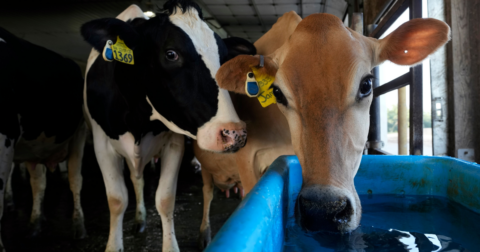
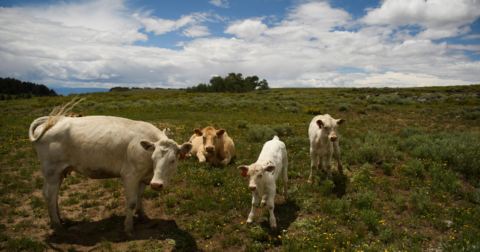
Climate change may cut the amount of land suitable for grazing livestock by one-third to one-half by the year 2100, a new modeling study suggests.
The impacts will be most strongly felt in sub-Saharan Africa, the study’s authors predict, where many pastoralists depend on livestock — that is, cattle, goats or sheep — for sustenance. Experts worry that the predicted change could reduce food access enough to endanger some low-income people’s health, based on the areas that would be hardest-hit.
There’s a big difference in how this would be felt in relatively wealthy areas of the globe compared to relatively poor ones, says environmental economist Andrew Hultgren from the University of Illinois Urbana-Champaign, who was not involved in the research. Globally, “there are a lot of people who literally on any given day cannot get enough calories to meet basic nutritional needs. So if you’re that person, and the price of your food becomes higher or your access to that food becomes more limited, that can pose actually just dramatic health concerns,” Hultgren says.
Meat consumption is vastly different in sub-Saharan Africa compared with wealthy nations like the United States, where Americans have been estimated to eat three times more meat per capita than the global average. Food production globally is responsible for about a third of all greenhouse gas emissions, with most of that third driven by meat and other forms of livestock production.
Livestock farming is extremely land-hungry, and land is not an infinite resource. Globally, 80% of agricultural land is used for grazing land or growing crops to feed livestock. Add in a growing world population and you have what researchers at the World Resources Institute describe as the “global land squeeze”: increasing pressure to use more land for energy, food and housing.
The study’s authors were inspired by similar research showing that humans can only survive in a certain range of climate conditions. They realized that no one had done similar work looking at the requirements of livestock, even though millions or even hundreds of millions of people’s livelihoods rely on animal agriculture, sustainability scientist Prajal Pradhan from the University of Groningen, one of the study’s authors, tells Sentient.
To fill this gap, Pradhan and his co-authors first looked at the range of climate conditions under which livestock have grazed in the past, including temperature, yearly precipitation, relative humidity and wind speeds. Then they predicted where these conditions will be felt under two different climate scenarios: one very optimistic scenario in which carbon dioxide emissions reach zero by 2100 and one worst-case scenario in which carbon dioxide emissions continue to rise throughout this century.
The outcome varied by climate scenario and also by geographic region. North America, for example, may actually gain a bit more grazing land than it loses under either scenario. In Asia, losses and gains could be about equal. In Europe and Africa, on the other hand, losses will be steep no matter how much societies curb carbon emissions. Globally, between one third and half of all grazing land will be lost, the researchers predict.
Pradhan wasn’t surprised to find that climate change would have a negative impact on grazing land, but “the surprise is the extent of the impact and its distribution,” he says. In particular, he was struck by the deep impacts the analysis suggested for sub-Saharan Africa, where many people depend on the livestock they raise for their survival. Reducing grazing opportunities will cut into the nutrients available to them as well as their opportunities to earn a living, he says.
In high-income countries, on the other hand, a decrease in available grazing land might cause meat prices to go up in a way that mimics inflation, Hultgren says. Most residents of high-income countries have the option of shifting their diets toward more plant-based products, and their health would largely benefit from the change. So the impacts of reduced grazing land are likely to be less severe.
Hultgren is glad to see research on the impacts climate change will have on livestock, because the topic is understudied. But he doesn’t think the authors’ conclusions are a sure thing. The analysis depends on the assumption that livestock need to graze under the conditions they’ve used in the past, but instead farmers might switch to raising animals that can tolerate harsher conditions, or animal breeding might make livestock more climate-resilient.
Lucas Phipps, a rangeland ecologist from the University of Nevada, Reno, agrees with Hultgren. “People are adaptable,” he tells Sentient. He’s seen it in his own work, where U.S. farmers find a way to raise livestock on sub-optimal vegetation. It’s probable that climate change will alter the ways farmers use landscapes, he adds, but he’s not convinced it will stop many landscapes from being usable at all.
Phipps works with livestock producers and public land management agencies in the Southwest U.S. to figure out how farmers can best cope with change. He doesn’t see the new study changing his approach because there are a lot of local nuances that the study doesn’t capture. For example, whether precipitation falls as rain or snow matters a lot in his region: water from melting snow penetrates the soil more deeply than rain, which favors deeper-rooted plant species that livestock are less likely to eat. In this respect, rain is better for grazing animals than snow. Because the study doesn’t get to that level of local detail, “I’m not totally sure what the action item is,” he says.
As usual, more research is needed. “The authors here identified a really important question,” says Hultgren, “that merits much further study.”
Saima May Sidik is a freelance science journalist based in Somerville, Massachusetts.
News
Climate•4 min read

Solutions
A new report from the World Resources Institute on its Coolfood pledge initiative observes progress and challenges in curbing cafeteria emissions.
Climate•6 min read
Explainer
It all comes down to burps and land.
Climate•5 min read