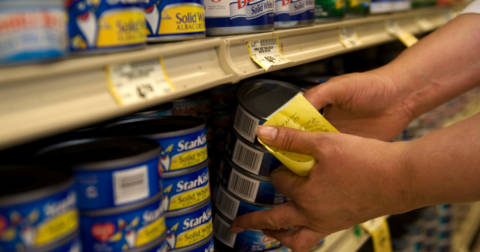
News
Sustainable Seafood Labels Aren’t Always What They Seem
Food•6 min read
Feature
Your ‘seacuterie’ board may not be as sustainable as you think.

Words by Jessica Scott-Reid
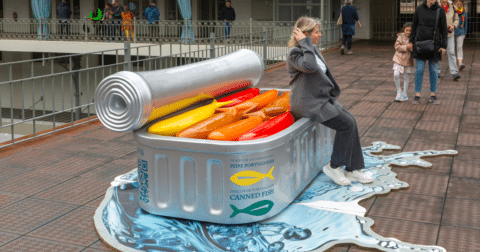
The “sardine girl summer” trend is still going strong, accompanied by fish-print pants, Instagram-ready tins and carefully curated “seacuterie” boards. According to industry reporting, the canned sardine market is “experiencing steady expansion due to rising global demand for shelf-stable, nutrient-rich seafood.” Sardines ostensibly offer an affordable and low-emissions protein option, but what does this cutesy fish trend overlook?
Researchers warn that growing demand for small forage fish, including sardines, mackerel and anchovies, could place added pressure on marine ecosystems already depleted by climate change, aquaculture and industrial fishing.
There is another impact to consider too. While humans may not think of these tiny creatures as sentient and capable of experiencing pain, “scientific evidence currently supports a realistic possibility of sentience in fishes, including sardines,” director of the Center for Environmental and Animal Protection at New York University, Jeff Sebo, tells Sentient in an email. “That means sardines might be capable of having their own feelings and emotions, including pleasure, pain, comfort, and distress.”
Just over a quarter of all captured forage fish is processed for human consumption.
In the U.S., Pacific sardine fishing off the West Coast (California, Oregon and Washington) largely closed in 2015 due to populations dropping below federal conservation thresholds, mainly as a result of climate-related changes in ocean conditions, as well as fishing pressure. Commercial fishing of Atlantic herring is permitted, but there is a quota in place.
Today, Europe is a leading producer and consumer of canned sardines, “accounting for over 35% of global demand, particularly in countries like Portugal, Spain, and Italy,” according to market data.
But most — about three quarters of all forage fish — are used for fish meal and oil. According to the National Oceanic and Atmospheric Administration, about 70% of that fishmeal and oil is used in aquaculture, primarily to feed farmed salmon, shrimp and other species.
Much of the remaining fishmeal and oil is fed to livestock on factory farms, providing protein and other nutrients. Fishmeal and oil have been major ingredients in swine and poultry feeds for many decades, and are increasingly fed to cattle and other ruminants.
As some consumers shifted to eating fish for health or climate concerns, sardines and other forage fish met their moment. In 2022, Abby Jackson, writing for The Cool Down, described these fish as “a great low-carbon alternative to beef, pork, and chicken,” for example.
According to the World Resources Institute’s protein scorecard, fish — including sardines and forage fish — are lower in emissions than pork, poultry and beef (there are differences based on production methods, as farmed fish come in higher). Sardines are relatively low in emissions because they grow faster and typically require fewer resources than larger farmed fish like tuna and salmon.
But tools for measuring food-related emissions may not fully capture the environmental impact of fishing these creatures. Sardines, anchovies and other forage fish are critical food sources for animals including whales, seabirds and larger fish. Emerging research suggests that when fish and other marine animals consume prey and produce fast-sinking particles such as fecal pellets, that process helps move carbon to the ocean floor, where it can be sequestered and kept out of the atmosphere.
Changes in marine food webs then, including taking food away from these larger fish and animals, may reduce how much carbon is exported to deeper waters, which weakens the positive climate effect.
Monterey Bay Aquarium Seafood Watch recommends consumers “avoid sardines caught in the Mediterranean region because overfishing is likely occurring in most areas, bycatch impacts, and ineffective management.” The organization also notes to avoid sardines caught in Brazil, citing ineffective oversight as the region lacks “policies protecting their role in the ecosystem.”
The Marine Stewardship Council, or MSC, states the popular tinned fish company FishWife has met its “standard for sustainable supply chain sourcing” and, more broadly, MSC promotes certified sardines as a sustainable option when sourced from “well-managed fisheries.”
However, this certifying body has come under scrutiny in recent years for potential greenwashing (also known as blue-washing when applied to the seafood sector). Some environmental and labor groups argue the certification can give consumers an overly simplified or inaccurate impression of sustainability. For example, a 2020 analysis found that while around half of MSC’s promotional materials depicted small-scale vessels, small-scale fisheries only accounted for 7% of MSC-certified catch. And a 2026 study identified “80 cases of labor abuses onboard 72 vessels harvesting MSC-certified seafood products.”
For all of the twee fish packaging and sustainability claims associated with the tinned fish trend, fish welfare has remained largely absent.
Wild-caught fish receive few legal welfare protections in most regulatory systems, and sustainable certification programs generally do not include welfare considerations. For example, in Seafood Watch’s guide to buying sardines, fish welfare metrics are not included. And in 2024, senior communications and public relations manager for MSC, Jackie Marks, wrote to Sentient in an email that “humane harvest and animal sentience sit outside the MSC’s remit.”
But fish sentience should be part of the conversation, argues Sebo. Though evidence about sardine sentience “remains limited,” he writes, “this is not a justification for neglecting them. When there is a realistic possibility of sentience in an animal, we have a responsibility to consider welfare risks for them while we seek to better understand them.” Research has found that fish possess pain-detecting nerve cells and neural pathways that are similar in many ways to those found in mammals, for example.
Sardines are typically caught by what are called purse seine nets, which work by surrounding entire schools of fish in midwater. The method is generally considered less damaging to the seafloor than bottom trawling, however it can still result in bycatch — which refers to the capture of non-target animals.
Advocates warn that animals caught in these nets can suffer. “These methods can involve crowding, crushing, asphyxiation, and death,” writes Sebo. “If sardines are in fact sentient, then these methods can be expected to cause them pain and distress.”
Because sardines are especially small fish, “more of them have to die to produce the same amount of food,” he adds. “It can be easy to dismiss welfare risks for smaller animals, but killing a larger number of smaller animals can produce as much or more suffering overall than killing a smaller number of larger ones.”
Ultimately, the sardine trend has capitalized on interest in affordable, low-emissions and healthy sources of protein. But critics argue that the trend risks overlooking both the ecological importance of forage fish and welfare concerns surrounding their capture — complexities that sit in juxtaposition to the cutesy, curated aesthetic of “sardine girl summer.”
Jessica Scott-Reid is Sentient's Disinformation Correspondent covering disinformation, misinformation and the impact of both on culture. A freelance journalist based in Canada, Jessica has covered animals, the environment and food systems for major media in Canada and beyond, for the last decade. Jessica has been a contributor to Sentient since 2019, and her work also appears regularly in The Globe and Mail, Toronto Star, Winnipeg Free Press and Corporate Knights Magazine.
News
Farms•7 min read
Investigation
A chemical additive helped stop fishmeal from catching fire on ships, but it carried a downstream carcinogenic risk to modern food systems.
Food•6 min read
Explainer
Three of the largest dairy co-ops market the vast majority of milk sales; some have expanded into milk processing and other parts of the dairy industry.Farmers say these organizations —…
Food•1 min read