Explainer
A Handful of Cooperatives Control the U.S. Milk Market
Food•1 min read
Investigation
Egg companies that received hundreds of millions of dollars in bird flu payments are ordered to settle for a fraction of the price.

Words by John McCracken
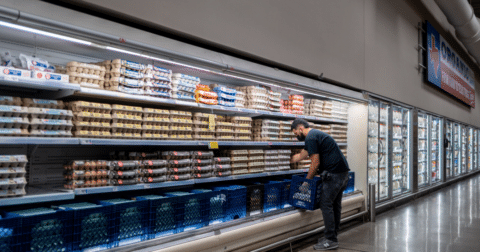
Three of the nation’s largest egg producers will pay $3.3 million to settle price-fixing allegations following a federal investigation.
The anti-trust case alleges that the companies coordinated to artificially inflate the price of eggs on grocery shelves and in restaurants across the country. Amid a raging bird flu epidemic, the federal government had promised to help consumers with skyrocketing egg prices.
“The Antitrust Division is steadfast in our work to protect our nation’s citizens from illegal conduct that makes daily life less affordable,” said Deputy Assistant Attorney General Nicole Sarrine of the Justice Department’s Antitrust Division in a statement.
Egg companies Cal-Maine Foods Inc., Versova and Hickman’s Egg Ranch Inc. were fined $3.3 million in total and ordered to donate 53 million eggs to food banks or non-profits on June 30, following a probe from the Department of Justice.
This is a drop in the bucket compared to the payments egg companies received in the midst of a devastating bird flu epidemic in which operators are reimbursed for sick flocks and commodity prices have skyrocketed. Cal-Maine, Hickman’s and Versova have received a total of $193 million in reimbursements for sick flocks from the USDA since 2020. That’s nearly 60 times as much as last week’s settlement.
Cal-Maine Foods, the Mississippi-headquartered, publicly-traded egg company, will pay $1.5 million while Hickman’s Egg Ranch, headquartered in Arizona, agreed to pay $1 million as a part of the settlement. Versova Holdings was ordered to pay $800,000.
All three companies denied any wrongdoing and have not been charged by the Justice Department as a part of the settlement.
“We are pleased that this agreement enables us to move forward so we can devote our full attention to what matters most: delivering affordable, high-quality eggs and egg-based prepared foods to consumers nationwide,” Sherman Miller, president and CEO of Cal-Maine Foods, said in a statement released alongside the department’s settlement.
Hickman’s Egg Ranch is owned by Mantiqueira USA, a Brazil-based egg supplier, which is co-owned by the global meat giant JBS. Hickman’s was purchased by the Brazilian giant in 2025 after the company lost nearly all of its flocks to bird flu. Hickman’s did not respond to a request for comment. Versova Holdings is a roughly $1 billion company that owns roughly 20 million laying hens across its industrial egg farms in Iowa, Ohio, Washington and Oregon.
“Our decision to accept this settlement simply reflects our firm intention to put this matter behind us and focus on our business,” a Versova spokesperson tells Sentient in a statement.
When President Donald Trump campaigned for office, he promised to lower grocery and egg prices. But once in power, his administration backtracked on its pledge to control egg prices. President Trump called for antitrust action in the nation’s food industry, but gutted the offices and budgets responsible for taking action on antitrust enforcement.
Reid Phifer, a former North Carolina contract turkey and broiler farmer and longtime advocate for poultry farming reform, says the small monetary penalty is just “the cost of doing business” to the top egg producers in corporate agriculture.
“They know they’ll probably get caught eventually, all of them know that,” Phifer says. “If I’ve made a billion dollars off of you, do you think I’m gonna mind giving you $100 million?”
Austin Frerick, antitrust expert and author of Barons: Money, Power, and the Corruption of America’s Food Industry, agrees with Phifer, telling Sentient in an email that he expects price-fixing behavior to occur again from the nation’s “egg mafia.”
“This settlement might actually encourage more criminal activity,” argues Frerick. “Importantly, these companies did not admit any wrongdoing, so victims cannot pursue further civil lawsuits based on these admissions. That means folks who overpaid for eggs are left without recourse.”
In recent years, bird flu has ravaged commercial egg farms across the country. Since 2022, over 200 million commercially-raised birds have been killed to prevent the spread of the disease, a practice known as depopulation. Cases of underage workers killing flocks and birds depopulated using controversial methods have been documented across the country.
When poultry is depopulated to prevent the spread of bird flu, companies receive reimbursements from the federal government in the form of indemnity payments. The USDA has awarded $1.5 billion in indemnity payments related to bird flu since 2020.
Cal-Maine, Hickman’s and Versova received a total of $193 million, or roughly 13%, of the industry’s bailout.
Last year, egg prices skyrocketed to over $6 a dozen as flocks across the country were killed. Egg companies stated at the time that bird flu was the main cause of the price disruptions.
“Results also reflect higher market prices, which have continued to rise this fiscal year as supply levels of shell eggs have been restricted due to recent outbreaks of highly pathogenic avian influenza,” Miller said in a Jan. 7, 2025 statement.
But the case from the Antitrust Division alleges that these three major egg companies manipulated the market to inflate prices and contracts for eggs across the country.
Cal-Maine boasted over a billion dollars in profit during 2025, while its market value surged and its stock became one of the top performers.
Delcianna Winders, director of the Animal Law and Policy Institute at Vermont Law and Graduate School, tells Sentient in an email that egg corporations created the conditions necessary for the disease to spread while also being reimbursed by taxpayers for killing unimaginable numbers of animals to stop the disease. She writes that this dynamic illustrates the massive imbalance of power between American consumers and the mega-corporations in control of our food.
“The difference between these handouts and the proposed settlement amounts — to say nothing of the profits these companies raked in while allegedly price fixing — shows what a mockery of justice this is,” Winders writes.
Correction: An earlier version of this story stated that Reid Phifer is a former contract turkey farmer; he was also a contract farmer of broilers.
John McCracken is an investigative reporter whose work examining the nation's consolidated meat industry, industrial agriculture and climate change has received awards and recognition from the Chicago Book Club, North American Agricultural Journalists, Wisconsin Newspaper Association, Iowa Newspaper Association and more. He has been invited to speak about his reporting at the Society for Environmental Journalists, NICAR and more.
Feature
Fisheries & Aquaculture•4 min read

Solutions
While the country’s farms tend to have high animal welfare standards, Bhutan also imports most of its meat.
Farms•7 min read
Feature
Fewer than 15% of veterinary school graduates are opting to care for farm animals.
Food•6 min read