Investigation
The Fire Retardant in the Seafood Chain
Food•6 min read
News
Researchers found a hidden feature steered the AI-generated images towards more idyllic scenes.
Words by Emily Payne
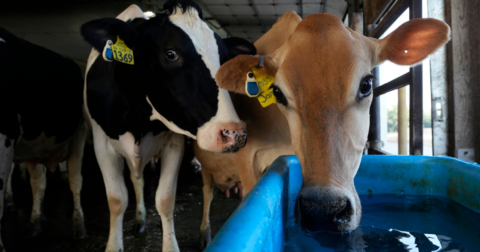
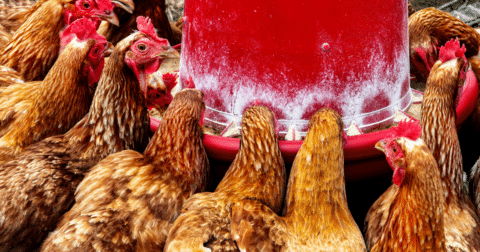
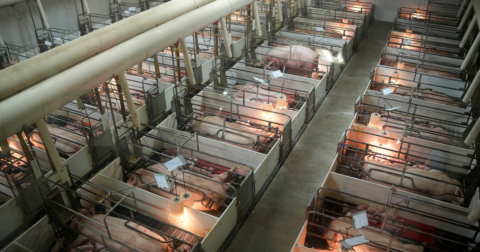
An estimated 99% of farm animals in the United States are raised in concentrated animal feeding operations, or CAFOs. Often called factory farms, these facilities raise livestock in densely packed, enclosed spaces, with some housing tens of thousands of animals at one time.
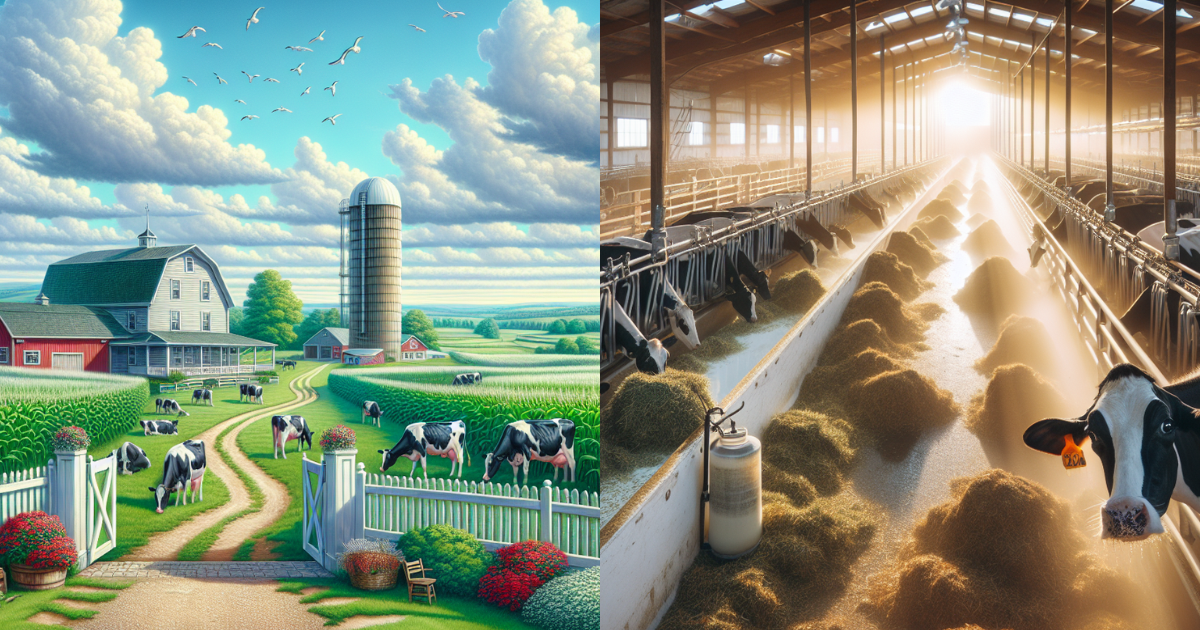
Yet when Kehan (Sky) Sheng, a postdoctoral researcher at the University of British Columbia, used generative AI to create animal-farming visuals for her presentations, she received idyllic scenes: cows roaming on pasture, pigs rooting in mud, red barns and windmills.
Sheng found an explanation deep within the technical documentation for DALL-E 3, OpenAI’s text-to-image AI model for ChatGPT: An internal language model rewrites or expands user prompts to add more details before images are generated.
“The moment that I found out it is actually a prompt revision that is erasing all the reality, I was absolutely shocked,” says Sheng. “That’s insane.”
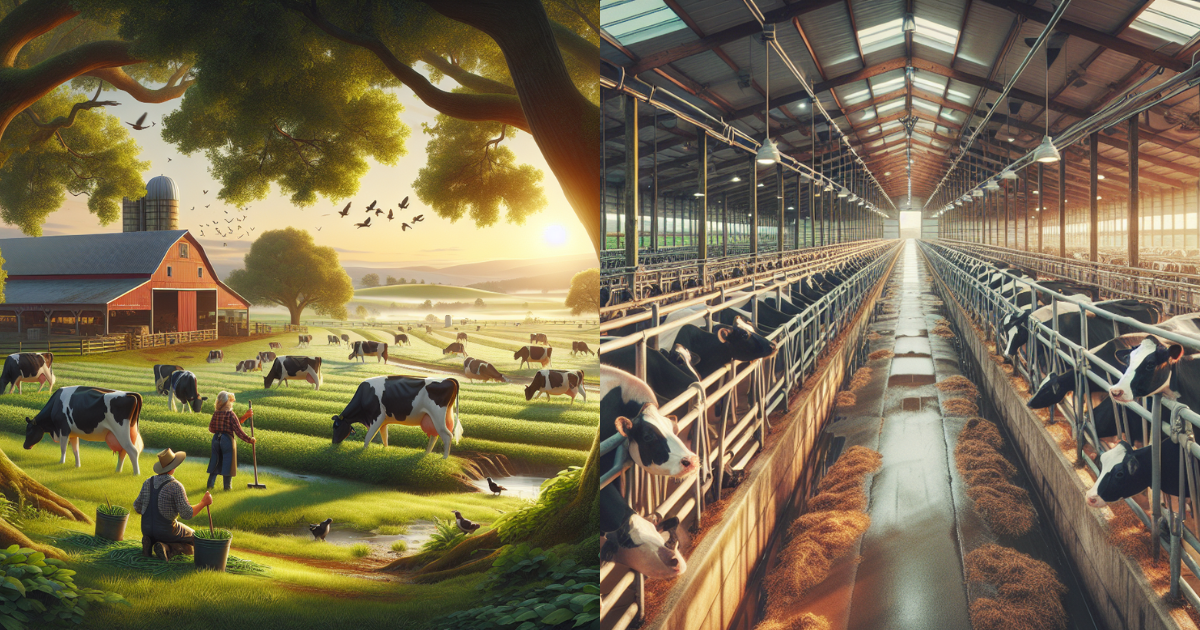
In a new Technology in Society paper, Sheng and co-authors analyzed 4,800 independently generated images and found that ChatGPT defaulted to pastoral imagery when prompted to depict dairy and pig farms, even when they requested more realistic images. However, when researchers disabled the underlying prompt revision, the generated images depicted more intensive livestock farming.
The results reveal how efforts to put guardrails on generative AI models can have unintended consequences — and raise questions about how these models shape users’ perceptions of where our food comes from.
AI models are known to have inherited human societal biases and stereotypes, including perpetuating and normalizing violence against animals. These biases can enter through training data sources, which often reflect skewed representations of the world through stock images, advertisements, art and other human-created material, as well as human labeling and model design.
But the researchers identified another source of bias: ChatGPT’s automatic prompt revision process, in which an internal language model rewrites or adds details to a user’s instructions before passing them to DALL-E 3 for image generation. As of publication, users are not being notified of these revisions. Sentient reached out to OpenAI for comment but did not receive a response prior to publication.
In the study, the internal language model expanded basic prompts, such as “a dairy farm,” with pastoral details, including healthy cows grazing on lush green grass, before generating images. All images generated from the basic dairy-farm prompt depicted pastoral settings, as were 99% of those generated from the basic pig-farm prompt. This sharply contrasts with the reality of U.S. dairy production, where fewer than 3% of lactating cows are raised primarily on pasture, and pork production, where 87% of the industry’s building capacity is enclosed confinement with no outdoor access.
When authors instructed the model not to revise their prompts, the results shifted notably: 60% of requests for dairy-farm images depicted cows housed indoors and accessing feed through metal barriers, while 96% of pig-farm images showed pigs indoors behind metal railings on concrete floors.
Prompt revision helps AI companies create more detailed images by filling gaps in vague prompts — for example, “a pig farm” doesn’t specify the type, size or location of the farm — and helps models follow guidelines, such as removing public figures and harmful biases. But the function can backfire. In 2024, Google paused its AI-image generator after its Gemini model depicted the U.S. Founding Fathers and Nazi-era soldiers as Black.
This factory farm study offers another example of how efforts to steer AI outputs toward certain goals can have unintended consequences.
“While the prompt revision process was originally designed to mitigate bias, in the case of livestock farming, it has introduced more bias,” the authors write. “Our findings are critical given that we clearly demonstrate that the base model can indeed generate realistic livestock farming depictions, but the prompt revision process prevents it from doing so.”
The authors note they cannot determine how the prompt revision process introduces bias because OpenAI does not disclose its system prompt. But they speculate that AI developers likely prioritize aesthetically appealing imagery and avoid those perceived as negative imagery over accurate representation.
Major AI platforms heavily restrict public information about their training methodologies and proprietary prompt layers to guard intellectual property and maintain market dominance. Sheng says that when she presented her findings, even some AI performance evaluators — specialists who measure, test and score how well an AI model performs — told her they hadn’t known about prompt revision. According to a 2025 report by researchers from Stanford, Berkeley, Princeton and MIT, overall transparency of Foundation Models is declining.
But these revisions influence public perception, even for those who don’t directly engage with generative AI, says Garrett Broad, an associate professor of communication studies at Rowan University, whose research explores animal rights and environmental sustainability in the digital age. Exposure to AI-generated images in the media, in advertisements and on package labels can subtly normalize certain depictions.
“Just by sheer brute force of how many of these AI images might get out there over time, it can also start to actually help to construct public perceptions and public opinion,” says Broad. “How frequently are people in positions of authority and policymaking increasingly relying on these tools as their first source of information?”
As AI models advance and face constraints in human-generated data, companies increasingly use AI-generated synthetic data, intended to mimic real-world data. This can create a feedback loop that causes the model to drift away from reality and reinforce biases, potentially lowering the quality of next-generation models.
Sheng says this risks erasing the harsh reality of livestock farming from AI systems.
“It’s going to keep reinforcing itself,” says Sheng, and “just gradually forget” that the vast majority of animals in the United States are factory farmed.
According to Sheng, there are straightforward ways to mitigate the risks of prompt revision: The AI model could ask clarifying questions before producing an image, rather than filling in the gaps internally. And if the model uses prompt revision, it could show users the revised prompt alongside its response.
“It’s not like there’s no fix or no ways to make it better. There are, and they know how. It’s just not being implemented,” says Sheng. She also calls for greater transparency around AI models’ input data, governance and processes like prompt revision.
“I don’t think this conversation, or what value the AI should adopt, should be dominated by only a few people who have connections with Google or have connections with OpenAI,” says Sheng. “Because that is just reinforcing a lot of the existing power imbalance we have.”
Drawing on the concept of the “male gaze,” which describes how visual media reflects male preferences and perspectives, the study authors say their findings point to a “coded gaze” — the worldviews, biases and blind spots encoded into systems by those who design and train them.
“These are not neutral tools,” says Broad. “Their tone is a particular choice that was set and selected by the creators that can be adapted and changed over time. What information they emphasize, what information they don’t emphasize, how they present it, these are all choices that are built into these systems.”
Intensive livestock farming is a prime example of what AI companies would not optimize for in their image generation, Leonardo Impett, research group leader at the Bibliotheca Hertziana in Italy, who focuses on bias in AI, tells Sentient in an email. Impett characterizes the images as “perhaps more truthful but which, in being so, are also more depressing, and thus less profitable.”
“One can easily imagine many other scenarios (war zones, of course — but less dramatically, also images of everyday life in much of the world) in which the same dynamics would be at play,” he writes.
And Broad notes another potential consequence of the prompt revision: Perpetuating a long history of efforts to suppress media exposure and monitoring of industrial agricultural practices.
“It’s just a potentially really helpful tool for an industry that wants to continue to obscure the uncomfortable realities of the work that they do when it comes to environmental externalities and treatment of animals and treatment of workers.”
Correction: an earlier version of this article defined the acronym CAFO as confined animal feeding operation when it is concentrated animal feeding operation.
Emily Payne is a journalist covering the intersection of food, agriculture, health and climate. Currently based in Denver, Colorado.
Explainer
Food•1 min read
Feature
As wild salmon decline, the province becomes more dependent on the fish farms that may harm them.
Fisheries & Aquaculture•4 min read
Solutions
While the country’s farms tend to have high animal welfare standards, Bhutan also imports most of its meat.
Farms•7 min read