News
Sustainable Seafood Labels Aren’t Always What They Seem
Food•6 min read
Solutions
Most farmed seafood comes from fin fish, but a new study urges shifting production toward bivalves and seaweed.

Words by Gaea Cabico
Aquaculture is often framed as a vital solution to food security by expanding the supply of seafood for a growing population. But new research from the University of British Columbia suggests the industry may be heading in the wrong direction.
Today, most farmed seafood comes from fin fish — like salmon, trout and tilapia — as well as shrimp. However, farming these species delivers limited benefits for food security, climate mitigation and biodiversity, according to the paper published in the journal Fish and Fisheries. Aquaculture is linked to water pollution, disease outbreaks and farmed fish escaping and mixing with wild populations. It also depends on fishmeal and fish oil, the production of which requires fossil fuels and depletes small fish that other marine species rely on.
“While aquaculture used to focus mostly on nutritious species low on the food chain (like carps, mussels and seaweeds), we now farm lots of resource-intensive fish species that are tough on the environment,” Aleah Wong, a PhD candidate at University of British Columbia and the lead author of the study, tells Sentient in an email.
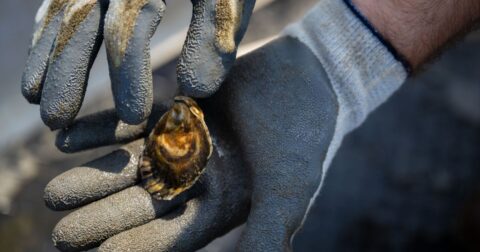
One way forward, the study suggests, is expanding the production of bivalve species — like mussels and oysters — and seaweed. These species don’t require fish-based feed and can provide a range of environmental benefits, Wong writes.
However, bivalves and seaweed remain underproduced globally and scaling them up is “very tricky and requires policy, market and cultural shifts,” Wong writes.
In 2022, aquaculture production surpassed capture fisheries for the first time, reaching 131 million metric tons, according to the Food and Agriculture Organization of the United Nations. Fin fish made up about half of this, with around 62 million metric tons produced. That’s far more than the 37 million metric tons of seaweed and 19 million metric tons of molluscs such as oysters, clams, mussels and scallops. That might sound like a surprisingly large amount of seaweed, but that category includes spirulina, used as a dietary supplement, and carrageenan, used as a gelling agent in products ranging from toothpaste to ice cream to processed meat.
The new study combined biological and ecological data on farmed species with global production data to see how aquaculture’s overall sustainability profile has changed from 1950 to 2023.
“Over time, we have shifted towards farming aquatic species with traits that are worse for food security, climate change and biodiversity,” Wong writes.
The global aquaculture industry is concentrated in a small number of countries. The top ten nations, which include China, Indonesia and India, account for 90% of total production. Scaling up shellfish farming in Europe, Africa and Asia could boost food security, the study suggests. Bivalves and seaweed are nutrient-rich: high in iron, zinc and healthy fats. Meanwhile, expanding seaweed production in the Americas, Africa and Asia would deliver greater climate benefits. Overall, increasing bivalve or seaweed production across most regions could support biodiversity in several ways, the authors write.
For one, bivalves and seaweed can improve water quality. Seaweed absorbs excess nutrients like nitrogen and phosphorus, while oysters and mussels filter the water as they feed. A study by environmental nonprofit the Nature Conservancy and the National Oceanic and Atmospheric Administration estimates that this ecosystem service is worth $1,320 to $7,740 per acre each year for shellfish, and $750 to $10,110 for seaweed.
Seaweed can also help capture and store carbon, while both types of farms can reduce wave energy and stabilize sediments, offering protection for coastal communities.
Just as important, shellfish and seaweed farms create habitat. Fish are about 1.6 times more abundant around these farms than in nearby natural areas, according to the Nature Conservancy and the National Oceanic and Atmospheric Administration study.
Aquaculture in some places, such as Egypt, India and Norway, currently relies on resource-intensive species. In these cases, diversifying species by adding more efficient species like bivalves and seaweed could further improve food security, climate and biodiversity outcomes, the University of British Columbia researchers say.
The University of British Columbia research used biological and ecological traits — such as growth rate, body size, nutrient density, thermal tolerance and carbon sequestration potential — of different farmed species to estimate how they affect food, climate and biodiversity outcomes. It then combined those species scores with global production data.
Wong explains that this simplification is a limitation of the study’s approach, which captures ecological impacts but does not reflect the full complexity of food equity, regulation and other global food security nuances.
Expanding bivalve and seaweed farming remains challenging, mainly because demand is still low. In contrast, farmed Atlantic salmon and whiteleg shrimp are highly profitable. Rising incomes have shifted consumer demand toward these higher-value but less sustainable species, Wong notes.
Intensification in aquaculture is shaped not only by species choice but also by limited coastal space, notes Luke Barrett, a research fellow in aquaculture at Deakin University in Australia. “If you’re a farmer and you have access to a relatively small lease area, there is a strong financial incentive to intensify your farming to get the best possible yield from that lease. Essentially, more intensive farming is more profitable,” he tells Sentient.
Barrett’s research suggests that the ecosystem benefits of bivalve and seaweed aquaculture depend heavily on where and how farms are placed. He says farms should not be placed “on top of a healthy, functioning ecosystem” but instead in already degraded areas where habitats like reefs or seagrass beds have been lost or are unlikely to recover. He adds that areas with excess nutrients or sediment from runoff are better suited, because farmed bivalve and seaweed species can help improve water quality.
Shifting production and consumption toward more sustainable species will require government subsidies and support for small-scale, climate-resilient aquaculture, Wong and Barrett say.
If aquaculture can successfully scale up bivalve and seaweed production, the study’s findings suggest, it could deliver improved nutrition, lower emissions and healthier ecosystems — but only if managed sustainably, Wong emphasizes. She cautions that “intensive farming of any species can lead to environmental impacts, resource conflicts and equity issues.”
Gaea Cabico is Sentient's editorial fellow, and an award-winning journalist from the Philippines who reports on climate change, environmental issues and energy through a social justice lens. She holds a master's degree in science journalism from New York University.
News
Farms•7 min read

Investigation
A chemical additive helped stop fishmeal from catching fire on ships, but it carried a downstream carcinogenic risk to modern food systems.
Food•6 min read
Explainer
Three of the largest dairy co-ops market the vast majority of milk sales; some have expanded into milk processing and other parts of the dairy industry.Farmers say these organizations —…
Food•1 min read