News
Farmed Salmon May Not Be as Nutritious as It Once Was, New Research Suggests
Health•5 min read
Solutions
A new study finds that adding animal images to menus increases the odds of choosing the vegetarian dish by 22%.

Words by Seth Millstein
If you want people to eat less pork, show them a picture of a pig. That’s what a new study conducted in the U.K. suggests. The odds of university students, staff and visitors choosing vegetarian dishes at the cafeteria were 22% higher when the menu listed a meat dish alongside a picture of the animal associated with it, the study finds. It’s an example of how a barely-perceptible intervention, or a “nudge,” can be used to encourage a choice — and in this case, promote dietary change.
Global meat consumption has doubled over the last 60 years despite the global call to eat less meat to mitigate the environmental harm caused by the meat industry. Animal agriculture is the biggest driver of deforestation and contributes up to 20% of all greenhouse gas emissions. But inspiring omnivores to cut down on meat has been an ongoing challenge.
Scientists have coined the phrase “the meat paradox” to describe this issue. Many people will say they care about the well-being of animals, but then turn around and eat meat, supporting an industry known for its inhumane treatment of animals. And they will often point to cultural values to justify their diet.
One way to redirect a person’s thinking back to their empathy is to use what’s called a “nudge” — a subtle change in design or presentation that may alter people’s decisions without affecting their freedom to choose. In the 2008 book of the same name, authors Richard Thaler and Cass Sunstein defined a nudge as “any aspect of the choice architecture that alters people’s behavior in a predictable way without forbidding any options or significantly changing their economic incentives.”
“To count as a mere nudge, the intervention must be easy and cheap to avoid,” the authors wrote. “Nudges are not mandates. Putting fruit at eye level counts as a nudge. Banning junk food does not.”
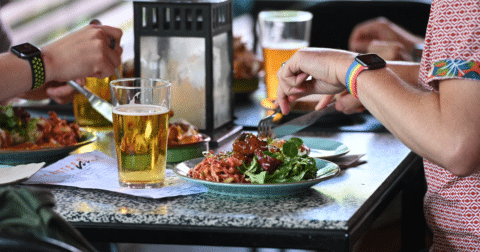
A nudge was the tool used in the UK study. Students, staff and visitors in a university cafeteria were given one of two menus: one that was text only or one that displayed images of living animals next to their corresponding meat dishes.
The researchers observed dining patterns over two six-day periods. They found that when people looked at menus with pictures of animals, their odds of ordering a vegetarian dish jumped by 22%. These findings were consistent across the various pork, beef, chicken and fish dishes included in the study, the researchers wrote.
The students still had complete freedom to choose their meals. There was no incentive to pick the vegetarian option. This “demonstrates that visual reminders of meat’s animal origins can influence actual food choices in a natural setting,” the researchers wrote.
It’s not the first study to support using nudges as a tool for encouraging eating more plant-based foods. A 2019 study found that when conference attendees were offered a meat buffet by default with the option of switching to a plant-based dish, 94% chose the meat meal — but when a plant-based buffet was offered as the default, only 13% chose a meat dish.
For years, organizations like Greener by Default and the Better Food Foundation have been helping places like hospitals and universities implement plant-based nudges at their cafeterias. This takes many forms, such as offering plant-based dishes by default, displaying them more prominently, and giving them more appetizing names.
New York City’s public hospitals deployed some of these policies, and after making subtle changes to how patients were offered food, the number of meat dishes served by the hospital fell by about 50%. The Better Food Foundation says that the various plant-based nudge initiatives it’s helped implement have collectively reduced carbon emissions by 7.9 million kilograms annually.
Many people are deeply attached to their food, and it’s not surprising that many don’t want to be told to eat less of something they love. This study adds to the growing body of evidence that nudges can be a powerful and effective way of encouraging people to choose to eat less meat.
Seth Millstein is a writer and musician living in the Bay Area. He has helped launch several early-stage journalism startups, including Bustle and Timeline, and his work has been published in Bustle, Huffington Post, The Daily Dot and elsewhere.
News
Health•5 min read

Monona County officials and residents fear a repeat of the communication gaps and loopholes that left them caught off guard by a plan to import treated slaughterhouse manure.
Health•9 min read
News
The rapid growth of chickens — now, 31 billion globally — has sped up pathogen evolution, boosting persistence, antibiotic resistance and spillover to humans.
Health•3 min read