Explainer
Why Beef Is Bad for Climate Change, Explained
Climate•5 min read
Explainer
The rights-of-nature movement aims to step in where environmental regulations fall short. But some critics are wary of the legal consequences.
Words by Seth Millstein
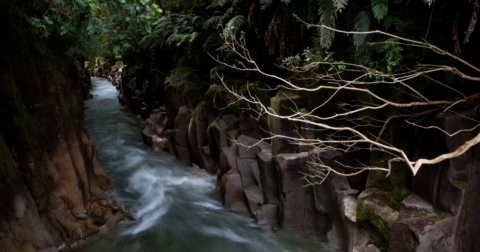
In 2021, the Magpie River in Québec became a person — not in the physical sense, but the legal one. Thanks to two parallel resolutions passed by local Indigenous and municipal leaders, the 120-mile river was given all of the rights and responsibilities of a living, breathing person. It wasn’t the first time a natural habitat had been granted what’s called environmental personhood, a legal tool that’s gaining traction to close the gaps left by traditional regulations.
Environmental personhood is part of a larger movement known as rights-of-nature. While traditional regulations treat the environment as a resource to be managed, the rights-of-nature movement holds that ecosystems and natural entities have inherent rights, such as the right to exist, thrive and evolve on their own terms.
“Rights-of-nature says the rights aren’t in the government to hand out to ecosystems,” Ben Price, education director at the Community Environmental Legal Defense Fund, tells Sentient. “The rights are inherent in the ecosystem.”
Granting personhood rights to ecosystems is one way to implement rights-of-nature and bolster legal protections for the natural world. But is it the best one?
Drawing heavily on Indigenous values around stewardship of and respect for the natural world, the rights-of-nature movement is largely a response to the failure of existing regulations to adequately protect the environment. Sometimes, this is because they’re poorly written or unenforced, but as Price points out, many environmental regulatory regimes have more fundamental flaws that go beyond their execution.
“Environmental regulation says, ‘we’re going to put a limit on how much harm can be done by any permit holder,’” Price says. “What we’re regulating is the rate of destruction of nature, how fast we’ll do it.”
Take water pollution. The EPA issues permits to facilities, such as factory farms, that set limits on how much waste they can legally release into public waters. While this may sound like a good thing, Price suggests that the agency is effectively giving these facilities a license to pollute, especially if violations aren’t enforced.
Under the regulation framework, the only time legal action can be taken to protect the environment is when a specific regulation is violated. By contrast, rights-of-nature laws offer a more open-ended and proactive set of tools.
One approach to support the rights of nature is to designate a natural entity as a legal person. Because people have fundamental legal rights that can’t be violated, classifying habitats this way grants them enforceable, inalienable rights that exist independent of any specific regulation.
The legal protection gained when a habitat is granted personhood makes it easier for courts and even citizens to seek remediation if that habitat is damaged, whether or not a specific regulation has been violated. It also allows for preemptive legal action to be taken to protect these habitats if they’re threatened by, say, a proposed development project.
For instance, a personhood law applied to a river might allow courts to issue preemptive injunctions against proposed development projects that could degrade the river, or allow individuals to sue on the river’s behalf if it’s damaged by pollution or industrial development. This can be especially helpful for people, life and ecosystems near factory farms that have been harmed by water contamination from improper manure storage and overfertilization.
If such a lawsuit against a farm or other facility were successful, that money could go into a fund that’s then used to restore the river’s natural properties as much as possible.
The Magpie River isn’t the only ecosystem currently enjoying personhood status. In New Zealand, the Te Urewera rainforest was granted legal personhood in 2014, as was the Whanganui River in 2017. The Mar Menor Lagoon in Spain is legally a person, as is the Klamath River in California. Price himself played a leading role in crafting a law that granted personhood to borough residents, ecosystems and natural communities in Tamaqua, Pennsylvania.
However, failed attempts to provide legal personhood to a number of rivers in India illustrate why some supporters of the rights-of-nature movement think the legal personhood approach is flawed.
From a legal standpoint, an entity that’s declared a person is given more than just rights. They are also given responsibilities and liabilities. A human being, for instance, has the right to live and move freely, but they also have an obligation not to harm other people or interfere with their rights.
Granting legal personhood has consequences, Price tells Sentient. “[In] simplest terms, it means that — like a corporation — it can be sued and can sue.”
Some environmentalists worry that designating ecosystems as legal persons could open the door to those ecosystems being sued or otherwise held liable for the damage or harm they cause.
In a 2021 interview, Mari Margil, executive director of the Center for Democracy and Environmental Rights, illustrated what this might look like. Margil brought up a hypothetical outcome of a river being granted personhood, flooding a community during a storm and subsequently getting charged with murder after a person drowns in the stormwater.
Some may think Margil’s scenario sounds preposterous, but this is precisely why, in 2017, the Supreme Court of India struck down an environmental personhood law that had been applied to portions of the Ganges and Yamuna rivers. It reasoned that it would open the door to the rivers being sued for murder and other unintended legal consequences.
Price sketches another hypothetical risk of using the environmental personhood approach. Suppose a coral reef with personhood is damaged by pollution from a factory farm. A court might order the farm to pay millions of dollars into a fund, which would be legally held by the reef itself and, in theory, would pay for its restoration.
So far, so good. But Price then adds, suppose that later in an unrelated incident, a storm blows a ship off course, and the bottom of the ship is destroyed by the reef. In theory, the company that owns the ship could then sue the coral reef itself. If the company won, the funds intended to restore the coral reef’s habitat could go to the ship’s owner.
“I know it’s all speculative, and you know, it’s a scenario that hasn’t happened,” Price says. “But it’s still very possible, and lawyers are very creative and looking for ways to get money.”
As an alternative, some advocates of the rights-of-nature movement have proposed that lawmakers and governments directly give rights to natural habitats rather than granting personhood. Protecting ecosystems in this way offers the same benefits as environmental personhood without the aforementioned risks. It’s also the approach favored by Price and Margil, the latter referring to it as “legal naturehood.”
Several jurisdictions have already recognized the rights-of-nature this way. In Ecuador, the rights-of-nature have been enshrined in the constitution since 2008. Bolivia’s Law of the Rights of Mother Earth grants “all systems of life and living beings” in the country several inalienable rights, such as the right to live free of pollution and the right to biodiversity. In Colombia, a high court ruled that the Atrato River has inherent rights under the country’s Constitution.
Natural habitats have historically been viewed as property to be claimed or owned, but the rights-of-nature movement flips this on its head, and posits that ecosystems — like humans — are fundamentally unownable.
Environmental personhood is one way of implementing this, but its potential downsides are worth dwelling on. As Margil points out, laws typically classify everything as either a person with rights and responsibilities or as property, which has neither. Natural ecosystems don’t quite fit into either category. The environmental naturehood approach is a potential remedy for this.
“It’s really about protecting the living system that sustains human life, and all other life,” Price says. “And to do that, we don’t say we’re going to grant it rights. We recognize that it already has rights.”
Seth Millstein is a writer and musician living in the Bay Area. He has helped launch several early-stage journalism startups, including Bustle and Timeline, and his work has been published in Bustle, Huffington Post, The Daily Dot and elsewhere.
Feature
Climate•4 min read
News
Warming waters alter where fish and shellfish live, push them beyond what they can tolerate and increase risk of disease.
Climate•6 min read
News
Planetary emissions are already in a dangerous phase, scientists warn.
Climate•4 min read